

Condemnation from Pakistan as India’s Modi leads consecration of Ram temple in Ayodhya

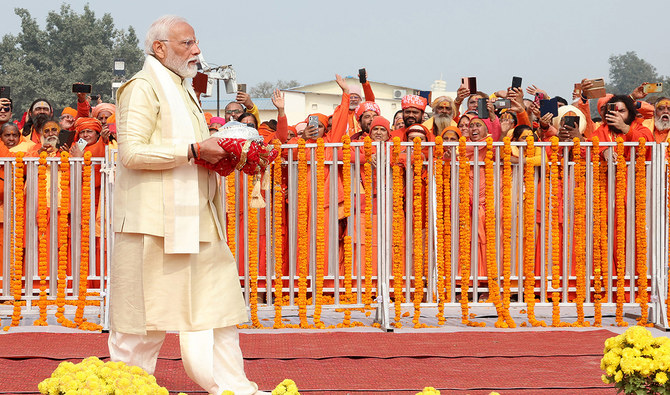
In this photograph taken on January 22, 2024 and released by Indian Press Information Bureau (PIB) India's Prime Minister Narendra Modi carries an offering as he walks towards the temple stairs to officially consecrate the Ram temple in Ayodhya in India's Uttar Pradesh state. (AFP)
Short Url
Updated 22 January 2024
Follow

Condemnation from Pakistan as India’s Modi leads consecration of Ram temple in Ayodhya

  • Pakistan says temple built on demolished mosque site to remain “blot on face of India’s democracy for times to come”
  • India’s Hindus say the site is birthplace of Lord Ram long before Muslim Mughals build the Babri Masjid in 1528

ISLAMABAD: Pakistan on Monday condemned the consecration of a grand temple to the Hindu god Lord Ram on a site believed to be his birthplace but where a 16th century mosque was demolished in 1992 in the Indian city of Ayodhya. 

The temple delivers on a key 35-year-old promise by Modi’s Hindu nationalist Bharatiya Janata Party (BJP), but it has been a contentious political issue that helped catapult the party to prominence and power.

For decades, the temple site was bitterly contested by Hindus and minority Muslims, leading to nationwide riots in 1992 that killed 2,000 people, mainly Muslims, after a Hindu mob destroyed a 16th-century mosque that had stood there.

India’s Hindus say the site is the birthplace of Lord Ram, and was holy to them long before Muslim Mughals razed a temple at the spot to build the Babri Masjid in 1528.

In 2019, the Supreme Court handed over the land to Hindus and ordered allotment of a separate plot to Muslims where construction of a new mosque is yet to begin.

“The developments of the last 31 years, leading to today’s consecration ceremony, are indicative of growing majoritarianism in India,” the Pakistani foreign office said, condemning Monday’s consecration. “These constitute an important facet of the ongoing efforts for social, economic and political marginalization of the Indian Muslims.”

A temple built on the site of a demolished mosque will remain “a blot on the face of India’s democracy for the times to come,” the statement added.

“Notably, there is a growing list of mosques, including the Gyanvapi Mosque in Varanasi and the Shahi Eidgah Mosque in Mathura, facing a similar threat of desecration and destruction,” the foreign office said. “The international community should take cognizance of the growing Islamophobia, hate speech and hate crimes in India.”

Nearly 8,000 people were invited to Monday’s ceremony, while more than 10,000 police personnel guarded the city of 3 million.

Security was also stepped up nationwide, especially in cities and towns that have suffered past Hindu-Muslim tension and strife.

The temple opens to the public on Tuesday and its management expects 100,000 visitors each day for the next few months.


Pakistan reports current account surplus in Jan. owing to improved trade, remittances

Updated 17 February 2026
Follow

Pakistan reports current account surplus in Jan. owing to improved trade, remittances

  • Pakistan’s exports crossed the $3 billion mark in Jan. as the country received $3.5 billion in remittances
  • Last month, IMF urged Pakistan to accelerate pace of structural reforms to strengthen economic growth

ISLAMABAD: Pakistan recorded a current account surplus of more than $120 million in January, the country’s finance adviser said on Tuesday, attributing it to improved trade balance and remittance inflows.

Pakistan’s exports rebounded in January 2026 after five months of weak performance, rising 3.73 percent year on year and surging 34.96 percent month on month, according to data released by the country’s statistics bureau.

Exports crossed the $3 billion mark for the first time in January to reach $3.061 billion, compared to $2.27 billion in Dec. 2025. The country received $3.5 billion in foreign remittances in Jan. 2026.

Khurram Schehzad, an adviser to the finance minister, said Pakistan reported a current account surplus of $121 million in Jan., compared to a current account deficit of $393 million in the same month last year.

“Improved trade balance in January 2026, strong remittance inflows, and sustained momentum in services exports (IT/Tech) continue to reinforce the country’s external account position,” he said on X.

Pakistan has undergone a difficult period of stabilization, marked by inflation, currency depreciation and financing gaps, and international rating agencies have acknowledged improvements after Islamabad began implementing reforms such as privatizing loss-making, state-owned enterprises (SOEs) and ending subsidies as part of a $7 billion International Monetary Fund (IMF) loan program.

Late last month, the IMF urged Pakistan to accelerate the pace of these structural reforms to strengthen economic growth.

Responding to questions from Arab News at a virtual media roundtable on emerging markets’ resilience, IMF’s director of the Middle East and Central Asia Jihad Azour said Islamabad’s implementation of the IMF requirements had been “strong” despite devastating floods that killed more than 1,000 people and devastated farmland, forcing the government to revise its 4.2 percent growth target to 3.9 percent.

“What is important going forward in order to strengthen growth and to maintain the level of macroeconomic stability is to accelerate the structural reforms,” he said at the meeting.

Azour underlined Pakistan’s plans to privatize some of the SOEs and improve financial management of important public entities, particularly power companies, as an important way for the country to boost its capacity to cater to the economy for additional exports.

“This comes in addition to the effort that the authorities have made in order to reform their tariffs, which will allow the private sector of Pakistan to become more competitive,” the IMF official said.