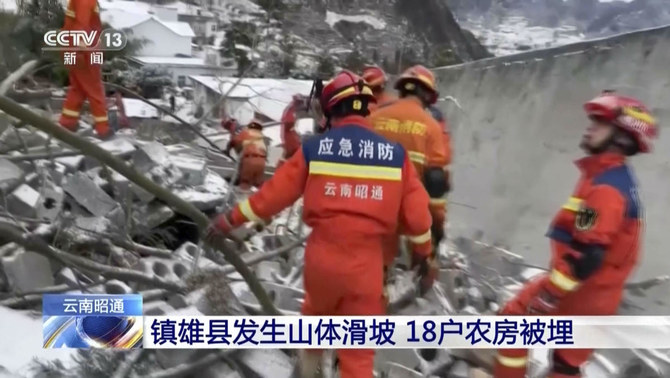
BEIJING: A landslide in southwestern China’s mountainous Yunnan province early on Monday buried 47 people, killing at least two, and forced the evacuation of 200 more amid freezing temperatures and falling snow.
The disaster struck just before 6 a.m. in the village of Liangshui in the northeastern part of Yunnan province. Rescue efforts were underway to find victims buried in 18 separate houses, the Zhenxiong county publicity department said.
Two bodies were pulled from the rubble, according to state broadcaster CCTV. The cause of the landslide wasn’t immediately known as survivors and rescuers struggled with snow and freezing temperatures that were forecast to persist for at least the next three days.
Luo Dongmei, 35, was sleeping when the landslide struck, but she survived and was relocated to a school building by local authorities.
“I was asleep, but my brother knocked on the door and woke me up. They said there was a landslide and the bed was shaking, so they rushed upstairs and woke us up,” Luo said.
Luo, her husband and their three children, along with many other residents, have been provided with food at the school but are still waiting for blankets and other protection from the cold weather, she said.
Luo said she’s been unable to contact her sister and aunt, who lived closer to the site of the landslide. “The only thing I can do is to wait,” she said.
Last week, rescuers evacuated tourists from a remote skiing area in northwestern China where dozens of avalanches triggered by heavy snow had trapped more than 1,000 people for a week. The avalanches blocked roads, stranding both tourists and residents in a village in Altay prefecture in the Xinjiang region, close to China’s border with Mongolia, Russia and Kazakhstan.
Landslides, often caused by rain or unsafe construction work, are not uncommon in China. At least 70 people were killed in landslides last year, including more than 50 at an open pit mine in China’s Inner Mongolia region.
In all, natural disasters in China left 691 people dead and missing and last year, causing direct economic losses of about 345 billion yuan ($48 billion, according to the National Commission for Disaster Reduction and the Ministry of Emergency Management. Meanwhile, the Ministry of Natural Resources enacted emergency response measures for geological disasters and sent a work team of experts to the site.
Minister of Emergency Management Wang Xiangxi has traveled to the landslide site to guide rescue operations, according to a statement from the ministry.
The landslide in Yunnan also came just over a month after China’s most powerful earthquake in years struck the northwest in a remote region between Gansu and Qinghai province. At least 149 people were killed in the magnitude 6.2 temblor that struck on Dec. 18, reducing homes to rubble and triggering heavy mudslides that inundated two villages in Qinghai province.
Nearly 1,000 people were injured and more than 14,000 homes were destroyed in what was China’s deadliest earthquake in nine years.


Landslide in mountainous southwestern China buries 47 people
https://arab.news/w7gp6
Landslide in mountainous southwestern China buries 47 people

- Rescue efforts were underway to find victims buried in 18 separate houses
- The cause of the landslide wasn’t immediately known as survivors and rescuers struggled with snow and freezing temperatures


Afghan man goes on trial over deadly Munich car-ramming
- The suspect, partially identified as Farhad N., 25, remained silent and did not offer a statement at the opening of the trial
- He faces two charges of murder and 44 of attempted murder
MUNICH: An Afghan man went on trial in Germany on Friday accused of ramming a car into a crowd in Munich last year, killing a two-year-old girl and her mother and injuring dozens.
The suspect, partially identified as Farhad N., 25, remained silent and did not offer a statement at the opening of the trial, sitting in the dock wearing a green fur-lined hooded jacket.
He faces two charges of murder and 44 of attempted murder, with prosecutors saying he acted out of a “religious motivation” and expected to die in the attack.
The vehicle rampage in February 2025 was one of several deadly attacks linked to migrants which inflamed a heated debate on immigration ahead of a general election that month.
Farhad N. is accused of deliberately steering his car into a 1,400-strong trade union street rally in Munich on February 13.
The vehicle came to a halt after 23 meters (75 feet) “because its front wheels lost contact with the ground due to people lying in front of and underneath the car,” according to the charge sheet.
A 37-year-old woman and her young daughter were both hurled through the air for 10 meters and sustained severe head injuries, of which they died several days later.
Prosecutors have said Kabul-born Farhad N. “committed the act out of excessive religious motivation,” and that he had uttered the words “Allahu Akbar,” meaning “God is the greatest,” after the car rampage.
“He believed he was obliged to attack and kill randomly selected people in Germany in response to the suffering of Muslims in Islamic countries,” they said when he was charged in August.
However, he is not believed to have been part of any Islamist militant movement such as the Daesh group.
Farhad N. was examined by a psychiatrist after exhibiting “certain unusual behaviors” during pretrial detention, including a tic in which he sometimes twitches his head, a court spokesman said on Friday.
The preliminary psychiatric report concluded that he is criminally responsible, but the presiding judge has said that the issue could be considered during the proceedings, according to the spokesman.
The trial is scheduled to run for 38 days until the end of June.
- Spate of attacks -
Farhad N. arrived in Germany in 2016 as an unaccompanied teenager, having traveled overland at the height of the mass migrant influx to Europe.
His asylum request was rejected but he was spared deportation, found work with a series of jobs and was able to remain in the country.
Police said Farhad N. worked in security and was heavily engaged in fitness training and bodybuilding.
The Munich attack came a month after another Afghan man had carried out a knife attack on a kindergarten group that killed two people, including a two-year-old boy, in the city of Aschaffenburg.
The perpetrator was later confined to a psychiatric facility after judges found he had acted during an acute psychotic episode.
In December 2024, six people were killed and hundreds wounded when a car plowed into a Christmas market in the eastern city of Magdeburg. A Saudi man was arrested and is currently on trial.
Several Syrian nationals were also arrested over attacks or plots at around the same time, including a stabbing spree that killed three people at a street festival in the city of Solingen.
Germany took in more than a million asylum seekers in 2015-2016 — an influx that has proved deeply divisive and helped fuel the rise of the far-right AfD.
Chancellor Friedrich Merz, who took power last May, has vowed to crack down on criminal migrants and has ramped up deportations of convicts to Afghanistan.
Germany in December also deported a man to Syria for the first time since that country’s civil war broke out in 2011.


