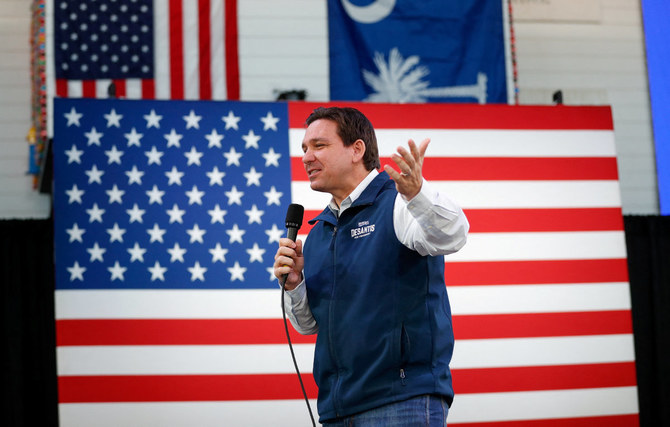

MANCHESTER, New Hampshire: Florida Gov. Ron DeSantis suspended his Republican presidential campaign on Sunday, ending his 2024 White House bid just before the New Hampshire primary while endorsing his bitter rival Donald Trump.
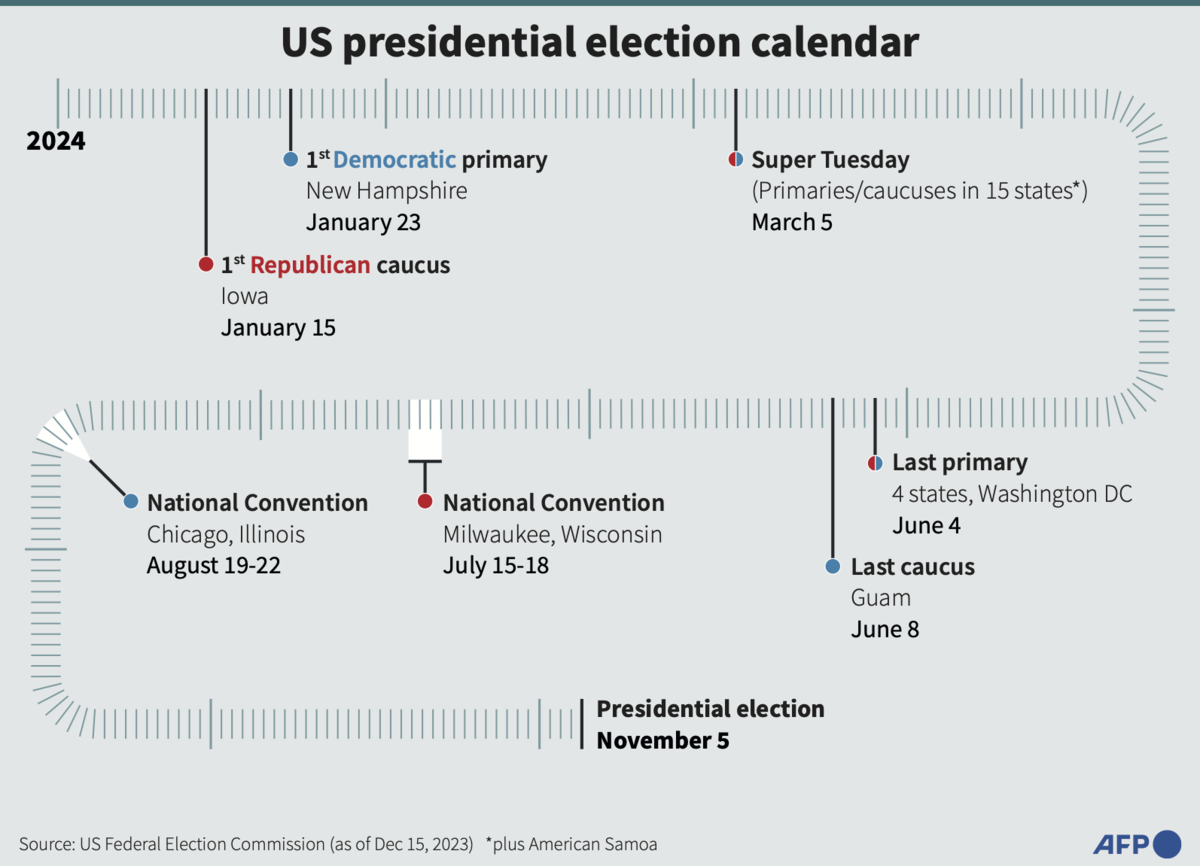
The decision leaves Trump and former UN Ambassador Nikki Haley as the last major candidates remaining in the race ahead of Tuesday’s New Hampshire primary. This is the scenario Trump’s foes in the GOP have long sought, raising the stakes for this week’s contest as the party’s last chance to stop the former president who has so far dominated the race.
But as some Trump critics cheered, DeSantis nodded toward Trump’s primary dominance — and attacked Haley — in an exit video he posted on social media.
“It’s clear to me that a majority of Republican primary voters want to give Donald Trump another chance,” DeSantis said in the straight-to-camera video, delivered in a cheerful tone.
He continued: “I signed a pledge to support the Republican nominee and I will honor that pledge. He has my endorsement because we can’t go back to the old Republican guard of yesteryear, a repackaged form of warmed-over corporatism that Nikki Haley represents.”
Haley spoke at a campaigning stop in Seabrook, New Hampshire, just as DeSantis announced his decision.
“He ran a great race, he’s been a good governor, and we wish him well,” she told a room packed with supporters and media. “Having said that, it’s now one fella and one lady left.”
DeSantis’ decision, while perhaps not surprising given his 30-point blowout loss last week in Iowa, marks the end of an extraordinary decline for a high-profile governor once thought to be a legitimate threat to Trump’s supremacy in the Republican Party.
DeSantis and Haley frequently attacked each other in debates and in advertising, often more directly than they went after Trump.
As internal financial concerns mounted, DeSantis turned aggressively to an allied super PAC to handle basic campaign functions such as organizing campaign events, advertising and an expansive door-knocking operation.
Federal law does not allow campaigns to coordinate directly with super PACs. In December, a nonpartisan government watchdog group filed a complaint with the Federal Election Commission, citing reporting by The Associated Press and others, alleging that the degree of coordination and communication between DeSantis’ campaign and the Never Back Down super PAC crossed a legal line.
DeSantis denied any wrongdoing and called the complaint “a farce.”
Still, the steady stream of negative developments leading up to the opening primary contests undermined the confidence of DeSantis’ donor network, which was supposed to be a major strength, and would-be supporters at the ballot box. As his polling numbers stagnated, DeSantis and his allies pulled back on their multistate strategy and focused virtually all of his resources on Iowa’s opening caucuses.
After leaving the 2024 presidential contest, DeSantis now refocuses his attention to the rest of his second and final term as Florida’s governor, which ends in January 2027.
His record wasn’t enough to overcome Trump.
He entered the 2024 presidential contest with major advantages in his quest to take on Trump, and early primary polls suggested DeSantis was in a strong position to do just that. He and his allies amassed a political fortune well in excess of $130 million, and he boasted a significant legislative record on issues important to many conservatives, like abortion and the teaching of race and gender issues in schools.
Such advantages did not survive the reality of presidential politics in 2024. From a high-profile announcement that was plagued by technical glitches to constant upheavals to his staff and campaign strategy, DeSantis struggled to find his footing in the primary. He lost the Iowa caucuses — which he had vowed to win — by 30 percentage points to Trump.
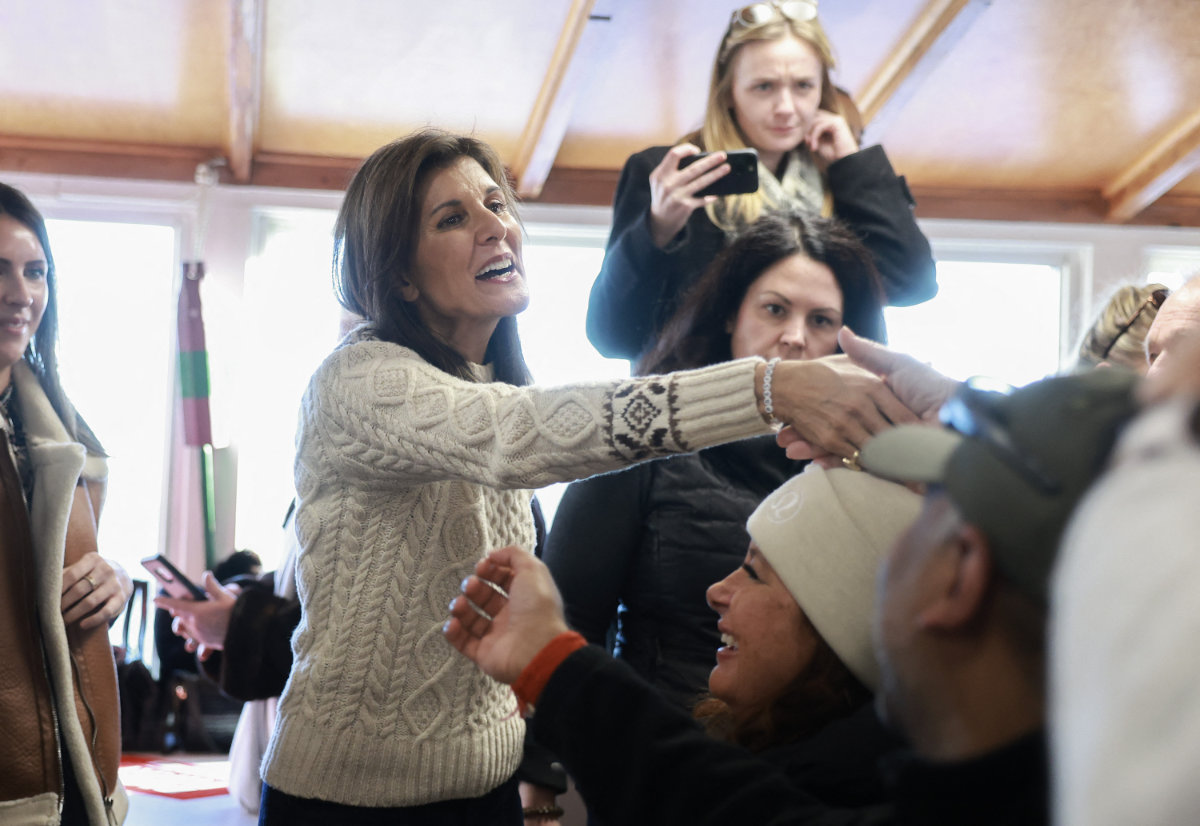
Republican presidential aspirant Nikki Haley campaigns in Seabrook, New Hampshire, on January 21, 2024 as Florida Gov. Ron DeSantis announced he was dropping out of the race. Haley continues to campaign across the state before the January 23rd state primary. (Getty Images/AFP)
A bitter rivalry comes to a meek end
He ultimately decided that he needed to endorse Trump given his popularity in the party despite the deeply personal feud between them.
“While I’ve had disagreements with Donald Trump, such as on the coronavirus pandemic and his elevation of Anthony Fauci, Trump is superior to the current incumbent, Joe Biden. That is clear,” said DeSantis, who is in his second and final term as Florida’s governor, which ends in January 2027.
The endorsement was a stunning tail-between-his-legs moment for DeSantis, whom Trump has mercilessly and relentlessly taunted in deeply personal terms for the better part of a year now.
For Trump, whose team includes many former DeSantis staffers, the attacks have often felt more like sport than political strategy. Trump and his aides have blasted the governor as disloyal for running in the first place, mocked his eating habits and his personality, and accused him of wearing high heels to boost his height.
DeSantis’ team joined Trump in attacking Haley as news of his departure rippled across the political landscape. Some doubt Haley, who was seen as splitting Republican votes and preventing a head-to-head matchup between Trump, would benefit from DeSantis’ decision.
“She will not be the nominee,” key DeSantis supporter Rep. Chip Roy, R-Texas, told AP. “She will not be the president of the United States.”
Trump had already shifted his focus to Haley in recent weeks, but minutes after DeSantis’ announcement, the former president’s campaign released a new memo highlighting the pressure on Haley to win New Hampshire.
“Now that we are a mere 48 hours from the primary, the tone has shifted mightily. We see it, you see it, but make no mistake, if Nikki Haley loses in New Hampshire — there are only two options,” wrote senior advisers Chris LaCivita and Susie Wiles.
“Option A: Nikki Haley drops out, unites behind President Trump, and commits to defeating Joe Biden,” they wrote. “Option B: Nikki Haley prepares to be absolutely DEMOLISHED and EMBARRASSED in her home state of South Carolina,” which votes on Feb. 24.
“Now, for some important advice,” they continued. “Choose wisely.”
Trump himself addressed DeSantis’ departure shortly after it was announced during a stop at Manchester campaign headquarters, according to a video shared by his staff.
“We just got some word that one of our opponents, very capable person, is dropping out of the race — Ron DeSantis. And Ron is dropping out and, in doing so, he endorsed us,” Trump said to cheers, before a “Trump!” chant broke out in the room of volunteers.
Asked if he would be using the nickname “Ron DeSanctimonious”: “I said that name is officially retired,” he said to loud cheers.
At roughly the same time not far away, DeSantis’ dejected supporters gathered privately in the Manchester restaurant where he had been scheduled to speak.
Rep. James Spillane, of Deerfield, said he had initially backed Trump, switched to DeSantis and will now vote for Trump.
“I had a suspicion this morning, and I had talked to some friends of mine saying the way I was hearing things shake out, I thought this was going to happen, and I was right,” he said. “Unfortunately, DeSantis is not going to be able to make it forward. However, in the future, hopefully we can have a viable way forward in 2028.”