Hamas says Gaza deaths top 25,000 as Israel pushes offensive

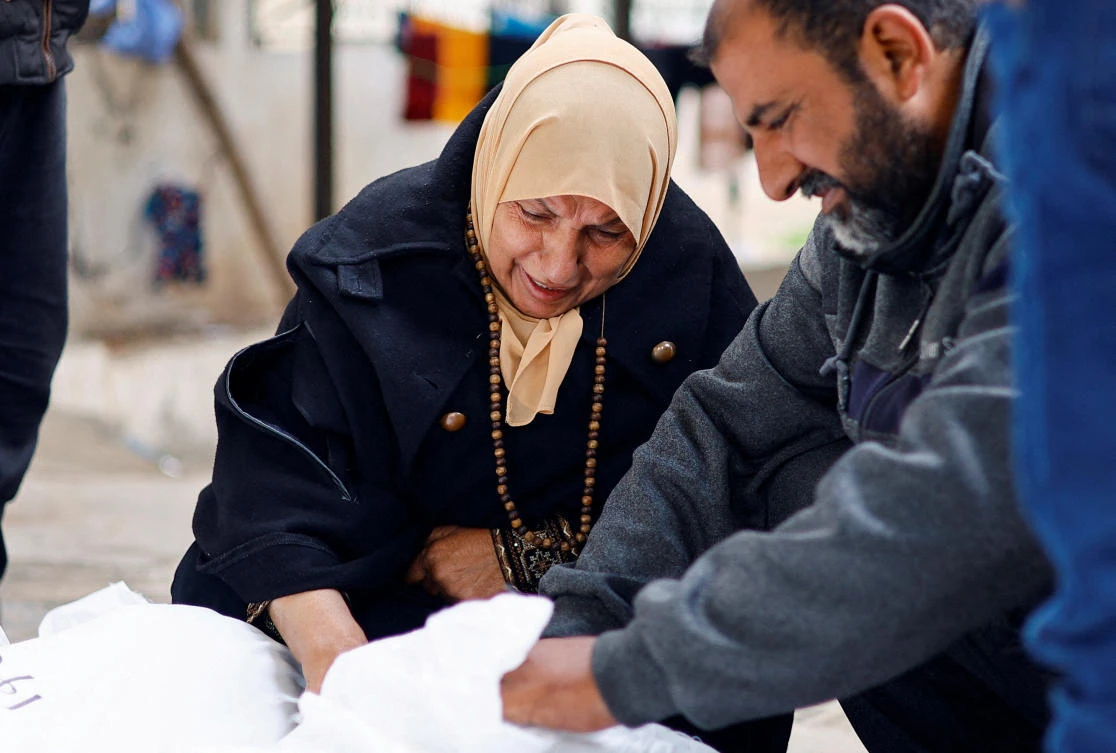
Mourners react next to the body of a relative, amid the ongoing conflict between Israel and the Palestinian Islamist group Hamas, in Rafah in the southern Gaza Strip, January 21, 2024. (Reuters)
Short Url
Updated 21 January 2024
Follow

Hamas says Gaza deaths top 25,000 as Israel pushes offensive

  • A Health Ministry spokesperson said Sunday that at least 178 bodies were brought to Gaza’s hospitals in 24 hours

GAZA STRIP: The health ministry in Gaza on Sunday said the death toll in the war-torn Palestinian territory breached 25,000 as Israel pushed its southward offensive and renewed bombardment in the north.
Witnesses told AFP Israeli boats were bombarding Gaza City and other areas in the north early Sunday. Hamas has also reported heavy combat in the north.
“Dozens are still under the rubble,” the Hamas government’s media office said, adding that the dead and injured “could not be transferred to hospitals due to the continued artillery shelling on... Khan Yunis and the Tal Al-Hawa area in Gaza City and the north.”
The Israeli army said it “eliminated a number of terrorists” in the main southern city of Khan Yunis and killed 15 militants in northern Gaza over the past day.
Thick plumes of smoke billowed above Khan Yunis on Sunday morning, AFP journalists saw.
The October 7 attacks by Hamas resulted in the deaths of about 1,140 people, mostly civilians, according to an AFP tally based on official Israeli figures.
Israel’s relentless bombardment and ground offensive have killed at least 25,105 people in Gaza, mostly women and children, according to the Hamas-run health ministry.

HOSTAGES 
Hamas militants also seized about 250 hostages during the October attacks.
Israel says around 132 remain in Gaza, of whom at least 27 captives are believed to have been killed, according to an AFP tally based on Israeli figures.
In a briefing on Saturday evening, Israeli military spokesman Daniel Hagari said troops had found a tunnel in Khan Yunis where some hostages had previously been kept.
Among the evidence of their presence were paintings, including by a five-year-old captive, he said.
“About 20 hostages” had been held there at different times “in difficult conditions without daylight... with little oxygen and terrible humidity.”
Soldiers entered the tunnel and fought a battle with militants in which “the terrorists were eliminated,” Hagari said.
Israeli Prime Minister Benjamin Netanyahu is under intense pressure to return the hostages and account for security failings surrounding the October attacks.
Thousands protested across Israel on Saturday evening to demand the release of the hostages and early elections to oust Netanyahu.
Avi Lulu Shamriz, the father of Alon Shamriz, a hostage mistakenly killed by Israeli troops earlier in the war, told AFP in Tel Aviv Netanyahu’s war cabinet was heading for disaster.
“The way we’re going, all the hostages are going to die. It’s not too late to free them.”

DISPLACEMENT
The UN agency for Palestinian refugees says about 1.7 million people have been displaced in Gaza, with about one million crowded into the Rafah area.
UN agencies have warned better aid access is needed urgently as famine and disease loom.
Diplomatic efforts have sought to secure scaled-up aid deliveries for Gaza and a truce, after a week-long cessation of hostilities in November saw Hamas release dozens of hostages in exchange for Palestinian prisoners held by Israel.
Hamas’s Qatar-based chief Ismail Haniyeh was in Turkiye Saturday for talks with the foreign minister, diplomatic sources said, renewing ties with the key regional power which asked the group’s leaders to leave the country following the October attacks.
Violence has meanwhile surged in the Israeli-occupied West Bank since October 7.
The Israeli military said it demolished two houses in Hebron belonging to two Palestinian gunmen who carried out an attack on a road between Jerusalem and Bethlehem in November.
An AFP journalist saw a fireball erupt and smoke billowing from a home on Sunday as Israeli armored vehicles maneuvered through Hebron’s roads during the raid.
Palestinians gathered outside the crumpled remains of one of the homes on Sunday, with young boys weaving their way through a thicket of tangled metal and rubble.
One man removed a banner Israeli forces attached to a destroyed house which read: “terrorism has no home.”
The official Palestinian news agency Wafa reported clashes between Israeli troops and Palestinian fighters in a village south of Jenin and the towns of Arura and Qalqilya.
Rising tensions and violence across the Middle East have also stoked fears of a wider conflagration involving Iran-backed groups in Lebanon, Iraq, Syria and Yemen.
Iranian media said an Israeli strike on Damascus on Saturday killed the Revolutionary Guards’ spy chief in Syria and four other Guards members, prompting a threat of retaliation.
A Kurdish-majority neighborhood in Syria recovers from clashes with hope for the future

Updated 8 sec ago
Follow

A Kurdish-majority neighborhood in Syria recovers from clashes with hope for the future

ALEPPO: A month after clashes rocked a Kurdish-majority neighborhood in Syria ‘s second-largest city of Aleppo, most of the tens of thousands of residents who fled the fighting between government forces and the Kurdish-led Syrian Democratic Forces have returned — an unusually quick turnaround in a country where conflict has left many displaced for years.
“Ninety percent of the people have come back,” Aaliya Jaafar, a Kurdish resident of the Sheikh Maqsoud neighborhood who runs a hair salon, said Saturday. “And they didn’t take long. This was maybe the shortest displacement in Syria.”
Her family only briefly left their house when government forces launched a drone strike on a lot next door where weapons were stored, setting off explosions.
The Associated Press visited the community that was briefly at the center of Syria’s fragile transition from years of civil war as the new government tries to assert control over the country and gain the trust of minority groups anxious about their security.
Lessons learned
The clashes broke out Jan. 6 in the predominantly Kurdish neighborhoods of Sheikh Maqsoud, Achrafieh and Bani Zaid after the government and the SDF reached an impasse in talks on how to merge Syria’s largest remaining armed group into the national army. Security forces captured the neighborhoods after several days of intense fighting during which at least 23 people were killed and more than 140,000 people displaced.
However, Syria’s new government took measures to avoid civilians being harmed, unlike during previous outbreaks of violence between its forces and other groups on the coast and in the southern province of Sweida, during which hundreds of civilians from the Alawite and Druze religious minorities were killed in sectarian revenge attacks.
Before entering the contested Aleppo neighborhoods, the Syrian army opened corridors for civilians to flee.
Ali Sheikh Ahmad, a former member of the SDF-affiliated local police force who runs a secondhand clothing shop in Sheikh Maqsoud, was among those who left. He and his family returned a few days after the fighting stopped.
At first, he said, residents were afraid of revenge attacks after Kurdish forces withdrew and handed over the neighborhood to government forces. But that has not happened. A ceasefire agreement between Damascus and the SDF has been holding, and the two sides have made progress toward political and military integration.
“We didn’t have any serious problems like what happened on the coast or in Sweida,” Sheikh Ahmad said. The new security forces “treated us well,” and residents’ fears began to dissipate.
Jaafar agreed that residents had been afraid at first but that government forces “didn’t harm anyone, to be honest, and they imposed security, so people were reassured.”
The neighborhood’s shops have since reopened and traffic moves normally, but the checkpoint at the neighborhood’s entrance is now manned by government forces instead of Kurdish fighters.
Residents, both Kurds and Arabs, chatted with neighbors along the street. An Arab man who said he was named Saddam after the late Iraqi dictator — known for oppressing the Kurds — smiled as his son and a group of Kurdish children played with a dirty but friendly orange kitten.
Other children played with surgical staplers from a neighborhood hospital that was targeted during the recent fighting, holding them like toy guns. The government accused the SDF of taking over the hospital and using it as a military site, while the SDF said it was sheltering civilians.
One boy, looking pleased with himself, emerged from an alleyway carrying the remnant of an artillery shell.
Economic woes remain
On Friday, SDF leader Mazloum Abdi said he had held a “very productive meeting” with US Secretary of State Marco Rubio and Syrian Foreign Minister Asaad Al-Shibani on the sidelines of a security conference in Munich to discuss progress made on the integration agreement.
While the security situation is calm, residents said their economic plight has worsened. Many previously relied on jobs with the SDF-affiliated local authorities, who are no longer in charge. And small businesses suffered after the clashes drove away customers and interrupted electricity and other services.
“The economic situation has really deteriorated,” Jaafar said. “For more than a month, we’ve barely worked at all.”
Others are taking a longer view. Sheikh Ahmad said he hopes that if the ceasefire remains in place and the political situation stabilizes, he will be able to return to his original home in the town of Afrin near the border with Turkiye, which his family fled during a 2018 Turkish offensive against Kurdish forces.
Like many Syrians. Sheikh Ahmad has been displaced multiple times since mass protests against the government of then-President Bashar Assad spiraled into a brutal 14-year civil war.
Assad was ousted in November 2024 in an insurgent offensive, but the country has continued to see sporadic outbreaks of violence, and the new government has struggled to win the trust of religious and ethnic minorities.
Hopes for reconciliation
Last month, interim President Ahmad Al-Sharaa issued a decree strengthening the rights of Syria’s Kurdish minority, including recognizing Kurdish as a national language along with Arabic and adopting Nowruz, a traditional celebration of spring and renewal marked by Kurds around the region, as an official holiday. Kurds make up about 10 percent of Syria’s population.
The decree also restored the citizenship of tens of thousands of Kurds in northeastern Al-Hasakah province after they were stripped of it during the 1962 census
Sheikh Ahmad said he was encouraged by Al-Sharaa’s attempts to reassure the Kurds that they are equal citizens and hopes to see more than tolerance among Syria’s different communities.
“We want something better than that. We want people to love each other. We’ve had enough of wars after 15 years. It’s enough,” he said.