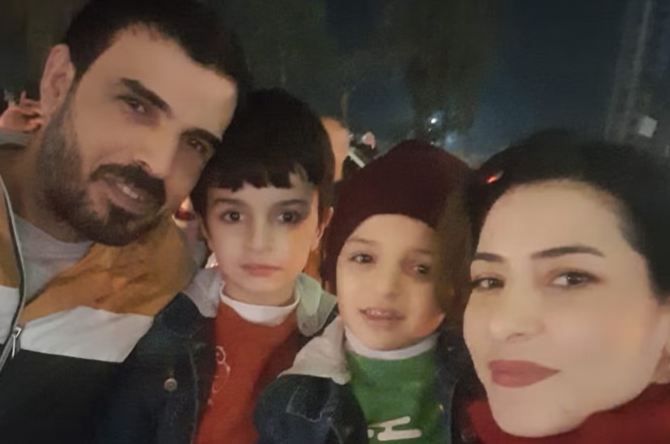
DUBAI: A Syrian family with an epileptic son has been in limbo since February 2020 and has not yet relocated to the UK despite being accepted for resettlement.
The family had an application to resettle in the UK accepted by the government in December 2019, and received the final approval in February 2020 under the UK Resettlement Scheme, but has not yet been able to relocate, The Independent reported on Friday.
The UKRS is a relocation program for vulnerable refugees who have been referred by the UN.
Medication for the 7-year-old epileptic boy has been costing the family a fortune during the wait for relocation. The report added that the family had not been able to obtain proper medication or receive hospital care for the ill child in Iraq, where they currently live.
Yawar, 40, the boy’s father who left Syria with his wife following a Daesh attack on hometown Kobani in 2014, told The Independent: “My eldest son needs special drugs because of his epilepsy, and it is a struggle to get this medication, but I would do anything I can for my child.
“The medication is not controlling his epileptic bouts completely and for the past two days we haven’t got any sleep, neither he nor us. The last time we saw the doctor he increased my son’s dosage to the highest possible and said that if that doesn’t work then there is nothing else for him. His epilepsy is still not controlled.”
The boy is not able to communicate with other children and also suffers from hydrocephalus, a condition in which fluid accumulates in the brain and causes delayed development.
Yawar’s 4-year-old son has developmental issues and suffers from social isolation, lawyers assisting the family have said. Yawar’s children were born after the couple fled to Iraq.
The International Organization for Migration has assessed the family’s needs and told the UK government that a home without stairs and with wheelchair access is required. The Home Office has told the family there is no suitable accommodation for them to live in the UK.
NHS England assessed the family’s case in June 2021 and told the government that the eldest son would need treatment at a regional pediatric neurosciences and surgery center.
Lawyers supporting the family have told the Home Office that Iraq’s state-run hospitals are “deeply inadequate and the only proper support available is at private hospitals, which (our client) cannot afford.” They added that even private hospitals in Iraq cannot treat hydrocephalus.
Iran sent missiles into Irbil, Iraq, this week, close to where the family is living.
Yawar told The Independent: “It was very scary in the middle of the night for children to live in this fear.”
He added: “When I first received the news that my application was accepted I was over the moon because I just wanted my children to have a better life, but now with the delays I am gradually feeling frustrated as the process is prolonged.
“I just want my children to get the treatment they need, for them to go to school, and for them to live a normal life like other children.
“When we go out, people look at us in a strange way. It just makes us feel very bad. They look at our children because of how they behave. There is not much acceptance of disability.”
The Home Office told the family’s lawyers in October 2022 that it was “aware of the urgent nature of this case” and that it would “continue to take steps to source suitable accommodation.”
Jon Featonby, chief policy analyst at charity Refugee Council, said: “This family’s case is a clear illustration of the urgent need to improve resettlement.”
Fionnuala Gregan, solicitor at Duncan Lewis, which has been supporting the family’s case, said: “We are concerned that while the family experiences ongoing delay in their being resettled to the UK, they face food scarcity, growing debt, and are unable to access adequate health care for their children’s disabilities.”


![]()


Syrian family with epileptic son remains in limbo despite being accepted for UK resettlement
Short Url
https://arab.news/9v7af
Syrian family with epileptic son remains in limbo despite being accepted for UK resettlement
- Medication has been costing a fortune during wait of nearly 4 years for relocation
- Parents fled Syria in 2014 after Daesh attacked their hometown Kobani


US NATO envoy says allies must ‘pull weight’ after Czech defense cut
PRAGUE, March 12 : The United States’ ambassador to NATO said on Thursday that all allies must “pull their weight,” after Czech lawmakers approved a 2026 budget that cuts defense outlays.
Czech Prime Minister Andrej Babis’ government, in power since December, pushed a revamped budget through the lower house on Wednesday evening which cut the defense ministry’s allocation versus a previous proposal to 154.8 billion crowns ($7.31 billion), or 1.73 percent of gross domestic product.
That is below a NATO target of 2 percent of GDP already expected before alliance members pledged last year in the Hague to raise defense spending to 3.5 percent of GDP plus 1.5 percent on other defense-relevant investments over the next decade.
The Czech Finance Ministry says total defense spending in the budget will reach 2.07 percent of GDP, but the country’s budget watchdog has warned that includes money earmarked elsewhere, like for the transport ministry for road projects, that may not be recognized by NATO.
“All Allies must pull their weight and honor The Hague Defense Commitment,” US Ambassador to NATO Matthew Whitaker said on X on Thursday with a picture of a news headline on the Czech budget approval.
“These numbers are not arbitrary. They are about meeting the moment — and the moment requires 5 percent as the standard. No excuses, no opt-outs.”
European NATO countries are under pressure to raise defense spending amid the Ukraine-Russia war and at US President Donald Trump’s urging.
Babis, whose populist ANO party won elections last year, said in February the country was “certainly not” on the path to raising core defense spending to the 3.5 percent target, saying there was a different focus, like on health care.
The budget watchdog on Thursday reiterated “strong doubts” that some spending deemed defense in this year’s budget would meet NATO’s definition.
President Petr Pavel, a former NATO official, has also said defense cuts risked a loss of trust from allies — but has signalled he would not veto the budget.
US Ambassador to Prague Nicholas Merrick said last week the Czech Republic may slip to the bottom of NATO’s defense-spending ranks.
Czech Prime Minister Andrej Babis’ government, in power since December, pushed a revamped budget through the lower house on Wednesday evening which cut the defense ministry’s allocation versus a previous proposal to 154.8 billion crowns ($7.31 billion), or 1.73 percent of gross domestic product.
That is below a NATO target of 2 percent of GDP already expected before alliance members pledged last year in the Hague to raise defense spending to 3.5 percent of GDP plus 1.5 percent on other defense-relevant investments over the next decade.
The Czech Finance Ministry says total defense spending in the budget will reach 2.07 percent of GDP, but the country’s budget watchdog has warned that includes money earmarked elsewhere, like for the transport ministry for road projects, that may not be recognized by NATO.
“All Allies must pull their weight and honor The Hague Defense Commitment,” US Ambassador to NATO Matthew Whitaker said on X on Thursday with a picture of a news headline on the Czech budget approval.
“These numbers are not arbitrary. They are about meeting the moment — and the moment requires 5 percent as the standard. No excuses, no opt-outs.”
European NATO countries are under pressure to raise defense spending amid the Ukraine-Russia war and at US President Donald Trump’s urging.
Babis, whose populist ANO party won elections last year, said in February the country was “certainly not” on the path to raising core defense spending to the 3.5 percent target, saying there was a different focus, like on health care.
The budget watchdog on Thursday reiterated “strong doubts” that some spending deemed defense in this year’s budget would meet NATO’s definition.
President Petr Pavel, a former NATO official, has also said defense cuts risked a loss of trust from allies — but has signalled he would not veto the budget.
US Ambassador to Prague Nicholas Merrick said last week the Czech Republic may slip to the bottom of NATO’s defense-spending ranks.
Latest updates


© 2026 SAUDI RESEARCH & PUBLISHING COMPANY, All Rights Reserved And subject to Terms of Use Agreement.