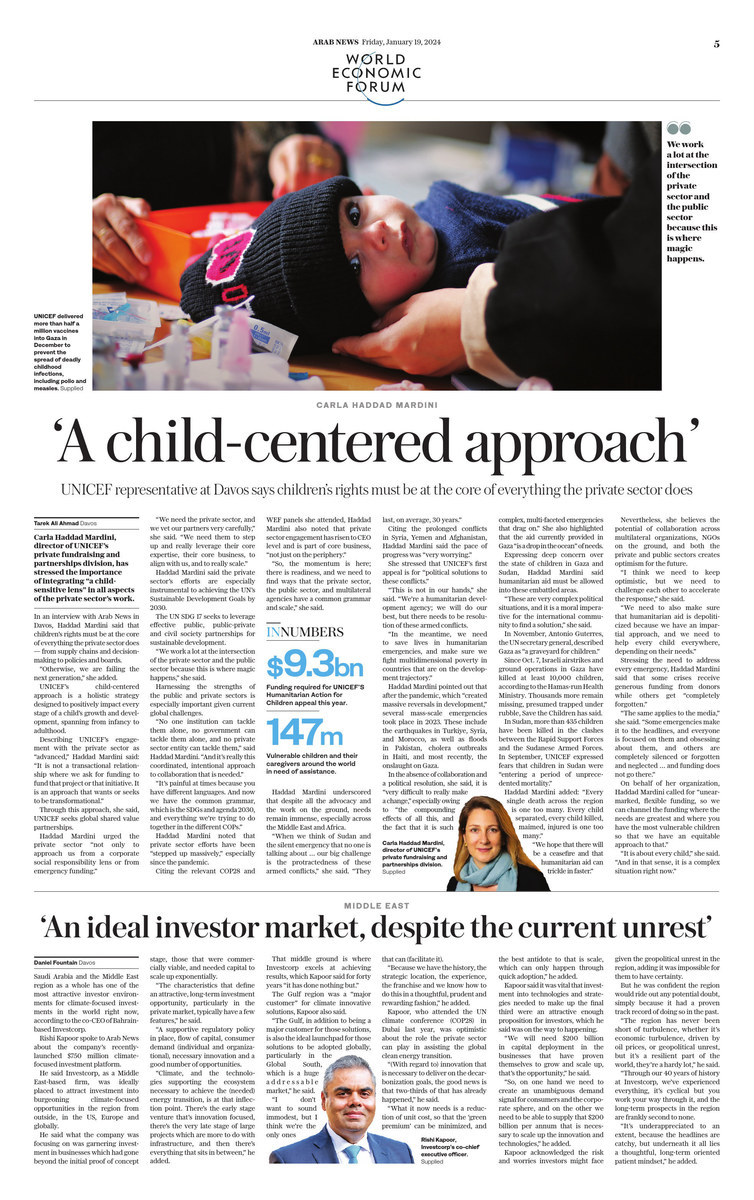

DAVOS: Carla Haddad Mardini, director of UNICEF’s private fundraising and partnerships division, has highlighted the importance of integrating “a child-sensitive lens” in all aspects of the private sector’s work.
In an interview with Arab News at the World Economic Forum in Davos, Haddad Mardini said that children’s rights must be at the core of everything the private sector does — from supply chains and decision-making to policies and boards.
“Otherwise, we are failing the next generation,” she said.
The UNICEF’s child-centered approach is a holistic strategy designed to positively impact every stage of a child’s growth and development, spanning infancy to adulthood.
Describing UNICEF’s engagement with the private sector as “advanced,” Haddad Mardini said: “It is not a transactional relationship where we ask for funding to fund that project or that initiative. It is an approach that wants or seeks to be transformational.”
Through this approach, she said, UNICEF seeks global shared value partnerships.
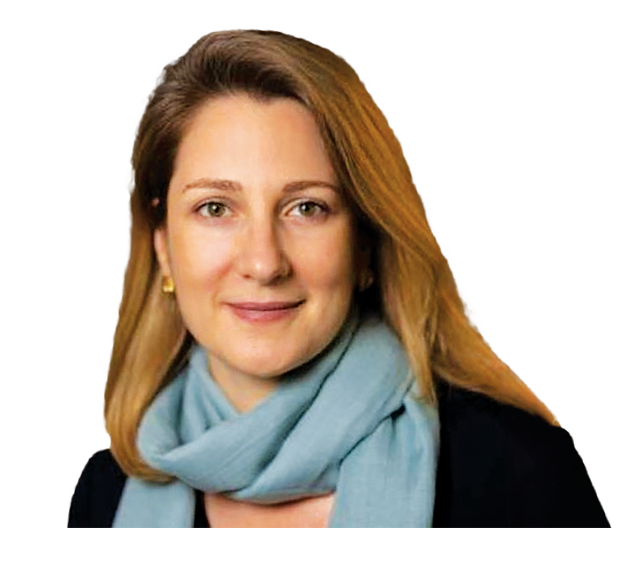
Carla Haddad Mardini,
The UNICEF expert urged the private sector “not only to approach us from a corporate social responsibility lens or from emergency funding.
“We need the private sector, and we do vet our partners very carefully,” she said. “We need them to step up and really leverage their core expertise, their core business, to align with us, and to really scale.”
Haddad Mardini said that the private sector’s efforts are especially instrumental to achieving the Sustainable Development Goals by 2030, adding that the UINCEF devotes considerable attention to SDG 17.
The United Nations SDG 17 seeks to leverage effective public, public-private and civil society partnerships for sustainable development.
“We work a lot at the intersection of the private sector and the public sector because this is where magic happens,” she said.
Elaborating on the importance of harnessing the strengths of the public and private sectors to bring their assets to bear and scale some of the transformational global initiatives, Haddad Mardini said that global challenges are immense.
“No one institution can tackle them alone, no government can tackle them alone, and no private sector entity can tackle them,” she said. “And it’s really this coordinated, intentional approach to collaboration that is needed.
“It’s painful at times because you have different languages. And now we have the common grammar, which is the SDGs and agenda 2030, and everything we’re trying to do together in the different COPs.”
The UN’s 2030 Agenda provides an action plan for countries, the UN system and other actors to protect the planet and human rights, end poverty, achieve equality and justice, and establish the rule of law.
Haddad Mardini said that private sector efforts have been “stepped up massively,” especially post pandemic.
Citing the COP28 and WEF panels she attended, Haddad Mardini also noted that private sector engagement has become central at the CEO level and in core business, “not just on the periphery.
“So, the momentum is here; there is readiness, and we need to find ways that the private sector, the public sector, and multilateral agencies have a common grammar and scale,” she said.
The UNICEF representative said that despite all the advocacy and the work on the ground, the needs are immense, especially across the Middle East, the Arab region and Africa.
“When we think of Sudan and the silent emergency that no one is talking about… our big challenge is the protractedness of these armed conflicts,” she said. “They last, on average, 30 years.”
Citing the prolonged conflicts in Syria, Yemen and Afghanistan, Haddad Mardini said that the lack of progress was “very worrying.”
She stressed that UNICEF’s first appeal is for “political solutions to these conflicts.
“This is not in our hands,” she said. “We’re a humanitarian development agency; we will do our best, but there needs to be resolution of these armed conflicts.
“In the meantime, we need to save lives in humanitarian emergencies, and make sure we fight multi-dimensional poverty in countries that are on the development trajectory.”
Haddad Mardini said that after the pandemic, which “created massive reversals in development,” several mass-scale emergencies took place in 2023. These included the earthquakes in Turkiye, Syria and Morocco, as well as floods in Pakistan, cholera outbreaks in Haiti and, most recently, the onslaught on Palestine’s Gaza Strip.
In the absence of collaboration and a political resolution, she added, it is “very difficult to really make a change,” especially due to “the compounding effects of all this, and the fact that it is such complex, multi-faceted emergencies that drag on.”
She also said that the aid currently provided in Gaza “is a drop in the ocean” of needs.
Expressing deep concern over the state of children in Gaza and Sudan, Haddad Mardini demanded that humanitarian aid be promptly allowed into these embattled areas.
“These are very complex political situations, and it is a moral imperative for the international community to find a solution,” she said.
In November, UN chief Antonio Guterres described Gaza as “a graveyard for children.”
Since Oct. 7, Israeli airstrikes and ground operations in Gaza have killed at least 10,000 children, according to the Palestinian enclave’s ministry of health. Thousands more remain missing, presumed trapped and buried under rubble, Save the Children said.
In Sudan, more than 435 children were killed in the clashes between the Rapid Support Forces and the Sudanese Armed Forces. In September last year, UNICEF expressed fears that children in Sudan were “entering a period of unprecedented mortality” due to the devastation of lifesaving services in the country.
Haddad Mardini said: “Every single death across the region is one too many. Every child separated, every child killed, maimed, injured is one too many.
“We hope that there will be a ceasefire and that humanitarian aid can trickle in faster.”
Nevertheless, she believes the potential for collaboration across multilateral organizations, NGOs on the ground, and both the private and public sectors creates optimism for the future.
“I think we need to keep optimistic, but we need to challenge each other to accelerate the response,” she said.
“We need to also make sure that humanitarian aid is depoliticized because we have an impartial approach, and we need to help every child everywhere, depending on their needs.”
Stressing the need to address every emergency, Haddad Mardini said that some emergencies receive great funding from donors while others get “completely forgotten.”
She said: “The same applies to the media. Some emergencies make it to the headlines, and everyone is focused on them and obsessing about them, and others are completely silenced or forgotten and neglected … and funding does not go there.”
On behalf of her organization, the UNICEF representative called for “unearmarked, flexible funding, so we can channel the funding where the needs are greatest and where you have the most vulnerable children so that we have an equitable approach to that.
“It is about every child,” she said. “And in that sense, it is a complex situation right now.”