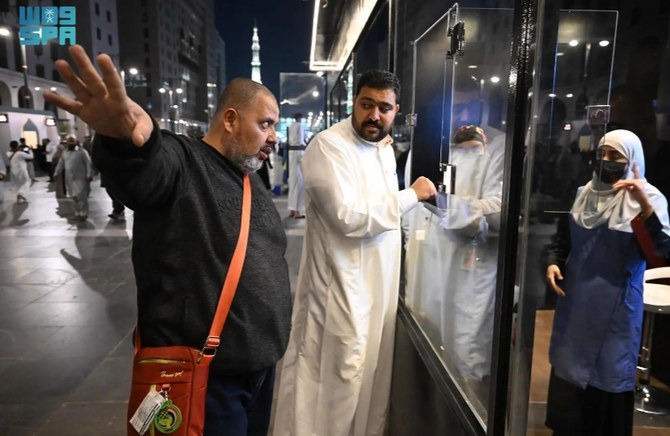
MADINAH: Staff speaking Arabic, English, Urdu, Indonesian, Persian, and Turkish have been employed at the Inquire About Madinah center to help visitors to the Prophet’s Mosque.
The multilingual team is also on hand to deal with queries about the Rawdah, the International Fair and Museum of the Prophet’s Biography and Islamic Civilization, and other sites in Madinah.
In addition, the center, which operates around the clock, provides information on transport to and from major landmarks in the holy city — including vehicle and emergency assistance for the elderly and people with disabilities — as well as its museums and historic mosques.


![]()


Six languages spoken by staff at Madinah visitor center
Short Url
https://arab.news/8yzzj
Six languages spoken by staff at Madinah visitor center
- Guides to Prophet’s Mosque, other sites


Saudi Arabia welcomes ceasefire agreement between Syrian Democratic Forces and Syria state
RIYADH: Saudi Arabia has welcomed an agreement between the Syrian state and Syrian Democratic Forces.
In a foreign ministry statement early on Monday, the Kingdom said it had welcomed an deal between Damascus and Kurdish Syrian Democratic Forces that was announced by the Syrian government on Sunday.
The agreement entails merging all SDF forces into the defense and interior ministries and means that Kurdish forces will redeploy to east of the Euphrates river.
The 14-point deal would also see the immediate administrative and military handover of Deir Ezzor and Raqqa governorates.
The Syrian state would regain control of all border crossings, oil fields, and gas fields in the region, with protection secured by regular forces to ensure the return of resources to the Syrian government, while considering the special case of Kurdish areas, the state news agency SANA reported.
The ceasefire comes after intense fighting between the SDF and government troops in Aleppo. But SDF troops have now pulled back from there and the Syrian army now controls most areas east of Aleppo.
The Saudi foreign ministry statement also thanked the US for the agreement. Washington is believed to have supported brokering the ceasefire between allies SDF and the Syrian government, who they have also backed diplomatically since the fall of long-time dictator Bashar Assad.
The Syrian state announced on Friday a raft of new directives to recognize Syrian Kurds, including making their language official and bolstering other rights for the minority group.

Latest updates


© 2026 SAUDI RESEARCH & PUBLISHING COMPANY, All Rights Reserved And subject to Terms of Use Agreement.