ISLAMABAD: Pakistan and the United Arab Emirates (UAE) have signed multiple agreements worth more than $3 billion for cooperation in railways, economic zones and infrastructure, a Pakistani official said on Thursday.
The development comes amid Pakistan Prime Minister Anwaar-ul-Haq Kakar’s visit to Davos, Switzerland to attend 54th summit of the World Economic Forum (WEF).
The agreements cover the development of a dedicated freight corridor, multi-modal logistics park, and freight terminals, according to a statement shared on X by Syed Mazhar Ali Shah, the Pakistan Railways secretary.
DP World, a Dubai-based Emirati multinational logistics company, will carry out infrastructure improvement at Qasim International Container Terminal, Pakistan’s leading trade gateway, as part of the project. The Emirati firm also plans to develop an economic zone near the terminal.
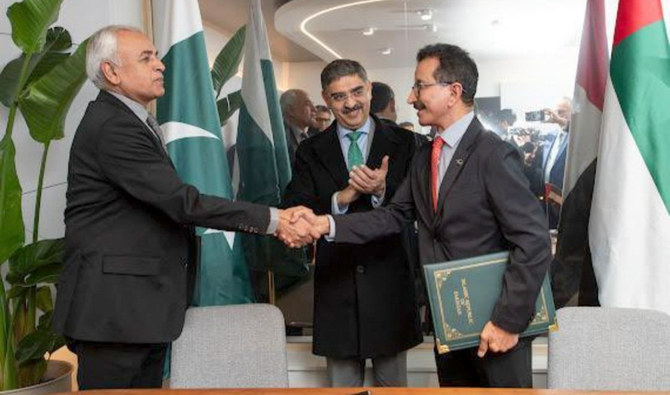
The agreements were signed by Pakistani Communication, Railways and Maritime Affairs Minister Shahid Ashraf Tarar and H.E Sultan Ahmed bin Sulayem, chairman of ports, customs and free zone corporation (PCFC) of the Dubai government.
“DP World has long standing proud presence in Pakistan witnessed by mutually rewarding engagement. Building on the unwavering trust and partnership, the two brotherly countries have decided to further consolidate the economic cooperation through landmark projects,” Tarar said at the signing ceremony in Davos.
“The signing of Investment Framework Agreements highlights the importance of Pakistan as gateway to Asia and commercial dividends associated with its strategic location.”
Sultan Ahmed bin Sulayem, who is also the CEO of DP World, said Pakistan was a growing market and they were proud of contributing to its trading ability.
“Pakistan is a growing market, and an important trade corridor to Central Asia. We are proud to have contributed to its trading ability through our operations at Qasim International Container Terminal and are honored to work with various Pakistani government organizations to develop new freight systems and with Port Qasim Authority to enhance port connectivity and investment,” he said.
“These will help serve Pakistan’s growing population, forecast to approach 300 million in the coming decade, and integrate it further into the wider region.”
For the development of the projects, DP World will act on behalf of the Dubai government, while Pakistan Railways and Port Qasim Authority will act on behalf of the Pakistan government.
The rail-based dedicated freight corridor is planned to run from Karachi Port on the Arabian Sea to the Pipri Marshalling Yard, approximately 50 km away. This will decongest the Pakistani port city of Karachi beside improving road safety. It will significantly improve efficiency, transport times and reduce the overall cost of logistics, according to Shah.
The two other inter-governmental framework agreements aim to strengthen bilateral relations in marine and logistics sectors.
Shah said a framework agreement was also signed with Pakistan’s Ministry of Maritime Affairs to dredge a navigation channel.
“This framework agreement will also see the development of an economic zone at Port Qasim, which aims to attract more than US $3 billion of foreign direct investment,” he said, adding that it aimed to maximize economic activity in Pakistan.


![]()
![]()

At Davos, Pakistan, UAE ink more than $3 billion investment pacts for cooperation in multiple sectors

Short Url
https://arab.news/2jsq8
At Davos, Pakistan, UAE ink more than $3 billion investment pacts for cooperation in multiple sectors
- The agreements cover development of a dedicated freight corridor, multi-modal logistics park, and freight terminals
- The investment pacts highlight Pakistan’s importance as gateway to Asia, commercial dividends of its location, minister says
Latest updates


© 2026 SAUDI RESEARCH & PUBLISHING COMPANY, All Rights Reserved And subject to Terms of Use Agreement.