

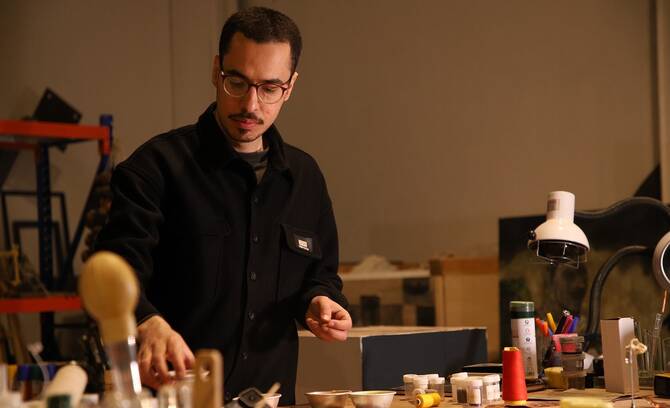

RIYADH: Abha-based Syrian artist Hatem Al-Ahmad left his lush green backyard to venture to the Kingdom’s bustling capital for his most recent milestone.
“Would I ever willingly live in Riyadh? No, never. It is not me, no,” Al-Ahmad tells Arab News. He prefers opening his front door onto picturesque nature.
But Riyadh was the setting for his solo exhibition “Sensitivity of the Ruins,” which ended this month at ATHR Gallery in Jax Art District. The show consisted of works produced over the last two years that address the climate crisis, emerging from the start of the Anthropocene era.

'Neglected Sensors (Revealer).' (Supplied)
In the immersive work “Tell Me Where the Seeds Are?” Al-Ahmad uses pomegranates — part of his regular diet, as they are abundant in Abha. He believes that his studio is much like a fresh pomegranate: a vibrantly colored protective shell with multiple mini parcels of juicy goodness encased within, coexisting in a thriving but contained ecosystem waiting to spill out when the timing and elements are right.
“Tell Me Where the Seeds Are?” was one of the most compelling works in the show. Visitors could walk around a stark white structure of bricks and see the artist’s attempt at preserving dried pomegranates in this ‘abandoned orchard’ and witness the fruit’s various levels of decay.
In his painting “Neglected Sensors,” Al-Ahmad depicts animals serving as biological sensors of ecological decay. These creatures have mutated because of atrazine (a widely used weedkiller). The piece also reflects on the historical use of canaries as detectors of poisonous gases including carbon monoxide in coal mines. Works such as this can make you laugh and wince simultaneously.

'Tell Me Where the Seeds Are.' (Supplied)
Al-Ahmad’s journey is one that many Arab artists will recognize. At university, he studied computer engineering (he notes that he was “really bad at it”).
“My father is a mechanical engineer,” he says. “I’m the only member of my family who has this level of interest in art. All of them are businessmen… that kind of thing,” he says. The assumption was that he would also do ‘that kind of thing.’
But he found his true calling in Al-Miftaha Fine Arts Village in Abha — an environment ripe in richly-vibrant landscapes saturated with vivid colors, that heavily influenced Al-Ahmad’s early visual style.
By closely observing the techniques of fellow local creators, he developed a distinct artistic vision that bridged tradition and modernity, whether drawing, painting, sculpting, or printmaking.
His work today is poetic, imbued with metaphors, sparking vital conversations centered on sustainability, cultural legacy, and the delicate balance between progress and preservation. It is gritty and beautiful at the same time.
But Al-Ahmad is not an emotional painter. In fact, he considers himself to be a “contractor who looks at the approved blueprint plan and executes it.” This clear boundary allows him to remain somewhat emotionally detached from the work.

'The Affinity of Submergence.' (Supplied)
“I am not injecting myself into any of the paintings; none of these figures are self-portraits. I consider my work as an algorithm,” he says. “The sorting of the information, the archiving of materials or elements that leads me to convert this research to visual elements… I’m just the person who arranges the puzzle parts.”
And what a puzzle it is.
“It’s all about the research,” he says. “Before starting, I choose the color palette, the composition — everything is ready, so I consider myself as a contractor.”
Music is also an important part of his work, he says. “I’m not a musician but I have different playlists and can tell you which songs link to each painting,” he says. “I listen to flamenco, Armenian songs, Arabic songs, of course, jazz, blues, heavy metal.”
But he stresses that, again, it doesn’t play an emotional role in his practice. “It doesn’t matter because I’m converting my research to a visual language. I have a sketch and blueprint and use that. The paint is not swayed or dictated by feelings or emotions, so even if I’ve had a good or bad day, or the world is good or bad, my painting will maintain its integrity and flow because I have that detailed outline. Music won’t change the mood of the painting either.”
He refers to some of his paintings as “slides,” which offers a clear glimpse into how he interacts with his work. He is not dispassionate — anyone who sees his work up close can sense the urgency in the brushstrokes. But he remains calm and diligent.
“I am not an activist, but an archivist,” he says. His signature style can be described as technicolor-drenched surrealism meets grotesque figuration.
And now that — as announced at his show’s closing event — he is officially being represented by ATHR, he has a lot more up his sleeve.
“I am ready,” Al-Ahmad says. “You will see.”


