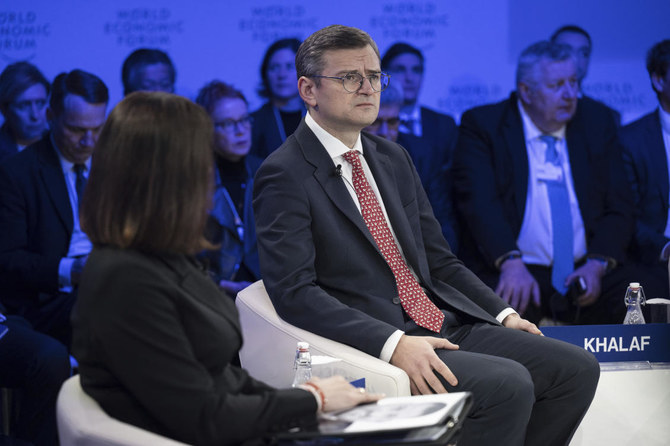
DAVOS: Ukraine’s Foreign Minister Dmytro Kuleba on Wednesday said his country’s priority for 2024 was to gain control over its skies, as Russia’s full-scale assault enters its third year.
His comments at the World Economic Forum in Davos came just hours after Russian drone and missile attacks overnight wounded 20 people across Ukraine.
The barrage left massive craters in the southern city of Odesa where AFP journalists saw residential buildings charred in the wake of the assault.
Rescue workers hauled out vulnerable residents on stretchers from housing blocs that had had their windows blown out, footage from emergency services showed.
“In 2024, of course the priority is to throw Russia from the skies,” Kuleba said in an address to the World Economic Forum in Davos.
“Because the one who controls the skies will define when and how the war will end,” he added.
Kyiv has long called on the West to deliver advanced fighter jets to support its troops entrenched in the south and east of the country.
Responding to those calls, President Emmanuel Macron announced this week that France would deliver a new batch of around 40 SCALP long-range cruise missiles as well as hundreds of bombs as Kyiv fights the Russian invasion.
But even that pledge is limited compared to the range of munitions that Russian forces have recently been raining down across Ukraine.
Officials in Kyiv have seen a steep rise in civilian casualties since December, as Moscow intensifies air attacks, reversing a downward trend seen earlier in 2023, the United Nations has warned.
And officials in the southern region of Kherson said one person had been killed and another injured by Russian shelling.
Kyiv said the overnight Russian attack consisted of 20 Iranian-designed drones targeting southern Ukraine, but said its air defense systems had destroyed all but one.
The conflict has ground to a stalemate after Ukraine’s long-awaited counter-offensive last year failed to punch through Russian positions.
Kuleba called for patience among Ukraine’s key Western backers, insisting that with the right support, Ukraine could be victorious.
“We are fighting a powerful enemy, a very big enemy that doesn’t sleep,” said Kuleba. “It takes time.
“We defeated them on the land in 2022. We defeated them in the sea in 2023 and we are completely focused on defeating them in the air in 2024,” he told a discussion panel at the forum in Switzerland.
His comments echo remarks by President Volodymyr Zelensky, who on Tuesday said that Ukraine “must gain air superiority” to enable “progress on the ground.”
Various NATO countries are currently training Ukrainian pilots on American-made F-16 fighter jets. Denmark said earlier this month it would transfer 19 F-16s in the second quarter of this year.
Washington had previously resisted allowing the jet transfers for fear of being deemed by Moscow a direct belligerent in the Ukraine war.
Russia meanwhile on Wednesday announced that Foreign Minister Sergei Lavrov would travel to New York next week for a meeting of the United Nations’ Security Council.
Asked whether Lavrov would attend the 23 January Security Council debate on the Middle East in person, foreign ministry spokeswoman Maria Zakharova said “yes,” TASS reported on Wednesday.
Russia has also been weathering increased fatal Ukrainian strikes, particularly in border regions where officials and residents are bolstering defenses.
“The situation is, of course, difficult at the moment,” a member of a volunteer defense group, Oleg Gerasimov told AFP in the border city of Belgorod.
“But we are hoping, believing, that the threat to our city and the whole country will end in the very near future,” he added.
Late last year, more than two dozen people were killed in a series of strikes on the city — the deadliest attack on Russian soil so far.


![]()
Ukraine says 2024 priority is to gain control of the skies
Short Url
https://arab.news/5yngv
Ukraine says 2024 priority is to gain control of the skies
- “In 2024, of course the priority is to throw Russia from the skies,” Kuleba said
- “Because the one who controls the skies will define when and how the war will end”

Latest updates





© 2026 SAUDI RESEARCH & PUBLISHING COMPANY, All Rights Reserved And subject to Terms of Use Agreement.