

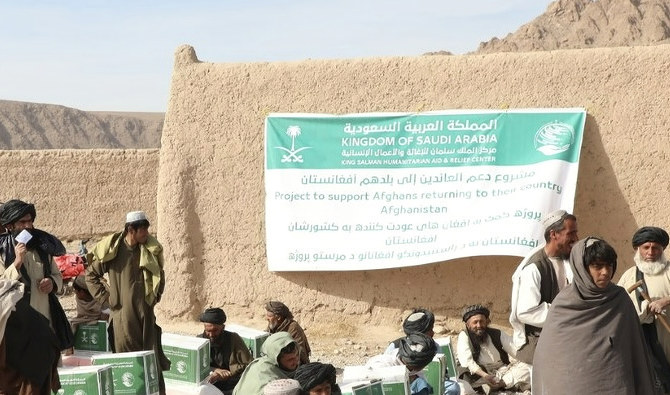
KSrelief provides aid to Afghans who returned home under Pakistan's expulsion policy

People receive relief packages at KSrelief food assistance camp in Kandahar, Afghanistan, on January 16, 2024. (Afghan Red Crescent Society)
Short Url
Updated 17 January 2024
Follow

KSrelief provides aid to Afghans who returned home under Pakistan's expulsion policy

  • Half a million people returned from Pakistan to Afghanistan since October
  • Most back with no place to stay, no means to sustain themselves, and no work

KABUL: King Salman Humanitarian Aid and Relief Center has been distributing aid to thousands of Afghans repatriated from Pakistan — most returning to start over with nothing.

Millions of Afghans found refuge in Pakistan during decades of conflict, after their homeland was invaded by the Soviet Union in 1979. Over the years, some would return, and some more would flee Afghanistan — most recently when the Taliban took over the war-torn country following the withdrawal of US-led forces in 2021.

But since October, around half a million of them have made their way back as Pakistani authorities launched a nationwide crackdown on undocumented foreign nationals.

The decision covered all the foreigners deemed as living in the country illegally, but it hit Afghans the most as some 1.7 million of them — out of the total of 4 million — were living in Pakistan unregistered.

The Afghan government has promised support for the returnees, but the $140 it had pledged for each returning family is a drop in the ocean of needs. Most returnees are back with no place to stay, no means to sustain themselves, and no work.

Those who have most recently entered Afghanistan through the Spin Boldak crossing in the southern Kandahar province are receiving food assistance from KSrelief this week.

“We are thankful to KSrelief for its continuous assistance to the Afghan people,” Abdul Mutalib Haqqani, spokesman of the Ministry of Refugees and Reparation, told Arab News.

“As per our data, the majority of those returning are children.”

The Afghan Red Crescent Society, which is distributing the aid, said in a statement that the packages containing staples such as flour, cooking oil, beans, sugar and dates have already reached 400 families.

They will allow each family to stay afloat for at least several weeks.

The unprecedented number of people arriving in such a short time leaves the Afghan government struggling to address their fundamental needs, including also shelter and work.

Since the Taliban took over Afghanistan in 2021, the country has been hit by international sanctions and its unemployment has more than doubled as it is struggling with a collapsing economy.

Those who have returned from Pakistan had to leave behind whatever they had built over the years.

“It will be very hard when you are starting your life from zero,” Haqqani said.
“Some of them have spent even 40 years in Pakistan and left everything there.”


Pakistan urges developed nations, global institutions to expand role in climate financing

Updated 4 sec ago
Follow

Pakistan urges developed nations, global institutions to expand role in climate financing

  • Pakistan is recognized among countries worldwide most affected by climate-induced disasters
  • Planning minister stresses redesigning global financial system on principles of responsibility, equity

ISLAMABAD: Pakistan’s Planning Minister Ahsan Iqbal this week called on developed nations and international financial institutions to play a greater role in helping developing countries adopt green technologies at lower costs, state-run media reported. 

Pakistan has suffered frequent climate change-induced disasters over the past couple of years, ranging from floods, droughts, heatwaves, cyclones and other irregular weather patterns. 

This year the South Asian country reported over 1,000 deaths from floods and landslides triggered by heavy rains and the melting of glaciers. 

“He [Iqbal] said Pakistan has urged developed countries and international financial institutions to expand their role in climate financing to enable developing nations to adopt green technologies at lower costs,” state-run Associated Press of Pakistan (APP) reported on Saturday. 

The minister was speaking at the Second Asia Energy Transition Summit held at Pakistani university LUMS on Saturday. 

Iqbal warned that climate change is intensifying emergencies and increasing economic burdens on vulnerable countries, adding that financial incentives and concessional financing have become indispensable for sustainable climate action.

“He further emphasized the need to redesign the global financial system based on the principles of collective responsibility and equity,” APP said. 

The minister noted that Pakistan has been introducing comprehensive reforms in its development agenda to promote renewable energy, solar power and green technological solutions. 

The country, he said, possesses “strong solar potential,” a robust renewable energy market, a wide talent pool in engineering and science and an enabling environment for green innovation.

Pakistan has regularly urged developed countries to fulfill past pledges and provide easy access to climate funding without attaching conditions, especially at Conference of Parties (COP30) climate summits. 

Islamabad was instrumental in getting the Fund for Responding to Loss and Damage (FRLD) established at the COP27 climate summit in Egypt in 2022. The Loss and Damage Fund aims to help developing and least developed countries cope with both economic and non-economic impacts of climate change, such as extreme weather events and slow-onset crises like sea-level rise and droughts.