

Indonesia breaks ground for first mosque in new capital city

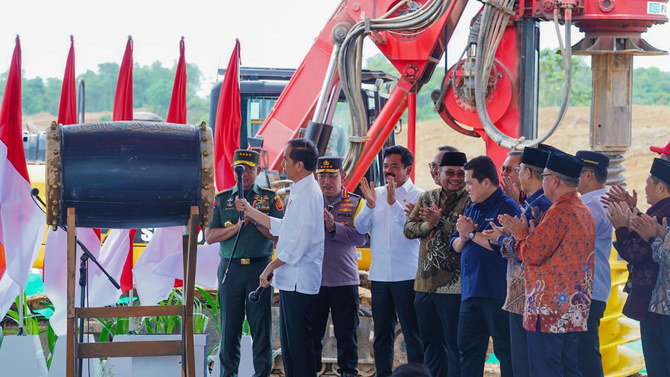
President Joko Widodo leads a groundbreaking ceremony for the first state mosque in the new capital city Nusantara. (Supplied)
Short Url
Updated 17 January 2024
Follow

Indonesia breaks ground for first mosque in new capital city

  • Mosque part of $32bn Nusantara capital city project, scheduled for completion in 2045
  • Famous sculptor Nyoman Nuarta designed mosque, other government structures

JAKARTA: President Joko Widodo on Wednesday led the groundbreaking ceremony for the first state mosque in Indonesia’s new capital city Nusantara.

The Indonesian government is relocating the capital to Borneo island to replace the overcrowded and sinking Jakarta on Java island, with the $32 billion megaproject scheduled for completion in 2045.

With the first phase of building set to end in 2024, Widodo inaugurated the construction of various buildings in Nusantara on Wednesday, including the mosque, a branch of the country’s biggest postal service firm Pos Indonesia, and a broadcast studio for the RRI state radio network.

The $62 million mosque will be built in a complex that will eventually house other places of worship, as the government will also erect Christian churches, and Buddhist, Hindu, and Chinese temples, Widodo noted.

“The construction value is about 940 billion rupiahs ($62 million), as this mosque will be huge … I hope this mosque will represent Indonesia’s diversity and serve as a space to increase our faith and piety,” he said during the groundbreaking ceremony.

“I want this mosque to be an example for other mosques in the world, and for it to showcase Indonesia’s unique qualities.”


A visualization of Masjid Negara in Indonesia's new capital, Nusantara, shared on Instagram by its designer Nyoman Nuarta on Oct. 19, 2023. (Instagram/nyoman_nuarta)

The state mosque in Nusantara has been designed by Balinese sculptor Nyoman Nuarta at Widodo’s request. Nuarta is one of Indonesia’s most famous visual artists and creator of the country’s tallest statue, Garuda Wisnu Kencana, located in Bali.

The 72-year-old is also the designer behind other main structures in Nusantara, including the new state palace.

“This event signifies the start of the mosque construction, which will have a capacity of 22,317 worshippers, and will eventually be increased to 61,392,” Religious Affairs Minister Yaqut Cholil Qoumas said.

“Philosophically, this structure will be built according to the values from the Qur’an, which says that we must maintain the balance between good relations with God and good relations between human beings.”

Widodo formally launched the new capital city project in 2019, in what has been widely seen as an attempt to seal his legacy before the end of his second and final term in office which ends this year.

More than 204 million Indonesians will head to the polls on Feb. 14 to choose the country’s new president, vice president, and legislators.


Italian suspect questioned over Bosnia ‘weekend sniper’ killings

Updated 11 min 34 sec ago
Follow

Italian suspect questioned over Bosnia ‘weekend sniper’ killings

  • The octogenarian former truck driver from the Friuli-Venezia Giulia region of northeast Italy, is suspected by Milan prosecutors of “voluntary homicide aggravated by abject motives,” according to Italian news agency ANSA

ROME: An 80-year-old man suspected of being a “weekend sniper” who paid the Bosnian Serb army to shoot civilians during the 1990s siege of Sarajevo was questioned Monday in Milan, media reported.

The octogenarian former truck driver from the Friuli-Venezia Giulia region of northeast Italy, is suspected by Milan prosecutors of “voluntary homicide aggravated by abject motives,” according to Italian news agency ANSA.

Lawyer Giovanni Menegon told journalists that his client had answered questions from prosecutors and police and “reaffirmed his complete innocence.”

In October, prosecutors opened an investigation into what Italian media dubbed “weekend snipers” or “war tourists“: mostly wealthy, gun-loving, far-right sympathizers who allegedly gathered in Trieste and were taken to the hills surrounding Sarajevo where they fired on civilians for sport.

During the nearly four-year siege of Sarajevo that began in April 1992 some 11,541 men, women and children were killed and more than 50,000 people wounded by Bosnian Serb forces, according to official figures.

Il Giornale newspaper reported last year that the would-be snipers paid Bosnian Serb forces up to the equivalent of €100,000 ($115,000) per day to shoot at civilians below them.

The suspect — described by the Italian press as a hunting enthusiast who is nostalgic for Fascism — is said to have boasted publicly about having gone “man hunting.”

Witness statements, particularly from residents of his village, helped investigators to track the suspect, freelance journalist Marianna Maiorino said.

“According to the testimonies, he would tell his friends at the village bar about what he did during the war in the Balkans,” said Maiorino, who researched the allegations and was herself questioned as part of the investigation.

The suspect is “described as a sniper, someone who enjoyed going to Sarajevo to kill people,” she added.

The suspect told local newspaper Messaggero Veneto Sunday he had been to Bosnia during the war, but “for work, not for hunting.” He added that his public statements had been exaggerated and he was “not worried.”

The investigation opened last year followed a complaint filed by Italian journalist and writer Ezio Gavanezzi, based on allegations revealed in the documentary “Sarajevo Safari” by Slovenian director Miran Zupanic in 2022.

Gavanezzi was contacted in August 2025 by the former mayor of Sarajevo, Benjamina Karic, who filed a complaint in Bosnia in 2022 after the same documentary was broadcast.

The Bosnia and Herzegovina prosecutor’s office confirmed on Friday that a special war crimes department was investigating alleged foreign snipers during the siege of Sarajevo.

Bosnian prosecutors requested information from Italian counterparts at the end of last year, while also contacting the International Residual Mechanism for Criminal Tribunals in The Hague, it said. That body performs some of the functions previously carried out by the International Criminal Tribunal for the former Yugoslavia.

Sarajevo City Council adopted a decision last month authorizing the current mayor, Samir Avdic, to “join the criminal proceedings” before the Italian courts, in order to support Italian prosecutors.