

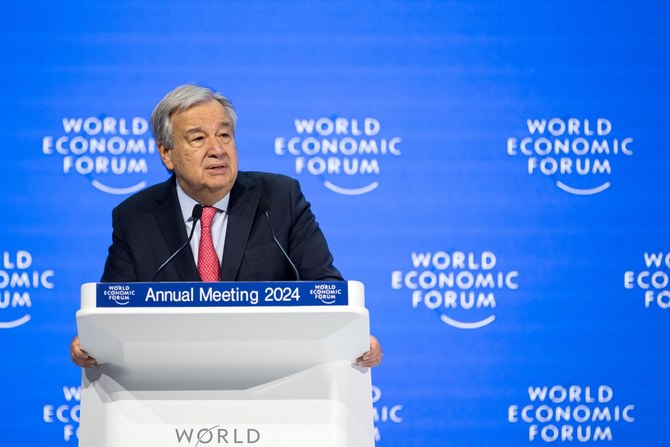
Geopolitical rifts preventing world tackling key issues, UN chief tells Davos

Guterres attributed the trust crisis in trust to the collapse of global norms. (AFP/File)
Short Url
Updated 17 January 2024
Follow

Geopolitical rifts preventing world tackling key issues, UN chief tells Davos

  • ‘Little wonder’ people are losing faith in governments, Antonio Guterres says
  • World ‘standing by as civilians, mostly women and children, are killed’

DAVOS: Geopolitical divides are hampering efforts to tackle issues like the climate crisis and unregulated developments in artificial intelligence, the UN secretary-general said on Wednesday.

In his address at the World Economic Forum in Davos, Antonio Guterres said that while the worsening climate crisis and AI-related risks were discussed at length at global and regional forums, the world lacked an effective strategy to deal with either.

“Geopolitical divides are preventing us from coming together around global solutions,” he said. “Little wonder that people everywhere are losing faith in governments, institutions and financial and economic systems.”

Some countries, he said, were “doing whatever it takes to further their own interests at all costs.”

Guterres pointed to the many conflicts that are fragmenting the world, including the war in Gaza, Russia’s invasion of Ukraine and the violence in Sudan, and said the parties driving them were “ignoring international law, trampling on the Geneva Conventions and even violating the United Nations Charter.”

“The world is standing by as civilians, mostly women and children, are killed, maimed, bombarded, forced from their homes and denied access to humanitarian aid.”

Guterres reiterated his call for a ceasefire in Gaza and said there was a need for “a process that leads to sustained peace for Israelis and Palestinians, based on a two-state solution.”

“This is the only way to stem the suffering and prevent a spillover that could send the entire region up in flames.”

The UN chief said also that geopolitical divisions played a major role in the faltering global economy and that economic insecurity was exacerbated by political instability.

Despite the challenges, Guterres expressed hope for the future.

“I am confident we can build a new, multipolar global order with new opportunities for leadership, balance and justice in international relations,” he said.

But to avoid a “slide into chaos,” it was vital that the world had strong multilateral institutions and frameworks, as well as effective mechanisms for global governance.

“Without them, further fragmentation is inevitable and the consequences are clear,” he said.

Guterres attributed the crisis in trust to the collapse of global norms.

“I am personally shocked by the systematic undermining of principles and standards we used to take for granted,” he said.

“I am outraged that so many countries and companies are pursuing their own narrow interests without any consideration for our shared future or the common good. I am certain that unless we take action, we can expect much, much worse.”

Rebuilding global trust required “deep reforms to global governance to manage geopolitical tensions during a new era of multipolarity” so we could build “a safer, more stable, more prosperous world,” he said.


US and Mideast countries seek Kyiv’s drone expertise as Russia-Ukraine talks put on ice

Updated 59 min 33 sec ago
Follow

US and Mideast countries seek Kyiv’s drone expertise as Russia-Ukraine talks put on ice

KYIV, Ukraine: The United States and its allies in the Middle East are seeking Ukraine's expertise in countering Iran's Shahed drones, according to Ukrainian President Volodymyr Zelenskyy.

Various countries, including the United States, have approached Ukraine for help in defending against the Iranian drones, Zelenskyy said late Wednesday. He said he has spoken in recent days with the leaders of the United Arab Emirates, Qatar, Bahrain, Jordan and Kuwait about possible cooperation.

Russia has fired tens of thousands of Shaheds at Ukraine since it invaded its neighbor just over four years ago, launching a swarm of more than 800 drones and decoys in its biggest nighttime barrage. Iran has responded to joint U.S.-Israeli strikes by launching the same type of drones at countries in the Middle East.

Ukrainian assistance in countering Iranian drones will be provided only if it does not weaken Ukraine's own defenses, and if it adds leverage to Kyiv's diplomatic efforts to stop the Russian invasion, according to the Ukrainian leader.

"We help to defend from war those who help us, Ukraine, bring a just end to the war" with Russia, Zelenskyy said. Later Thursday, Zelenskyy said he had received a U.S. request for support to defend against the drones in the Middle East and had given the order for equipment to be provided along with Ukrainian experts without providing further details.

"Ukraine helps partners who help our security and the protection of our people's lives," he added in a social media post.

Trump, in an interview Thursday with Reuters, said, "Certainly I'll take, you know, any assistance from any country."

Ukraine has battle-tested drone defenses

Ukraine has pioneered the development of cut-price drone killers that cost as little as $1,000, rewriting the air defense rule book and making other countries take notice.

European countries got a wake-up call last September on the changed nature of air defense when Poland scrambled multimillion-dollar military assets, including F-35 and F-16 fighter jets and Black Hawk helicopters, in response to airspace violations by cheap drones.

Ukrainian manufacturers have developed low-cost interceptor drones specifically designed to hunt and destroy Shaheds, and its rapidly expanding drone industry is producing excess capacity.

Zelenskyy announced earlier this year that Ukraine would begin exporting the battle-tested systems.

The European Union's top diplomat, Kaja Kallas, said before chairing a meeting of EU and Gulf foreign ministers via video link Thursday that the talks would look at how Ukraine's experience can help countries counter Iranian drones.

Middle East war delays Russia-Ukraine talks

The Iran war, now in its sixth day, has drawn international attention away from Europe's biggest conflict since World War II, and forced the postponement of a new round of U. S-brokered talks between Russia and Ukraine planned for this week, Zelenskyy said.

Western governments and analysts say the Russia-Ukraine war has killed hundreds of thousands of people, while there is no sign that yearlong U.S.-led peace efforts will stop the fighting any time soon.

"Right now, because of the situation around Iran, there are not yet the necessary signals for a trilateral meeting," Zelenskyy said. "But as soon as the security situation and the overall political context allow us to resume that trilateral diplomatic work, it will be done."

Zelenskyy thanked the United States for the return from Russia on Thursday of 200 Ukrainian prisoners of war. Russia's Defense Ministry also said it received the same number of prisoners from Ukraine and thanked the U.S. and United Arab Emirates for mediating.

Prisoner swaps have been one of the few tangible results of the talks. Vladimir Medinsky, a Russian negotiator, said on social media that a total of 500 prisoners from each side would be exchanged between Thursday and Friday.

Oleksandr Merezhko, the head of Ukraine's parliamentary foreign affairs committee, said Russian President Vladimir Putin is trying to drag out the negotiations so that he can press on with Russia's invasion while escaping further U.S. sanctions.

He urged the U.S. administration to look at the Russia-Ukraine war and the war in the Middle East as linked.

"In reality, Russia and Iran are close allies that act in concert — Iran supplies weapons and Russia helps Iran develop its defense industry. These are interconnected conflicts," Merezhko told The Associated Press.

Ukraine's army has recently pushed back Russian forces at some points along the roughly 1,250-kilometer (750-mile) front line, according to the Institute for the Study of War.

Localized Ukrainian counterattacks liberated more territory than Ukrainian forces lost in the last two weeks of February, the Washington-based think tank said this week, estimating the recovered land at about 257 square kilometers (100 square miles) since Jan. 1.