

Aramco CEO predicts tighter oil markets, sees Red Sea risks

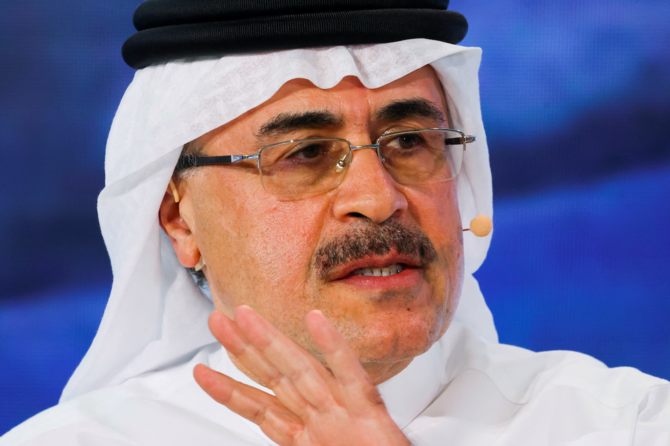
Nasser said he saw oil demand at 104 million barrels a day in 2024, meaning growth of roughly 1.5 million bpd. Reuters
Short Url
Updated 17 January 2024
Follow

Aramco CEO predicts tighter oil markets, sees Red Sea risks

DAVOS: Global oil markets will cope with Red Sea disruptions in the short run, although prolonged attacks by the Houthis on ships would lead to a shortage of tankers due to longer voyages and a supply delay, the CEO of Saudi oil giant Aramco has told Reuters.

Amin Nasser said he expected the oil market to tighten after consumers depleted stocks by 400 million barrels in the last two years, which left Organization of the Petroleum Exporting Countries’ spare capacity as the main source of additional supply to meet rising demand.

Attacks by the Houthis on ships in the Red Sea have forced many companies to divert cargoes around Africa. The Iran-aligned Houthis say they are acting in solidarity with Palestinians during Israel’s ongoing war with Gaza.

“If it’s in the short term, tankers might be available ... But if it’s longer term, it might be a problem,” Nasser said in an interview on the sidelines of this week’s World Economic Forum in the Swiss ski resort of Davos. “There will be a need for more tankers and are they going to have to take a longer journey.”

Container vessels have been pausing or diverting from the Red Sea that leads to the Suez Canal, the fastest route from Asia to Europe, where about 12 percent of world shipping passes.

The alternative route around South Africa’s Cape of Good Hope adds 10-14 days to the journey.

Aramco can bypass the Bab Al-Mandab strait near Yemen, from where the Houthis launch attacks, via a pipeline connecting its eastern oil facilities with its western coast and giving it quicker access to the Suez Canal, Nasser said.

Some oil products might have to sail around Africa, Nasser said, adding that he does not expect the Houthis to attack Aramco’s facilities again as a result of peace talks between Saudi Arabia and Yemen.

Spare capacity 

Nasser said he saw oil demand at 104 million barrels a day in 2024, meaning growth of roughly 1.5 million bpd after growing by 2.6 million bpd in 2023.

Demand growth, combined with low stocks, will help tighten the market further, he added.

Nasser said global stocks have shrunk to the low end of a five year average after consumers depleted offshore and inland reserves by 400 million barrels over the past two years.

“The only card available today is the spare capacity, which is around 3.5 percent globally. And as demand picks up, you will erode that spare capacity unless there is additional supply.”

Nasser said he could not predict when oil demand would peak or plateau as fossil fuel consumption was migrating from developed to developing countries, which were getting richer.

“There is good growth and demand is very healthy in China,” he said.

Aramco has invested in Chinese refineries with crude supply deals attached and is in talks for more, with a focus on converting liquids into chemicals.

“There are not many refineries around the world that are fully integrated. China offers that opportunity and demand for chemicals is expected to grow, so it’s an attractive market,” Nasser said. 


Saudi banking sector outlook stable on higher non-oil growth: Moody’s 

Updated 4 sec ago
Follow

Saudi banking sector outlook stable on higher non-oil growth: Moody’s 

RIYADH: Saudi Arabia’s banking sector outlook remains stable as stronger non-oil economic growth and solid capital buffers support lending and profitability, Moody’s Ratings said, forecasting continued expansion despite liquidity constraints. 

In its latest report, credit rating agency Moody’s said the Kingdom’s non-oil gross domestic product is projected to expand by 4.2 percent this year, up from 3.7 percent recorded in 2025. 

In January, S&P Global echoed a similar view, saying banks operating in Saudi Arabia are expected to sustain strong lending growth in 2026, driven by financing demand tied to Vision 2030 projects. 

Fitch Ratings also underscored the healthy state of Saudi Arabia’s banking system last month, stating that credit growth and high net interest margins are supporting bank profitability in the Kingdom. 

Commenting on the latest report, Ashraf Madani, vice president and senior credit officer at Moody’s Ratings, said: “We expect credit demand to remain robust, but tight liquidity conditions will continue to limit the sector’s lending capacity.” 

Madani added that operating conditions in Saudi Arabia will continue to support banks’ strong asset quality and profitability. 

“The operating environment for banks remains buoyant, underpinned by a forecast increase in non-oil GDP growth, robust solvency and continued progress toward the government’s economic diversification goals,” he added.  

Moody’s said authorities in the Kingdom are introducing business-friendly reforms to bolster investment and private sector activity, while implementing key development projects and preparing for major global events. 

Saudi Arabia continues to advance reforms including full foreign ownership rights, simplified capital market registration procedures and improved investor protections, which could accelerate credit growth to 8 percent this year. 

Problem loans are expected to remain near historical lows at around 1.3 percent of total loans, supported by ongoing credit growth, favorable operating conditions and lower interest rates, which collectively strengthen borrowers’ repayment capacity. 

Retail credit risk remains controlled in Saudi Arabia because most borrowers are government employees with stable income streams. 

“Concentration of single borrowers and specific sectors remains high although the growing proportion of consumer loans — now nearing 50 percent of overall sector lending — continues to reduce aggregate concentration risk,” added Moody’s.  

The report said profitability is expected to remain solid among Saudi banks, supported by sustained loan growth and fee income. 

Margins are expected to remain stable despite lower asset yields as banks take advantage of credit demand to widen loan spreads on existing and new lending. 

Moody’s expects net income to tangible assets to remain stable at 1.8 percent to 1.9 percent this year. 

The report added that Saudi banks benefit from a very high likelihood of government support in the event of any failures. 

“We assume a very high likelihood of government support in the event of a bank failure. This is based on the government’s track record of timely intervention,” Moody’s said.  

It added that Saudi Arabia remains the only G-20 country that has not adopted a banking resolution framework. However, it is the only Gulf Cooperation Council member to have introduced a law for systemically important financial institutions.