

Iran says it has launched attacks on what it calls militant bases in Pakistan

1 / 2
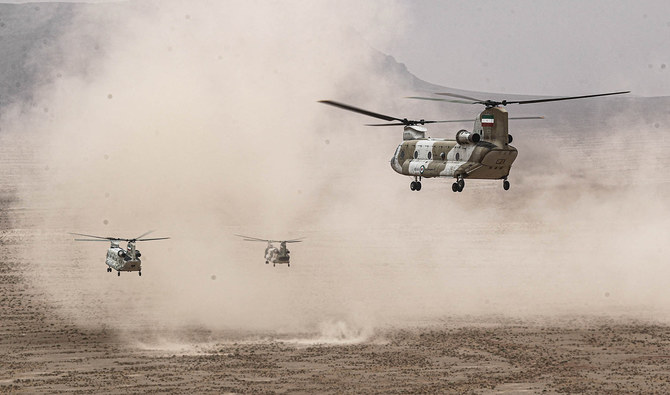
A handout picture provided by the Iranian Army media office on October 28, 2023 shows helicopters during a military drill in the Isfahan province in central Iran. (AFP/File)
2 / 2
Pakistani soldiers stand next to the closed border of Pakistan-Iran in Taftan on February 25, 2020. (AFP/File)
Short Url
Updated 16 January 2024
Follow

Iran says it has launched attacks on what it calls militant bases in Pakistan

  • Confusion followed announcement as some reports of attack disappeared on Iranian state media
  • Iran’s state media said missiles, drones were used in attack which was not acknowledged by Pakistan

JERUSALEM: Iran launched attacks Tuesday in Pakistan targeting what it described as bases for the militant group Jaish Al-Adl, state media reported, potentially further raising tensions in a Middle East already roiled by Israel’s war on Hamas in the Gaza Strip.

Confusion followed the announcements as some of the reports soon disappeared. However, any attack inside of nuclear-armed Pakistan by Iran would threaten the relations between the two countries, which long have eyed each other with suspicion.

The state-run IRNA news agency and state television had said that missiles and drones were used in the attack, which was not immediately acknowledged by Pakistan. Jaish Al-Adl is a militant group which largely operates across the border in Pakistan.

Reports were then suddenly removed without explanation, though the semi-official Fars and Tasnim news agencies still ran nearly identical stories on their websites Tuesday night. Press TV, the English-language arm of Iranian state television, later attributed the attack to Iran’s paramilitary Revolutionary Guard.

Authorities offered no explanation of what was happening, though sensitive stories in Iran can suddenly disappear from state media.

Officials in Pakistan did not immediately respond to requests for comment.

Late Monday, Iran fired missiles into Iraq at what it called an Israeli “spy headquarters” near the US Consulate compound in the city of Irbil, the seat of Iraq’s northern semi-autonomous Kurdish region, and at targets linked to the extremist Daesh group in northern Syria.

Iraq on Tuesday called the attacks, which killed several civilians, a “blatant violation” of Iraq’s sovereignty and recalled its ambassador from Tehran.


Sindh assembly passes resolution rejecting move to separate Karachi

Updated 21 February 2026
Follow

Sindh assembly passes resolution rejecting move to separate Karachi

  • Chief Minister Shah cites constitutional safeguards against altering provincial boundaries
  • Calls to separate Karachi intensified amid governance concerns after a mall fire last month

ISLAMABAD: The provincial assembly of Pakistan’s southern Sindh province on Saturday passed a resolution rejecting any move to separate Karachi, declaring its territorial integrity “non-negotiable” amid political calls to carve the city out as a separate administrative unit.

The resolution comes after fresh demands by the Muttahida Qaumi Movement (MQM) and other voices to grant Karachi provincial or federal status following governance challenges highlighted by the deadly Gul Plaza fire earlier this year that killed 80 people.

Karachi, Pakistan’s largest and most densely populated city, is the country’s main commercial hub and contributes a significant share to the national economy.

Chief Minister Syed Murad Ali Shah tabled the resolution in the assembly, condemning what he described as “divisive statements” about breaking up Sindh or detaching Karachi.

“The province that played a foundational role in the creation of Pakistan cannot allow the fragmentation of its own historic homeland,” Shah told lawmakers, adding that any attempt to divide Sindh or separate Karachi was contrary to the constitution and democratic norms.

Citing Article 239 of Pakistan’s 1973 Constitution, which requires the consent of not less than two-thirds of a provincial assembly to alter provincial boundaries, Shah said any such move could not proceed without the assembly’s approval.

“If any such move is attempted, it is this Assembly — by a two-thirds majority — that will decide,” he said.

The resolution reaffirmed that Karachi would “forever remain” an integral part of Sindh and directed the provincial government to forward the motion to the president, prime minister and parliamentary leadership for record.

Shah said the resolution was not aimed at anyone but referred to the shifting stance of MQM in the debate while warning that opposing the resolution would amount to supporting the division of Sindh.

The party has been a major political force in Karachi with a significant vote bank in the city and has frequently criticized Shah’s provincial administration over its governance of Pakistan’s largest metropolis.

Taha Ahmed Khan, a senior MQM leader, acknowledged that his party had “presented its demand openly on television channels with clear and logical arguments” to separate Karachi from Sindh.

“It is a purely constitutional debate,” he told Arab News by phone. “We are aware that the Pakistan Peoples Party, which rules the province, holds a two-thirds majority and that a new province cannot be created at this stage. But that does not mean new provinces can never be formed.”

Calls to alter Karachi’s status have periodically surfaced amid longstanding complaints over governance, infrastructure and administrative control in the megacity, though no formal proposal to redraw provincial boundaries has been introduced at the federal level.