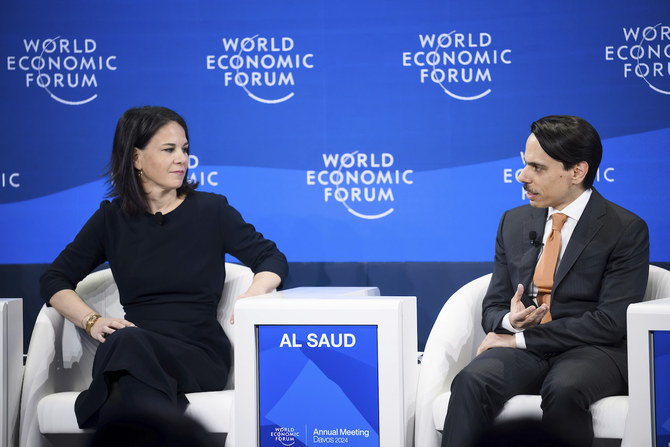
LONDON: Saudi Arabia is “incredibly concerned” about regional security following Houthi attacks on international shipping in the Red Sea and the situation in Gaza, the Kingdom’s foreign minister said on Tuesday at the World Economic Forum in Davos, Switzerland.
Prince Faisal bin Farhan told a panel titled “Securing an Insecure World” that de-escalation in the Red Sea is essential, and that Riyadh will continue to “engage with all stakeholders” after US and UK airstrikes against Houthi positions in Yemen last week.
While “clearly connected with the war in Gaza,” it is important that the conflict in the Palestinian enclave is addressed separately, he said.
“We need to focus on the war in Gaza not because of the Red Sea,” he told the panel. “We need to focus on the war in Gaza because of its impact on the Palestinians, first, but on regional security in general and on the risks it poses for further escalation.”
Prince Faisal said since Israel began military operations in Gaza, nearly 30,000 Palestinians have died and humanitarian aid is still being heavily restricted, but he has “not seen any real sign” that Tel Aviv is achieving its strategic objectives.
He praised parts of the international community for “moving more in the direction” of calling for a cease-fire, adding that peace between the two sides “will resolve many of the challenges that we have in the region.”
German Foreign Minister Annalena Baerbock called the war “a total disaster” and reiterated that the “only way out” of the ongoing situation is a two-state solution.
However, she said “a cease-fire, unfortunately, doesn’t fall from the sky” and can only be achieved if both sides “are ready.”
Baerbock said a “vicious circle” of blame is preventing a cease-fire from happening, but insisted that first and foremost, Hamas needs to lay down its weapons and release all remaining hostages in Gaza.
“The answer is there on the table,” she said. “But we can’t ignore that the majority of hostages are still (with) Hamas.”
US Sen. Christopher Coons said he is “optimistic” that peace can be achieved based on talks between American senators and Saudi Crown Prince Mohammed bin Salman in Riyadh in 2023, as well as meetings with Israeli Prime Minister Benjamin Netanyahu in Tel Aviv and Egyptian President Abdel-Fatah El-Sisi in Cairo.
However, Coons added that conditions in Gaza are worsening daily, and that Netanyahu has built a political career out of opposing a two-state solution.
Prince Faisal said he is heartened by the “concrete agreement” among major nations that the current situation is untenable, adding: “We need to translate that into action.”
He said Riyadh will continue to work with Washington “toward a much better future for the region,” and raised the possibility of future Saudi recognition of Israel if peace with the Palestinians could be reached.
Coons hinted that a series of elections in Western countries in 2024 could potentially affect the shape of the current set of Middle East crises.
He said Iran’s role in conflicts ranging from Yemen to Ukraine needs to be recognized, but talked down any possibility that a return to the White House for former President Donald Trump would lead to a US withdrawal from NATO. “The US rarely ratifies defense treaties, but when we do, we keep them,” Coons said.
Citing growing concerns about inter-regional conflicts, NATO Secretary-General Jens Stoltenberg said: “What happens in Asia matters for Europe.”
He also noted that Iran is aiding Russia in Ukraine, selling Moscow military drones and helping it construct drone and munitions facilities in Tatarstan.
But he said there is cause for optimism for Ukrainians, noting Russia’s failure to make major progress following the early days of the invasion, and highlighting Kyiv’s success in opening up channels for the export of grain through the Black Sea.
Finnish Foreign Minister Elina Valtonen said nobody wants to live in a world “where only the strongest survive,” adding that her country had felt compelled to join NATO because of Russia’s aggression, highlighting Moscow’s use of “hybrid strategies” to push “third-party citizens” from other countries into Europe via Finland’s border.
Pointing to Finland’s right to security, Nigerian Foreign Minister Yussuf Tuggar said: “What the minister says could apply just as much to Palestine — they have the right.”
He said the world needs to see concrete changes in the makeup of global security institutions, bemoaning a decline in international diplomacy, and adding that a country such as Nigeria should have a place on the UN Security Council. The UNSC “needs to democratize,” Tuggar said. “Clearly it isn’t fit for purpose.”
He added: “Nigeria is a large country. It’s the most populous country on the continent of Africa. It has a population of 220 million people — it’s going to be 400 million by the year 2050. It belongs in the UN Security Council.”