

Pakistani PM in Davos as annual World Economic Forum meeting kicks off

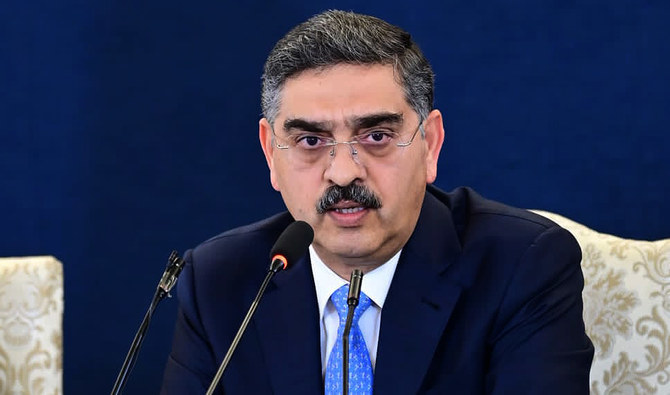
Caretaker Prime Minister Anwaar-ul-Haq Kakar speaks during a media briefing at the Prime Minister's House in Islamabad on August 31, 2023. (Photo courtesy: Government of Pakistan/File)
Short Url
Updated 16 January 2024
Follow

Pakistani PM in Davos as annual World Economic Forum meeting kicks off

  • Meeting takes place as global economy faces year of subdued growth prospects, uncertainty stemming from geopolitical strife
  • PM Kakar to attend three thematic events on global conflicts, economic fracture and restoring faith in the global system

ISLAMABAD: The 54th annual meeting of the World Economic Forum has kicked off in Davos, Switzerland, Radio Pakistan reported on Tuesday, with Caretaker Prime Minister Anwaar-ul-Haq Kakar representing Pakistan at the global conference. 

The meeting takes place as the global economy faces a year of subdued growth prospects and uncertainty stemming from geopolitical strife, tight financing conditions and the disruptive impact of artificial intelligence, according to an annual survey of top economists conducted each year ahead of the WEF meeting in the Swiss resort of Davos and released on Monday.

“The Prime Minister will attend three key thematic events: Preventing an Era of Global Conflicts, Restoring Faith in the Global System and Preventing Economic Fracture,” Radio Pakistan reported. “He will deliver a keynote address on the theme Trade, Tax, Trillion Dollar Promise.”

Kakar is also expected to hold meetings with government and business leaders on the sidelines of the forum, which will go on until Friday.
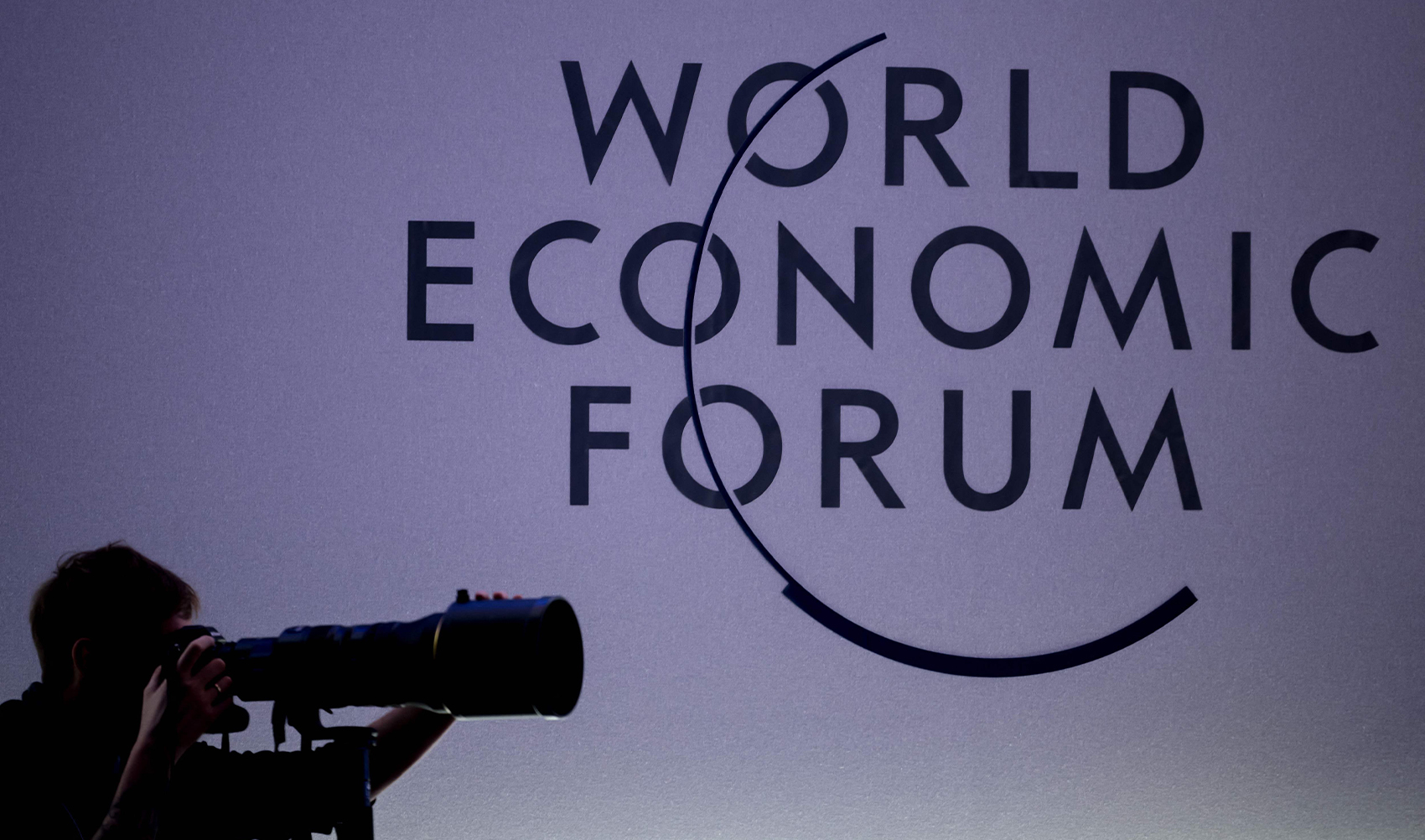


A press photographer works next to the logo of the World Economic Forum (WEF) at the opening of their annual meeting in Davos on January 15, 2024. (AFP)

Over 60 heads of state and government, including Israeli President Isaac Herzog and Ukrainian President Volodymyr Zelensky, are attending Davos this year to hold both public appearances and closed-door talks. They will be be among more than 2,800 attendees, including academics, artists and international organization leaders.

The gathering is a venue to connect decision-makers in an array of fields and industries but is often panned by critics as an emblem of the yawning gap between the rich and the poor: Young Swiss Socialists staged a rally Sunday to blast the forum and brand attendees as “the richest and most powerful, who are responsible for today’s wars and crises.”

While Davos is generally big picture, regional conflict can cast a long shadow, as the war in Ukraine did a year ago, prompting organizers to exclude any Russian delegation. This year, Israel’s three-month war in Gaza, plus US and British airstrikes on Houthi militants in Yemen who have fired missiles into Red Sea shipping lanes, are looming large.

Herzog, the Israeli president, whose job is more ceremonial than Prime Minister Benjamin Netanyahu’s, will be on hand for a Davos session Thursday, and the prime ministers of Qatar, Jordan and Lebanon also will be attending. A “humanitarian briefing on Gaza” session gets a half-hour slot Tuesday.


Pakistan reports current account surplus in Jan. owing to improved trade, remittances

Updated 17 February 2026
Follow

Pakistan reports current account surplus in Jan. owing to improved trade, remittances

  • Pakistan’s exports crossed the $3 billion mark in Jan. as the country received $3.5 billion in remittances
  • Last month, IMF urged Pakistan to accelerate pace of structural reforms to strengthen economic growth

ISLAMABAD: Pakistan recorded a current account surplus of more than $120 million in January, the country’s finance adviser said on Tuesday, attributing it to improved trade balance and remittance inflows.

Pakistan’s exports rebounded in January 2026 after five months of weak performance, rising 3.73 percent year on year and surging 34.96 percent month on month, according to data released by the country’s statistics bureau.

Exports crossed the $3 billion mark for the first time in January to reach $3.061 billion, compared to $2.27 billion in Dec. 2025. The country received $3.5 billion in foreign remittances in Jan. 2026.

Khurram Schehzad, an adviser to the finance minister, said Pakistan reported a current account surplus of $121 million in Jan., compared to a current account deficit of $393 million in the same month last year.

“Improved trade balance in January 2026, strong remittance inflows, and sustained momentum in services exports (IT/Tech) continue to reinforce the country’s external account position,” he said on X.

Pakistan has undergone a difficult period of stabilization, marked by inflation, currency depreciation and financing gaps, and international rating agencies have acknowledged improvements after Islamabad began implementing reforms such as privatizing loss-making, state-owned enterprises (SOEs) and ending subsidies as part of a $7 billion International Monetary Fund (IMF) loan program.

Late last month, the IMF urged Pakistan to accelerate the pace of these structural reforms to strengthen economic growth.

Responding to questions from Arab News at a virtual media roundtable on emerging markets’ resilience, IMF’s director of the Middle East and Central Asia Jihad Azour said Islamabad’s implementation of the IMF requirements had been “strong” despite devastating floods that killed more than 1,000 people and devastated farmland, forcing the government to revise its 4.2 percent growth target to 3.9 percent.

“What is important going forward in order to strengthen growth and to maintain the level of macroeconomic stability is to accelerate the structural reforms,” he said at the meeting.

Azour underlined Pakistan’s plans to privatize some of the SOEs and improve financial management of important public entities, particularly power companies, as an important way for the country to boost its capacity to cater to the economy for additional exports.

“This comes in addition to the effort that the authorities have made in order to reform their tariffs, which will allow the private sector of Pakistan to become more competitive,” the IMF official said.