

Hamas airs video purporting to show two Israeli hostages killed in captivity

1 / 2
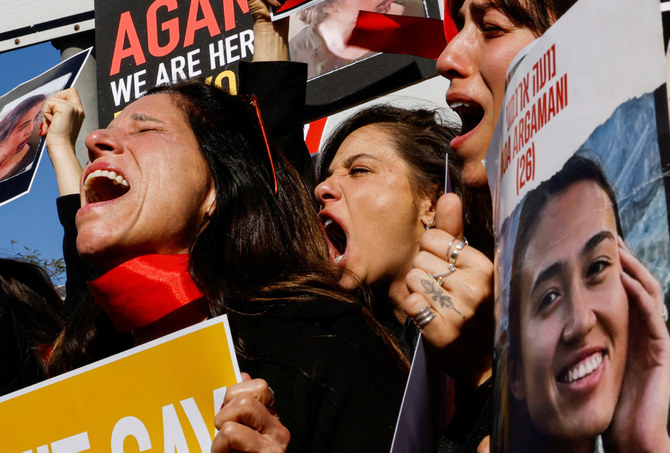
(From left to right): Yossi Sharabi, Noa Argamani & Itai Svirsky. (Photo/Social media)
2 / 2
People take part in a protest in support of the release and protection of hostages held in Gaza, kidnapped by Palestinian Islamist group Hamas gunmen during the October 7 attack, amid the ongoing conflict between Israel and Hamas, near Urim, southern Israel, January 12, 2024. (REUTERS)
Short Url
Updated 16 January 2024
Follow

Hamas airs video purporting to show two Israeli hostages killed in captivity

  • Aragamani said in the video that they were killed by Israeli strikes, while she was injured
  • Israeli Defense Minister Yoav Gallant said on Monday that Hamas carries out “psychological abuse” with its handling of the hostages

DOHA/GAZA/JERUSALEM: Hamas appeared to show the dead bodies of two Israeli hostages on Monday after warning Israel they might be killed if it did not stop its bombardment of Gaza.
A new video released by the Palestinian militant group purportedly showed the bodies of Yossi Sharabi, 53, and Itai Svirsky, 38, who had appeared in an initial video on Sunday.
It also showed a third Israeli hostage, university student Noa Argamani, 26, seemingly reading a script in front of a blank white wall, saying the two were killed by Israeli strikes.
Israel’s military spokesperson said there was serious concern regarding the fate of the hostages purported to be dead in the video, while specifying that one of them, whom he identified as Svirsky, was not killed by Israeli fire.
“Itai was not shot by our forces. That is a Hamas lie. The building in which they were held was not a target and it was not attacked by our forces,” said military spokesperson Rear Admiral Daniel Hagari, who did not give the name or any details about the second person as per the family’s request.
“We don’t attack a place if we know there may be hostages inside,” he said, adding that areas nearby had been targeted.
Reuters was unable to verify what had happened to the three, who were among some 240 people taken hostage by Islamist Hamas militants during a surprise cross-border rampage into southern Israel on Oct. 7.
Around half of those hostages were released during a short-lived November truce, but Israel says 132 remain in Gaza and that 25 have died in captivity.
The three Israelis were shown in a Hamas video on Sunday in which the group urged the Israeli government to halt its aerial and ground offensive and bring about their release.
It ended with the caption: “Tomorrow (Monday) we will inform you of their fate.”
Israeli officials have generally declined to respond to Hamas’ public messaging on the hostages.
Forensic officials have said that autopsies of slain hostages who had been recovered found causes of death inconsistent with Hamas’ account they had died in air strikes.
Israel has also made clear it is aware of the risks to hostages from its offensive, and is taking precautions.

BOMBARDMENT INTENSIFIES
As night fell, residents said Israeli planes and tanks intensified their bombardment again across Gaza.
In Al-Bureij in central Gaza, medics said an Israeli missile strike killed four people and wounded others, while in the Tel Al-Hawa suburb of Gaza City in the north, they said two people were killed and others wounded by an Israeli strike.
Israel’s military said it had withdrawn another division of troops as part of plans for more targeted operations against Hams leaders in the south after an initial all-out offensive centered on the heavily built-up northern end of the Strip.
Israeli Defense Minister Yoav Gallant, speaking around the same time as the latest hostage video was shown, said intense military operations in southern Gaza were almost over, but that Hamas would not agree to release any more hostages without military pressure.
The armed wing of Hamas said its fighters had ambushed and killed five Israeli soldiers in the southern city of Khan Younis. Palestinian health officials said earlier that seven people had been killed and others hurt in an Israeli air strike near the city’s Nasser hospital.
Israel’s campaign in Gaza since the Oct. 7 Hamas assault has turned much of the Palestinian territory into a wasteland and killed, health officials say, some 24,100 people and wounded nearly 61,000.
Health officials said 132 were killed in the past 24 hours, suggesting to Palestinians that there has been little let-up in the intensity of Israel’s offensive despite its announcement of a shift to the new, more targeted phase.
Almost two million displaced people are sheltering in tents and other temporary accommodation in southern Gaza amid the fighting, and are facing increased risks of starvation and disease due to chronic shortages of food, fuel and medicines.

VIOLENCE SPREADS
The more than three-month-old conflict has intensified violence in the Israeli-occupied West Bank and in the wider Middle East and on Monday it reached further into Israel.
Palestinians carried out coordinated car-rammings in the central Israeli town of Raanana, killing a woman and injuring 12 other people, police and medical officials said. France said two of its nationals were among the injured.
The two suspects were from the same family in Hebron in the Israeli-occupied West Bank and at least one of the vehicles used in the attacks had been stolen, police said.
Sami Abu Zuhri, head of Hamas’ political unit in exile, told Reuters the incidents were linked to Israeli “crimes” and were further evidence that the conflict was expanding.
Violence has also flared in the West Bank, run by the internationally-recognized Palestinian Authority, where the health ministry says 351 people have been killed as Israel conducts raids that it says are aimed at flushing out militants.
A man and a woman were killed on Monday by Israeli gunfire in Dora near Hebron during what Palestinian official news agency WAFA said were stone-throwing clashes that erupted after Israeli forces raided the town. Separately, WAFA said a Palestinian security officer, Mahmoud Abdullah Khalifa, was killed near the West Bank town of Tulkarm.
Further afield, Houthi fighters who control much of Yemen have stepped up attacks on ships in the Red Sea it says are linked to Israel out of what they say is solidarity with the people of Gaza.
On Monday they damaged a US-owned vessel carrying steel products with an anti-ship ballistic missile south of the Yemeni port of Aden, saying they were expanding their targets after US and British air strikes on their positions in Yemen.


‘No one to back us’: Arab bus drivers in Israel grapple with racist attacks

Updated 18 February 2026
Follow

‘No one to back us’: Arab bus drivers in Israel grapple with racist attacks

  • “People began running toward me and shouting at me, ‘Arab, Arab!’” recalled Khatib, a Palestinian from east Jerusalem

JERUSALEM: What began as an ordinary shift for Jerusalem bus driver Fakhri Khatib ended hours later in tragedy.
A chaotic spiral of events, symptomatic of a surge in racist violence targeting Arab bus drivers in Israel, led to the death of a teenager, Khatib’s arrest and calls for him to be charged with aggravated murder.
His case is an extreme one, but it sheds light on a trend bus drivers have been grappling with for years, with a union counting scores of assaults in Jerusalem alone and advocates lamenting what they describe as an anaemic police response.

Palestinian women wait for a bus at a stop near Israel's controversial separation barrier in the Dahiat al-Barit suburb of east Jerusalem on February 15, 2026. (AFP)

One evening in early January, Khatib found his bus surrounded as he drove near the route of a protest by Israel’s ultra-Orthodox Jewish community.
“People began running toward me and shouting at me, ‘Arab, Arab!’” recalled Khatib, a Palestinian from east Jerusalem.
“They were cursing at me and spitting on me, I became very afraid,” he told AFP.
Khatib said he called the police, fearing for his life after seeing soaring numbers of attacks against bus drivers in recent months.
But when no police arrived after a few minutes, Khatib decided to drive off to escape the crowd, unaware that 14-year-old Yosef Eisenthal was holding onto his front bumper.
The Jewish teenager was killed in the incident and Khatib arrested.
Police initially sought charges of aggravated murder but later downgraded them to negligent homicide.
Khatib was released from house arrest in mid-January and is awaiting the final charge.

Breaking windows

Drivers say the violence has spiralled since the start of the Gaza war in October 2023 and continued despite the ceasefire, accusing the state of not doing enough to stamp it out or hold perpetrators to account.
The issue predominantly affects Palestinians from annexed east Jerusalem and the country’s Arab minority, Palestinians who remained in what is now Israel after its creation in 1948 and who make up about a fifth of the population.
Many bus drivers in cities such as Jerusalem and Haifa are Palestinian.
There are no official figures tracking racist attacks against bus drivers in Israel.
But according to the union Koach LaOvdim, or Power to the Workers, which represents around 5,000 of Israel’s roughly 20,000 bus drivers, last year saw a 30 percent increase in attacks.
In Jerusalem alone, Koach LaOvdim recorded 100 cases of physical assault in which a driver had to be evacuated for medical care.
Verbal incidents, the union said, were too numerous to count.
Drivers told AFP that football matches were often flashpoints for attacks — the most notorious being those of the Beitar Jerusalem club, some of whose fans have a reputation for anti-Arab violence.
The situation got so bad at the end of last year that the Israeli-Palestinian grassroots group Standing Together organized a “protective presence” on buses, a tactic normally used to deter settler violence against Palestinians in the Israeli-occupied West Bank.
One evening in early February, a handful of progressive activists boarded buses outside Jerusalem’s Teddy Stadium to document instances of violence and defuse the situation if necessary.
“We can see that it escalates sometimes toward breaking windows or hurting the bus drivers,” activist Elyashiv Newman told AFP.
Outside the stadium, an AFP journalist saw young football fans kicking, hitting and shouting at a bus.
One driver, speaking on condition of anonymity, blamed far-right National Security Minister Itamar Ben Gvir for whipping up the violence.
“We have no one to back us, only God.”

‘Crossing a red line’ 

“What hurts us is not only the racism, but the police handling of this matter,” said Mohamed Hresh, a 39-year-old Arab-Israeli bus driver who is also a leader within Koach LaOvdim.
He condemned a lack of arrests despite video evidence of assaults, and the fact that authorities dropped the vast majority of cases without charging anyone.
Israeli police did not respond to AFP requests for comment on the matter.
In early February, the transport ministry launched a pilot bus security unit in several cities including Jerusalem, where rapid-response motorcycle teams will work in coordination with police.
Transport Minister Miri Regev said the move came as violence on public transport was “crossing a red line” in the country.
Micha Vaknin, 50, a Jewish bus driver and also a leader within Koach LaOvdim, welcomed the move as a first step.
For him and his colleague Hresh, solidarity among Jewish and Arab drivers in the face of rising division was crucial for change.
“We will have to stay together,” Vaknin said, “not be torn apart.”