

Arab League plans emergency session to discuss repercussions of Ethiopia-Somaliland agreement

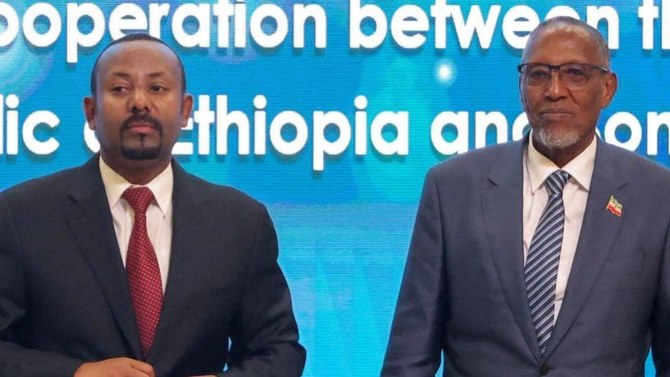
Ethiopia’s Prime Minister Abiy Ahmed and Somaliland leader Muse Bihi Abdi. (Reuters)
Short Url
Updated 15 January 2024
Follow

Arab League plans emergency session to discuss repercussions of Ethiopia-Somaliland agreement

  • Meeting of foreign ministers convened at the request of Somalia and with the support of 12 Arab countries
  • Ethiopia to gain naval and commercial access to Somaliland’s Berbera port in exchange for recognition of the region’s independence

CAIRO: The Arab League has called an emergency meeting via video conference on Wednesday to discuss the implications of the recent memorandum of understanding signed by Ethiopia and Somaliland.

Ambassador Hossam Zaki, assistant secretary-general of the league, said the meeting of foreign ministers had been convened at the request of Somalia and with the support of 12 Arab countries.

He said Somalia had submitted an explanatory memorandum with complete consensus supporting its position.

Morocco, the current president of the ordinary session of the Arab League Council, will chair the meeting.

Arab League Secretary-General Ahmed Aboul Gheit will meet Somali leader Hassan Sheikh Mohamud if he is in Cairo during the president’s upcoming visit, added Zaki.

Elias Sheikh Omar Abu Bakr, Somalia’s ambassador to Egypt and permanent representative to the league, announced on Jan. 4 that his country had submitted a request for an emergency meeting.

The ambassador stressed the need to take a unified Arab position to respond to the “blatant violation carried out by Ethiopia against the sovereignty and territorial integrity of Somalia.”

He said Ethiopia’s “unilateral measures constituted a threat to Arab national security and navigation in the Red Sea,” and criticized the memorandum as an attempt to undermine Somalia’s sovereignty, independence, and unity.

The ambassador called on Arab countries to defend Somalia’s sovereignty and territorial integrity under international resolutions and laws, while stressing the importance of adhering to the rules of good neighborliness to enhance peace, security, and stability in the Horn of Africa region.

He said the step taken by Ethiopia represented a blatant violation of Somali sovereignty and further inflamed the situation in the region, and warned of the consequences of the move.

The Arab League and the Arab Parliament on Jan. 3 joined the Somali government in condemning the controversial deal between Ethiopia and Somaliland, which declared its independence from Somalia in 1991.

The Arab League said the memorandum of understanding violated Somalia’s sovereignty and territorial integrity.

Ethiopia signed an agreement on Jan. 1 granting it naval and commercial access to a port on Somaliland’s coast in exchange for recognition of the breakaway region’s independence.

The memorandum, which was signed by Ethiopia’s Prime Minister Abiy Ahmed and Somaliland leader Muse Bihi Abdi, gives Ethiopia access to the Red Sea port of Berbera.


Paraguay lawmakers approve defense agreement allowing an increased US military presence

Updated 5 sec ago
Follow

Paraguay lawmakers approve defense agreement allowing an increased US military presence

ASUNCIÓN: Paraguay’s Chamber of Deputies on Tuesday approved a defense agreement allowing the temporary presence of US military and civilian personnel inside its borders, widely seen as a victory for the Trump administration, which has sought to strengthen its presence in Latin America.
The Status of Forces Agreement, or SOFA, was approved by a large majority of lawmakers and now awaits the signature of President Santiago Peña to take effect. Peña, one of Trump’s closest allies in the region, is expected to sign the deal in the coming days.
The agreement passed with 53 votes in favor and eight against, and four abstentions out of a total 80 lawmakers. Fifteen were not present for the vote.
Signed by both countries in Washington in December, the agreement establishes a legal framework for the presence of US security forces in Paraguay for training, joint exercises, and humanitarian assistance. It also authorizes the United States to have criminal jurisdiction over its personnel while in the country.
The treaty, praised as “historic” by both the US State Department and Paraguayan Foreign Minister Rubén Ramírez Lezcano, was approved by the Paraguayan Senate last week, where debate was more polarized due to concerns over potential violations of sovereignty.
Some legislators argued against the agreement, citing a controversial provision to grant foreign troops immunity from prosecution, equivalent to that handed to diplomatic personnel.
“We believe in international cooperation, but we also believe in strong states, respected institutions and real democratic sovereignty,” said independent congressman Raúl Benítez.
Despite criticisms, Paraguay’s foreign minister backed the agreement, arguing in December that its main purpose is to strengthen cooperation between the United States and Paraguay in fighting transnational organized crime and “terrorism.” He also clarified that “there is no possibility of the installation of US military bases” in Paraguay.
Washington has also praised SOFA, with US Secretary of State Marco Rubio calling it a “historic agreement” that would help facilitate bilateral and multinational training, humanitarian assistance, disaster response, and other shared security interests.
The approval of SOFA comes as Washington seeks to expand its influence in Latin America under the Trump administration’s national security strategy and as a sector of civil society in Paraguay continues to raise its voice against it.
“The security of a country is not built by importing troops or shielding foreign agents with diplomatic immunities,” said Peace and Justice Service, a civil organization which has a presence across Latin America, in a statement released days before the final vote. The treaty, it added, “does not represent progress in security, but rather the formalization of a geopolitics of impunity that undermines the pillars of our national dignity.”