

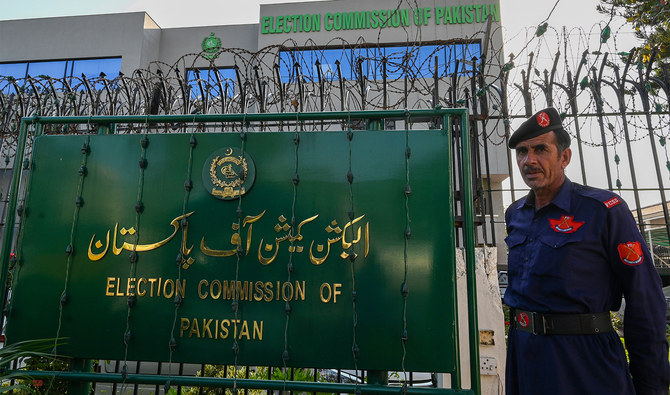

ISLAMABAD: Pakistan’s election regulator has categorically told the Senate that “it will not be advisable” for it to postpone polls beyond Feb. 8, days after a resolution in the upper house sought postponing polls in the South Asian country due to poor weather and security challenges.
The non-binding resolution was passed on Friday in the Senate, calling for polls to be delayed out of fear that elections in the cold month of February would trigger a low voter turnout, especially in the northwestern Khyber Pakhtunkhwa (KP) and southwestern Balochistan provinces.
The resolution was presented by Dilawar Khan, an independent senator from KP, who also cited recent attacks on politicians in the province as another reason to postpone polls. It was passed when only 14 senators out of 100 were present in the upper house of Pakistan’s parliament, according to media reports.
In a letter addressed to the joint secretary of the Senate Secretariat on Jan. 13, ECP’s Additional Director General Elections Syed Nadeem Haider mentioned that the ECP had appointed Feb. 8 as the election date after consulting Pakistan’s president. It added that the ECP had also issued directions to the caretaker federal and provincial governments to beef up security arrangements and provide a “congenial environment” to the electorate for peaceful elections on Feb.8.
“ECP has made all necessary arrangements regarding the conduct of General Elections 2024,” the letter stated. It said that the election watchdog had also committed to Pakistan’s Supreme Court that it would hold polls on Feb. 8.
Responding to Khan’s reservation on polls being held during the extremely cold in KP and Balochistan, the ECP said general elections had been held in the past during the winter season.
“Sequel to the above narrated facts, it will not be advisable for the Commission to postpone General Elections 2024 at this stage,” the letter concluded.
Caretaker Information Minister Murtaza Solangi shared a copy of the letter on social media platform X, saying that the ECP is “committed” to hold elections on Feb. 8.
Elections in the politically and economically troubled South Asian nation were originally due to be held in November, 90 days after the dissolution of the lower house of parliament in August, but were first delayed to February due to the fresh demarcation of constituencies under a new census.
Pakistan is currently being run by a caretaker government under interim Prime Minister Anwaar-ul-Haq Kakar that is meant to oversee a general election.
Caretakers are usually limited to overseeing elections, but Kakar’s set-up is the most empowered in Pakistan’s history thanks to legislation that allows it to make policy decisions on economic matters.
Political analysts fear that a prolonged period without an elected government would allow the military, which has ruled Pakistan for over three decades since independence in 1947 and wields considerable control even if not in power, to consolidate control.
Fears of violence spreading ahead of polls were ignited last week when an election candidate, contesting the upcoming polls independently, was shot dead with two others in Pakistan’s northwestern Waziristan district. The same day, a Pakistan Muslim League-Nawaz (PML-N) former minister was critically wounded when gunmen opened fire on his vehicle in the southwestern Turbat district.
Pakistan’s western provinces bordering Afghanistan have seen a surge in militant violence since November 2022 when a fragile truce between the Pakistani Taliban and the state broke down.
The Pakistani Taliban have carried out some of the deadliest attacks against security forces and civilians in the country for the last decade-and-a-half. In a bid to impose its brand of strict Islamic law, the Pakistani Taliban have targeted political parties and their candidates, such as the Awami National Party (ANP) and the Pakistan Peoples Party (PPP) who position themselves as secular, progressive forces.



