

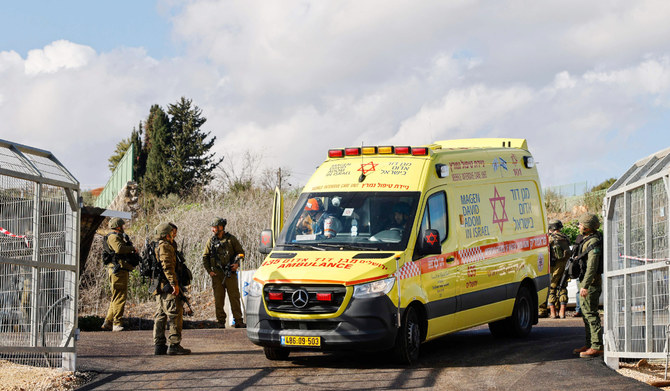

JERUSALEM: An anti-tank missile fired from Lebanon hit a home in northern Israel on Sunday, killing two civilians and renewing concerns about the risk of a second front erupting in the Israel-Hamas war.
The deadly strike near the border came on the 100th day of the conflict between Israel and Hamas that has killed nearly 24,000 Palestinians, devastated vast swaths of Gaza, driven around 85 percent of the territory’s 2.3 million residents from their homes and pushed a quarter of the population into starvation.
The war was triggered by Hamas’ Oct. 7 surprise attack into southern Israel in which militants killed some 1,200 people, mostly civilians, and took around 250 hostages, about half of whom are still in captivity.
Since then, tensions have soared across the region, with Israel trading fire almost daily with Lebanon’s Hezbollah militant group and Iranian-backed militias attacking US targets in Syria and Iraq. In addition, Yemen’s Houthi rebels have been targeting international shipping, drawing a wave of US airstrikes last week.
Sunday’s missile strike came a day after the Israeli army said it killed three militants who tried to infiltrate Israel.
Hezbollah’s leader, Hassan Nasrallah, said his group won’t stop until a ceasefire is in place for Gaza.
“We are continuing, and our front is inflicting losses on the enemy and putting pressure on displaced people,” Nasrallah said in a speech, referring to the tens of thousands of Israelis who have fled northern border areas.
The unprecedented level of death and destruction in Gaza has led South Africa to lodge allegations of genocide against Israel at the International Court of Justice. Israel denies the accusations and has vowed to press ahead with its offensive even if the court in The Hague issues an interim order for it to stop.
Israel has also vowed to return the more than 100 hostages still held in Gaza as Israeli leaders have faced mounting protests from hostages’ families, including a 24-hour rally in Tel Aviv that began Saturday evening and drew tens of thousands of supporters.
FEARS OF A SECOND FRONT
Israel and Hezbollah have been careful not to allow their back-and-forth fighting to erupt into full-blown war on a second front.
But they have come close on several occasions — most recently in the aftermath of an airstrike that killed a top Hamas official in Beirut on Jan. 2. Hamas and Hezbollah have both blamed Israel for the strike.
The latest attacks on Israel, including the deaths of the two civilians on Sunday, raised the likelihood of new Israeli reprisals. Late Sunday, the Israeli military said it had carried out a series of strikes on Hezbollah targets in Lebanon.
The army’s chief spokesman, Rear Adm. Daniel Hagari, said Israel would not tolerate attacks on civilians.
“The price will be extracted not just tonight, but also in the future,” Hagari said.
Earlier Sunday, the Lebanese missile hit a home in the town of Yuval, killing a man in his 40s and his mother, who was in her 70s, Israeli rescuers said.
Although Yuval is one of more than 40 towns along the northern border evacuated by the government in October, Israeli media reported that the family stayed in the area because they work in agriculture.
More than 115,000 Israelis have evacuated from northern Israel due to the ongoing tensions.
The deadly strike came hours after the army said it killed three militants who entered a disputed Israeli-controlled enclave in the Golan Heights.
A group called Islamic Glory Brigades claimed responsibility for the infiltration. The Associated Press could not independently verify the statement, and Hezbollah, Hamas and Islamic Jihad all said the group was not affiliated with them.
Tensions have also spread to the Israeli-occupied West Bank, where Palestinian health officials say nearly 350 Palestinians have been killed by Israeli fire in confrontations throughout the war.
On Sunday, the Israeli army said troops opened fire after a Palestinian car breached a military roadblock in the southern West Bank and an attacker fired at soldiers. Palestinian health officials said two Palestinians were killed.
US SHIELDS ISRAEL FROM CALLS FOR TRUCE
Israel has also been under growing international pressure to end the war in Gaza, but it has so far been shielded by US diplomatic and military support. Israel argues that any ceasefire would hand victory to Hamas, which has ruled Gaza since 2007 and is bent on Israel’s destruction.
Thousands took to the streets of Washington, London, Paris, Rome, Milan and Dublin on Saturday to demand an end to the war. Protesters converging on the White House held aloft signs criticizing President Joe Biden’s unwavering support for Israel.
In recent weeks, Israel has scaled back operations in northern Gaza, the initial target of the offensive, where weeks of airstrikes and ground operations left entire neighborhoods in ruins. Netanyahu said there are no immediate plans to allow hundreds of thousands of Palestinians to return to their homes there, after US Secretary of State Antony Blinken raised the issue during a visit to the region last week.
Meanwhile, Israel has launched major operations against the southern city of Khan Younis and built-up refugee camps in central Gaza.
“No one is able to move,” said Rami Abu Matouq, who lives in the Maghzai camp. “Warplanes, snipers and gunfire are everywhere.”
In the central town of Deir Al-Balah, health officials said at least 15 people were killed in Israeli strikes late Saturday.
At the entrance of the Al-Aqsa Martyrs Hospital, men lined up to pray for the dead, their bodies wrapped in white shrouds. The bodies were put on the back of a pickup truck before they were taken to be buried.
Meanwhile, the Egyptian TV station Al-Ghad said a cameraman was killed in an Israeli airstrike in northern Gaza. The channel said Yazan Al-Zwaidi was apparently in a crowd of people at the time. Details were not immediately available, and the Israeli military had no comment.
Meanwhile, the Internet advocacy group Netblocks said communications in Gaza were still out after a 48-hour outage. The Palestinian telecommunications operator in Gaza, Jawwal, said two of its employees were killed Saturday when they were hit by a shell while fixing lines in Khan Younis.
ISRAEL EYES EXPANDING OFFENSIVE
Netanyahu said Israel would eventually need to push further south and take control of Gaza’s border with Egypt, which Israeli officials say is still used by Hamas to smuggle in arms.
Egypt — which in recent years has fortified the border, demolished tunnels and established a buffer zone — insists it has full control of the border and that any such operation would have to be considered in light of agreements with Israel and the United States.
The area in and around the border town of Rafah is also packed with hundreds of thousands of Palestinians who fled from other parts of Gaza and are crowded into overflowing UN-run shelters and tent camps.
The Gaza Health Ministry said Sunday that hospitals had received 125 bodies in the last 24 hours, bringing the overall death toll to 23,968. The ministry does not differentiate between civilians and combatants but says around two-thirds of the dead are women and minors. It says over 60,000 people have been wounded.
Israel says Hamas is responsible for the high civilian casualties, saying its fighters make use of civilian buildings and launch attacks from densely populated urban areas. The military says 189 soldiers have been killed and 1,099 wounded since the start of the ground offensive.


