

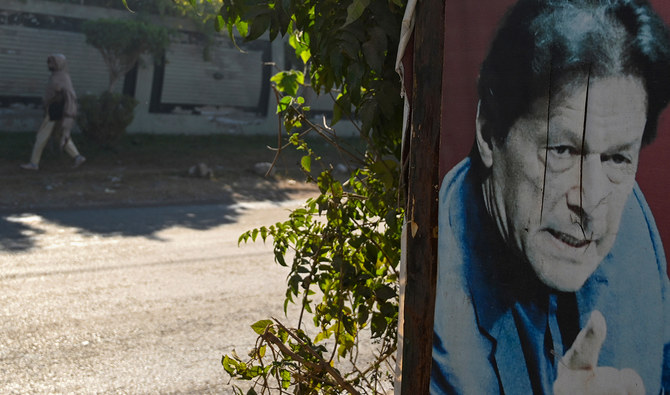

ISLAMABAD: Former prime minister Imran Khan’s Pakistan Tehreek-e-Insaf (PTI) party will come back stronger in the upcoming national elections, scheduled for February 8, a party spokesman said on Sunday, a day after the Pakistan top court stripped the party of its election symbol, a cricket bat.
The Supreme Court of Pakistan’s ruled on Saturday that the PTI was ineligible to retain the poll symbol due to its failure to conduct intraparty elections as mandated by the country’s election laws.
Consequently, PTI nominees will now participate in the national elections as independent candidates, with each one of them using a different electoral symbol. The ruling also denies the PTI a share in reserved seats for women and religious minorities in national and provincial legislatures, which are allotted on the basis of total seats won by political parties.
The Election Commission of Pakistan (ECP) revoked bat as the PTI’s election symbol on December 22, citing non-compliance with intraparty election rules. While the PTI initially secured a verdict in its favor by the Peshawar High Court (PHC), the election oversight body challenged it in the top court.
“This judgment is not based on true legal interpretation and is unconstitutional, because it has violated the fundamental rights of the citizens of Pakistan and political parties,” Shoaib Shaheen, a PTI spokesperson and a key member of Khan’s legal team, told Arab News.
“Recognizing Khan’s popularity, we anticipate that voters will support our candidates regardless of the symbol chosen.”
As part of its strategy under the present circumstances, the PTI would communicate to the masses the candidates backed by it in the elections, he said.
Election symbols are crucial in Pakistan where the adult literacy rate is just 58 percent, according to World Bank data.
The bat symbol is reflective of ex-PM Khan’s past as a successful cricketer, who led Pakistan to their only 50-over World Cup win in 1992, propelling him to an unrivaled position among the country’s cricket greats.
Shaheen, however, said the participation of candidates, backed by the party, as independents would result in the loss of reserved seats, which was a right inherent to every political party.
“It could also lead to public confusion, particularly among 70 percent illiterate voters who mostly rely on party symbols,” he added.
Political pundits say while the Supreme Court ruling came as a significant setback to the PTI, the party’s communication strategy remains robust and it continues to benefit from the public support.
“The real loss is that of the party losing out on reserved seats for women and non-Muslim minorities,” Aasiya Riaz, an analyst, told Arab News.
Due to this, the PTI will not be able to emerge as a solid bloc in any of the national and provincial assemblies, according to Riaz.
“There would be further challenges like the party legislators would not be bound by party discipline, especially for the election of leaders of houses immediately after the election, and could be more susceptible to outside pressure,” she pointed out.
Barrister Muhammad Shoaib Razzaq, a legal expert, said the PTI would lose more than 100 reserved seats in national and provincial legislatures, which would ultimately impact its ability to form a government under any circumstances.
“The PTI has incurred a significant loss, an outcome aligned with the intentions of both the establishment and the election commission,” Razzaq told Arab News.
He highlighted another impact would be the absence of coordinated efforts by more than two candidates in a single constituency, coupled with different symbols for national and provincial assembly seats, leading to potential voter confusion.
Political parties and their members in Pakistan are often tangled in legal proceedings that rights monitors say are orchestrated by the powerful military, which has ruled the country directly for more than half of its history and continues to enjoy immense power.
Khan’s PTI party has also been struggling against a widespread crackdown, with leading party figures either jailed or forced to leave the party.
The ex-premier, who has been locked up since August on graft charges, has accused Pakistan’s powerful military, the ECP, and his political rivals of colluding to keep him and the PTI out of elections. All three deny the allegation.


