

New Zealand beat Pakistan by 21 runs to take control of T20 series

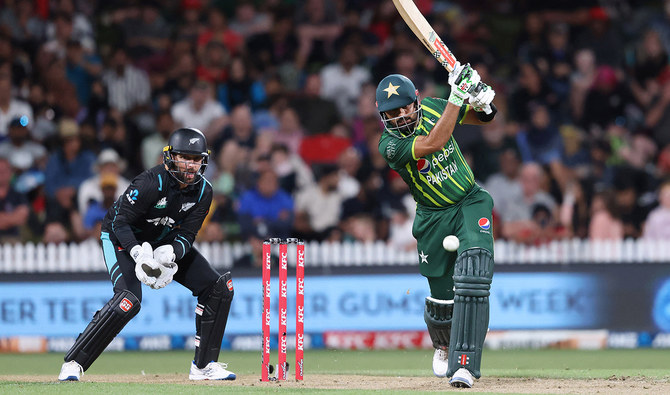
Pakistan's Babar Azam bats while being watched by New Zealand wicketkeeper Devon Conway (L) during the second Twenty20 international cricket match between New Zealand and Pakistan at Seddon Park in Hamilton on January 14, 2024. (AFP)
Short Url
Updated 14 January 2024
Follow

New Zealand beat Pakistan by 21 runs to take control of T20 series

  • Adam Milne takes four to inspire New Zealand to take 2-0 lead in series
  • Pakistani batters Babar Azam, Fakhar Zaman scored half-centuries 

HAMILTON: Pace bowler Adam Milne claimed four wickets as New Zealand beat Pakistan by 21 runs in the second Twenty20 international Sunday to take a 2-0 series lead.

The tourists threw away a strong position in their run chase after Babar Azam and Fakhar Zaman scored half-centuries as they were dismissed for 173 in the final over, in response to New Zealand’s 194-8.

Victory came at a cost for the Black Caps, whose captain Kane Williamson retired hurt with a hamstring injury while batting, placing him in doubt for the remainder of the five-match series.

The match bore similarities to New Zealand’s 46-run win in the opening match in Auckland on Friday, with their attack taking wickets at regular intervals to deny Pakistan a foothold in their chase.

However, the target looked within sight before Fakhar was bowled by Milne for a power-packed 50 off 25 balls in the 10th over, leaving Pakistan 97-3.

They struggled from that point, with only Babar looking a threat until he was caught off Ben Sears for 66.

Milne finished with 4-33, having earlier removed the dangerous Mohammad Rizwan as Pakistan lost both openers with just 10 runs on the board.

New Zealand were again asked to bat first and Finn Allen took on the visitors’ attack, blasting five sixes in his 74 off 41 balls to dominate the innings.

Well placed at 111 for one at the midway point, the Black Caps suffered a major setback soon afterwards when Williamson was forced to retire hurt for 26.

There will be concern it is a continuation of the spate of injuries the veteran skipper has suffered in the last year.

A long-standing knee problem ruled the 33-year-old out of both white ball series at home to Bangladesh in December.

Allen powered on in trademark big-hitting fashion before being bowled by leg-spinner Usama Mir.

New Zealand’s remaining batters struggled, with pace bowler Haris Rauf particularly adept over the closing overs, finishing with 3-38.

Spinner Mitchell Santner replaced seamer Matt Henry in New Zealand’s only change from the Auckland match, while Pakistan fielded the same team.


High energy prices dull Ramadan boom for Pakistan’s glass bangle industry

Updated 5 sec ago
Follow

High energy prices dull Ramadan boom for Pakistan’s glass bangle industry

  • Producers say gas prices up 92% in two years as industry operates at half capacity
  • Hyderabad manufacturers warn 200,000 jobs at risk without tax and tariff relief

Hyderabad/Karachi: In a cramped room in Hyderabad’s historic Choori Gali, 50-year-old Farmida Khalid carefully joins the two open ends of a glass bangle over the flames of oil lamps, working alongside her children in sweltering heat to complete nearly 3,000 bangles a day.

For generations, glass bangles have been a staple of festive shopping in Pakistan, with women buying brightly colored sets during the final days of Ramadan and ahead of the Eid Al-Fitr festival. Much of that demand is met by workshops in Hyderabad, the country’s largest glass bangle manufacturing hub.

But producers say the industry’s future is increasingly uncertain as soaring gas tariffs and rising taxes push up costs and squeeze both manufacturers and buyers.

Pakistan’s energy prices have risen sharply in recent years as the government withdrew subsidies under a $7 billion International Monetary Fund (IMF) stabilization program. Gas, the primary fuel used in bangle furnaces, has become significantly more expensive, raising production costs across the sector.

“Gas is the most important utility for bangle production, and its cost has become extremely high,” said Muhammad Saleem Khan, president of the Hyderabad Glass Bangle Manufacturers Association (HGBMA).

A worker is seen stacking glass bangles at a factory in Hyderabad, Pakistan, on February 21, 2026. (AN photo)

According to Khan, gas prices have surged by 92% in the past two years to Rs2,300 ($8.20) per one million British Thermal Units (MMBTU). He said the industry also pays an 18% general sales tax on manufacturing, plus an additional 4% applied to unregistered wholesalers, effectively a 22% tax burden.

Workers are seen stacking glass bangles at a factory in Hyderabad, Pakistan, on February 21, 2026. (AN photo)

The result, he said, is a dramatic rise in retail prices.

“Gas that once allowed us to produce bangles costing Rs50 now results in products sold at Rs500 in the market,” Khan said. “And higher-end designs can reach Rs1,000 or Rs2,000.”

The HGBMA estimates the Rs10 billion (approximately $36 million) industry employs around 200,000 people in Hyderabad and supplies markets across Pakistan, as well as exports to Afghanistan, Bangladesh, Nepal and the Gulf region.

A worker is seen stacking glass bangles at a factory in Hyderabad, Pakistan, on February 21, 2026. (AN photo)

SOMEHOW SURVIVING”

Once bustling with roaring furnaces and the constant clink of glass, Choori Gali today has shuttered workshops and reduced production lines. Khan said the industry is operating at about 50% of its capacity and producing roughly 100,000 bunches during peak seasons such as Eid.

Traditionally, the Islamic months of Shaban and Ramadan were peak production periods, with factories running at around 70% capacity. This year, however, manufacturers say output has dropped closer to 30% amid inflationary pressures and disruptions to cross-border trade with Afghanistan, a key export market.

A worker is stashing glass bottles at a factory in Hyderabad, Pakistan, on February 21, 2026. (AN photo)

At the worker level, the slowdown has translated into fewer shifts and lower earnings.

“Work has mostly decreased. In winter, we get less material and less gas,” Khalid said. “In summer, we get more. That is how the work goes [on].”

Islam Din, 30, who works 12-hour shifts at Al Naeem Glass Works, one of the largest manufacturers, produces about 1,500 bangles per shift. He said factory operations are often suspended for weeks at a time.

“Of course, we have problems,” Din said. “But we are somehow surviving. We don’t have any other business.”

Glass bangles are stacked at a factory in Hyderabad, Pakistan, on February 21, 2026. (AN photo)

Rising prices are also reshaping consumer behavior. Pakistan’s annual inflation rate surged to a record 38 percent in May 2023 before easing to single-digit levels, but household purchasing power remains under strain.

“Cheaper metal bangles have taken over more than 50 percent of the market across Pakistan,” Khan said. “We cannot compete with them because glass bangles are more expensive.”

Wholesaler Muhammad Imran Shaikh said order volumes have shrunk significantly.

“Now, our orders look like 500, 700, 300, 400, 100 boxes,” he said, recalling a time when monthly orders reached 2,000 boxes.

Glass bangles are stacked at a factory in Hyderabad, Pakistan, on February 21, 2026. (AN photo)

Khan urged the government to rationalize gas tariffs by at least 35 percent to Rs1,500 per MMBTU and reduce the overall tax burden.

“If relief is not provided, it [industry] will gradually close down,” he warned.