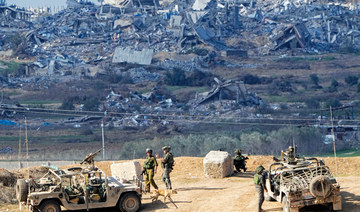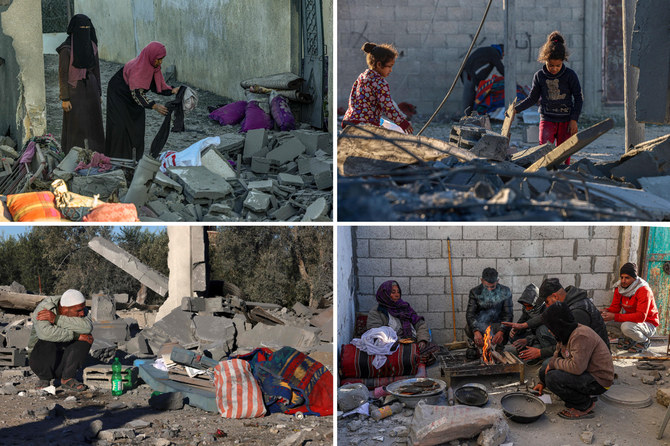

GAZA STRIP: The United Nations said on Saturday the Gaza war was “staining humanity” on the eve of its 100th day as Israeli Prime Minister Benjamin Netanyahu doubled down on vows to defeat Hamas.
The devastating conflict has unleashed a humanitarian crisis in Gaza and fears of a regional escalation intensified after US and British forces struck pro-Hamas Houthi rebels in Yemen on Friday following attacks on Red Sea shipping.
The war was triggered on October 7 when Hamas militants launched an unprecedented attack from the Gaza Strip that resulted in about 1,140 deaths in Israel, mostly civilians, according to an AFP tally based on official figures.
Hamas, considered a “terrorist” group by the United States and the European Union, also seized about 250 hostages, 132 of whom Israel says remain in Gaza, including at least 25 believed to have been killed.
Israel vowed to destroy Gaza’s Islamist rulers and launched a relentless bombardment that has killed at least 23,843 people, mostly women and children, according to the latest toll from the territory’s health ministry.
An Israeli siege has sparked acute shortages of food, water, medicine and fuel in Gaza, where the health system is collapsing.
Visiting the Gaza Strip, the head of the UN agency for Palestinian refugees, Philippe Lazzarini, said “the massive death, destruction, displacement, hunger, loss and grief of the last 100 days are staining our shared humanity.”
An entire generation of children in Gaza were being “traumatized,” diseases were spreading and the clock is “ticking fast toward famine,” he warned.
The Hague-based International Court of Justice this week heard arguments in a case launched by South Africa — and welcomed by Gazans — accusing Israel of breaching the UN Genocide Convention.
The case seeks a halt to the military campaign, which Israel stressed to the court was in self-defense and not aimed at Palestinian residents.
But Netanyahu insisted no court or military foe could stop Israel from achieving its aim of destroying Hamas.
“No one will stop us — not The Hague, not the Axis of Evil and no one else,” he told a televised press conference, referring to the Iran-aligned “axis of resistance” groups in Lebanon, Syria, Iraq and Yemen.
“It is possible and necessary to continue until victory and we will do it,” he added, saying most Hamas battalions in Gaza had been “eliminated.”
Israel’s army chief Herzi Halevi said the war in Gaza was a struggle “for our right to live here in safety,” adding that the October 7 attacks would never be forgotten.
Health officials in Gaza said that Israeli strikes killed at least 60 people in the besieged territory.
Nimma Al-Akhras, 80, described the strike that destroyed her home.
“It was very powerful,” she said. “We started to scream and I couldn’t move but someone pulled me out and put me on a cart.”
The Israeli army said it struck dozens of rocket launchers that were “ready to be used” in central Gaza and eliminated four “terrorists” in air strikes on Khan Yunis, Gaza’s main southern city.
The military also reported that its engineers had destroyed a Hamas “command center” and weapons found there, after a raid in central Gaza.
At Rafah’s Al-Najjar hospital, mourners gathered and prayed around the bodies of slain relatives.
One man, Bassem Araf, held up a photo of a child.
“She died hungry with bread in her hand. We tried to remove the bread from her hand but it was held tight,” Araf said.
“This is the resistance they are targeting in Gaza, just children.”
An AFP reporter in Rafah said telecommunications had been partially restored, a day after Gaza’s main operator Paltel reported the latest outage.
Paltel did not immediately confirm the service restoration but said an Israeli strike killed two of its employees in Khan Yunis while they were repairing the network.
Winter rains have exacerbated the dire humanitarian situation in Gaza, where the UN estimates 1.9 million — nearly 85 percent of the population — have been displaced.
Many have sought shelter in Rafah and other southern areas where the health ministry says there isn’t the infrastructure to support them.
Gaza’s health ministry spokesman accused Israel of “deliberately targeting hospitals... to put them out of service,” warning of “devastating repercussions.”
Hospitals, protected under international humanitarian law, have repeatedly been hit by Israeli strikes in Gaza since the war erupted.
The Israeli military accuses Hamas of operating command centers in tunnels under hospitals, a charge the Islamist group denies.
Fewer than half of Gaza’s hospitals are functioning and those only partly, the World Health Organization says.
In Israel, concern grew for hostages held in Gaza as they approach their 100th day in captivity, with Netanyahu under domestic pressure to get them home.
Thousands rallied in Tel Aviv on Saturday calling for their release, after relatives unveiled a replica of the Gaza tunnels where the captives are believed to be held.
“We will continue to come here week after week until everybody is released,” Edan Begerano, 47, told AFP.
Separately, about 100 people gathered to call for an end to the war, brandishing signs saying: “Revenge is not victory” and: “No to the occupation.” Minor scuffles broke out between them and government supporters.