

Pakistan modernizing weapon systems in line with ‘requirements’ — army chief

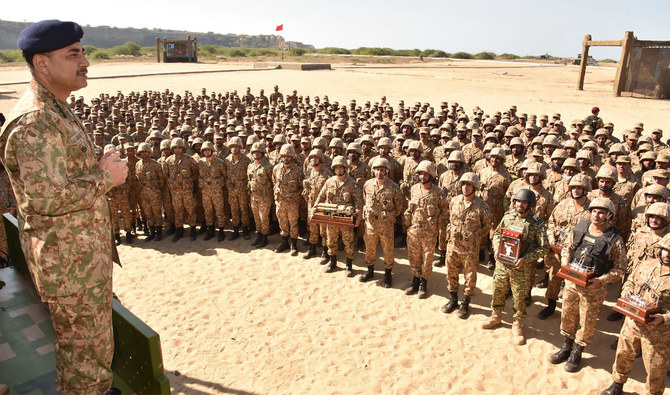
Pakistan army chief, General Asim Munir, is seen addressing troops during an exercise, Al-Bayza-III, held at Sonmiani in Pakistan's southwestern Balochistan province on January 12, 2024. (ISPR)
Short Url
Updated 13 January 2024
Follow

Pakistan modernizing weapon systems in line with ‘requirements’ — army chief

  • The statement came during Al-Bayza-III exercise that included integrated fire and battle maneuvers involving air defense systems 
  • Gen Asim Munir appreciated the remarkable achievement of engaging targets with precision, operational readiness, military says

ISLAMABAD: Pakistan’s army chief, General Asim Munir, said on Friday that armed forces of Pakistan were modernizing their weapon systems in line with the country’s “requirements,” according to the Pakistani military.

The army chief said this while addressing troops during an exercise, Al-Bayza-III, held at Sonmiani in the southwestern Balochistan province, according to the Inter-Services Public Relations (ISPR), the military’s media wing.

“Armed forces of Pakistan are modernizing their systems in line with our requirements to deter and be able to respond to any threat emanating against Pakistan,” Gen Munir was quoted as saying by the ISPR.

Gen Munir viewed integrated fire and battle maneuvers, which involved air defense systems of varying ranges, according to the ISPR. He appreciated the remarkable achievement of engaging targets with precision and operational readiness.

“In a landmark achievement and milestone in enhancing the air defense of the aerial frontiers of Pakistan, HIMAD (High to Medium Air Defense ) system in maiden fire was able to successfully engage the target at maximum ranges along with other layered weapon systems which were tested during the exercise,” the ISPR said.

Several other officials, including Karachi corps commander, Army Air Defense commander, inspector-general (IG) of Training and Evaluation, and IG Arms, also witnessed the exercise.

Earlier upon arrival at the Army Air Defense Center, Gen Munir laid floral wreath at the martyr’s monument and installed Lt Gen Muhammad Zafar Iqbal as colonel commandant of the Air Defense Corps.

Death toll in Pakistan wedding suicide blast rises to six

Updated 59 min 21 sec ago
Follow

Death toll in Pakistan wedding suicide blast rises to six

  • Attack targeted members of local peace committee in Khyber Pakhtunkhwa’s Dera Ismail Khan
  • Peace committees are community-based groups that report militant activity to security forces

PESHAWAR: The death toll from a suicide bombing at a wedding ceremony in northwestern Pakistan rose to six, police said on Saturday, after funeral prayers were held for those killed in the attack a day earlier.

The bomber detonated explosives during a wedding gathering in the Dera Ismail Khan district of Khyber Pakhtunkhwa province, injuring more than a dozen, some of them critically.

“The death toll has surged to six,” said Nawab Khan, Superintendent of Police for Saddar Dera Ismail Khan. “Police have completed the formalities and registered the case against unidentified attackers.”

“It was a suicide attack and the Counter Terrorism Department will further investigate the case,” he continued, adding that security had been stepped up across the district to prevent further incidents.

No militant group has claimed responsibility for the blast so far.

Khan cautioned against speculation, citing ongoing militancy in the area, and said the investigation was being treated with “utmost seriousness.”

The explosion targeted the home of a member of a local peace committee, which is part of community-based groups that cooperate with security forces and whose members have frequently been targeted by militants in the past.

Some media reports also cited a death toll of seven, quoting police authorities.

Emergency officials said several of the wounded were taken to hospital soon after the blast.

Militant attacks have intensified in parts of Khyber Pakhtunkhwa since the Taliban returned to power in neighboring Afghanistan in 2021, with Islamabad accusing Afghan authorities of “facilitating” cross-border assaults, a charge Kabul denies.