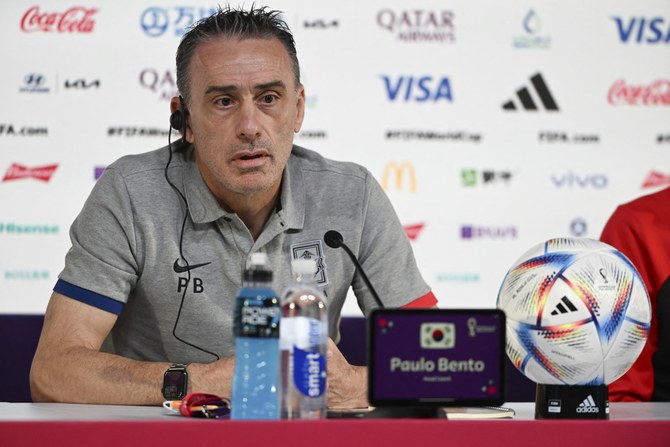

Abu Dhabi: An Asian Cup imbued with tantalizing, yet fragile, hope lies ahead for Paulo Bento’s blossoming UAE.
Pained memories of a tortured World Cup 2022 qualifying campaign were assuaged in a six-match winning run upon the ex-Portugal and South Korea tactician’s summer arrival.
A sense of renewal defines the 54-year-old’s refreshed squad who are attempting to follow in hallowed footsteps of their nation’s Golden Generation and secure a third successive semi-final berth.
Previous AFC players of the year, Ahmed Khalil and Omar Abdulrahman, are now glorious footnotes. New leadership allied with elite performers such as Al-Wasl’s naturalized forward Fabio de Lima, Shabab Al-Ahli Dubai Club sensation Harib Abdalla, and historic 85-goal Al-Jazira marksman Ali Mabkhout hint at better times after the ignominy of last January’s humbling group-stage exit at the Arabian Gulf Cup.
Yet, this month’s deflating 1-0 friendly reversal to unfancied Oman makes predictions of deep progress a tremulous undertaking.
Here, Arab News looks at the Whites’ major issues and key men ahead of Sunday’s Group C opener against Hong Kong at Khalifa International Stadium.
Bento’s big challenge
Ambitions – and expectations – swell when the UAE compete at Asian Cups.
Abdulrahman, Khalil, and Mabkhout electrified Australian crowds at the 2015 running under Mahdi Ali. A measured approach from Alberto Zaccheroni on home soil four-years later, also, dragged them to the last four.
This edition’s intriguing pool contains inviting clashes with Hong Kong and Palestine, plus a bellwether trial versus Iran. Quarterfinals look to be the minimum expectation from there for the AFC’s eighth highest-ranked competitor (64) by FIFA.
Pre-tournament standing as a dark horse has, on the surface, been strengthened by the UAE’s narrow miss for World Cup 2022. Slender fourth-round disappointment to heavyweights Australia, however, under Rodolfo Arruabarrena was illusionary.
Their curious campaign contained five permanent head coach appointments. It was also run alongside consecutive opening-round departures at the 24th and 25th Gulf Cups, plus consequential 5-0 quarter-final elimination by Qatar at the 2021 FIFA Arab Cup which ultimately put paid to Bert van Marwijk’s second spell in charge since March 2019.
Contrasting tactics and philosophies confused minds. Bento’s opening test has been to generate clarity after July’s appointment on a contract until December 2026.
A possession-based system has been successfully applied within the 4-2-3-1 formation ubiquitous in Emirati football. Bento’s debut 4-1 thrashing of Keylor Navas’ Costa Rica in September provided ignition, ahead of the accelerator being pressed for World Cup 2026 qualifying’s supreme opening in November against Nepal (4-0) and Bahrain (2-0).
Culture was key to Bento’s record five-year stint with South Korea. Superstars such as Son Heung-min and Kim Min-jae were treated in the same fashion as lesser lights.
This meritocracy has continued with the UAE and, critically, appears to have received similar buy-in.
Mabkhout – the sole extant talisman from the preceding Golden Generation – netted a brace from the start versus Nepal, yet would score off the bench at Bahrain when a different starting 11 was required.
Further commitment from a promising squad is key to hopes of advancement this winter.
Fresh faces for new quest
Bento’s bold selection has echoed Roberto Mancini’s clean slate with Saudi Arabia, rather than the status quo chosen by Tintin Marquez for holders – and hosts – Qatar.
Key men De Lima and Caio Canedo, of Al-Wasl, did not even hold UAE passports at the previous Asian Cup. Mabkhout, Al-Ain goalkeeper Khalid Essa, Al-Jazira center-back Khalifa Al-Hammadi, club-mate Ali Khaseif, and Al-Wasl midfielder Ali Salmeen are the only survivors from the matchday squad beaten 4-0 by Qatar in those semis.
Pride of Abu Dhabi full-backs Abdulla Idrees and Zayed Sultan have been entrusted to provide fresh impetus. Fellow Al-Jazira performer Abdullah Ramadan adds further drive in midfield and ample star quality.
Enviable options in attack see the aforementioned Mabkhout, De Lima, Canedo, and Abdalla supplemented by the likes of 23-year-old Al-Wasl skipper Ali Saleh and a maturing Yahya Al-Ghassani of ADNOC Pro League champions Shabab Al-Ahli.
It is not, however, a perfect picture for Bento.
Question marks remain
For all the beguiling exuberance of Abdulrahman and punishing lethality of Mabkhout, granite defending was just as crucial in 2015 and 2019.
Exemplary rear-guard actions dumped out champions Japan and Australia at the quarter-final stages of both.
No replacements have subsequently emerged for center-back warriors Ismail Ahmed and Mohanad Salem, despite the polar qualities of Khalifa Al-Hammadi and Al-Jazira partner Mohammed Al-Attas. This also applies in defensive midfield where the retired Khamis Esmail casts a long shadow.
Spines of the 2015 and 2019 selections were drawn from Al-Ahli and Al-Ain club sides who made AFC Champions League finals. Years of underwhelming performances in that competition, however, denies this roster similarly fortifying experiences.
Recent Gulf Cup, Arab Cup, and World Cup qualifying failures make doubts arise, despite obvious talent. It is up to Bento and his players to positively answer them.
Prediction
It is important to quantify which staging post Bento’s UAE are currently at.
Only six months have passed since his hire. Just four squad members hold more than 50 caps, while De Lima and Mabkhout are the solitary players with international goals counted in double figures.
The Asian Cup’s generous Group C offers the chance to build momentum enough to prevail against likely round-of-16-opponents China. From there, a football miracle is required to continue the journey past a Japan who have downed Peru, Germany, Turkiye, Canada, and Tunisia in their current 10-match winning streak.
Valiant defeat versus Samurai Blue would represent failure to replicate prior semi-final runs but should solidify belief in Bento’s methods ahead of the defining quest for a World Cup return.