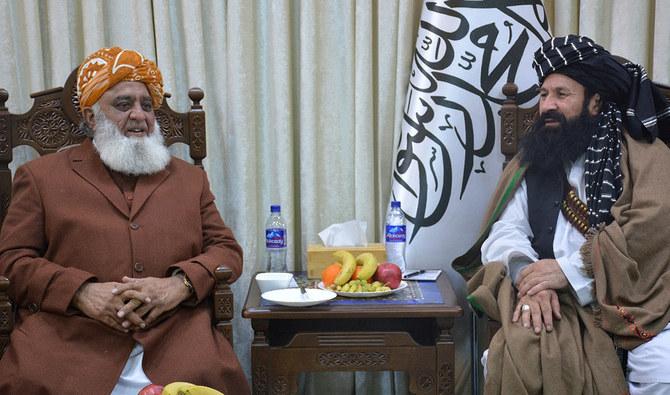
ISLAMABAD: Maulana Fazlur Rehman, leader of a prominent Pakistani religious party, has met Afghanistan’s interim interior minister Sirajuddin Haqqani and discussed with him internal and external stability of both countries, Rehman’s party said on Friday.
Rehman, who heads the Jamiat Ulema Islam (JUI) party, has been on a visit to Afghanistan since Jan. 7 to hold talks with Taliban officials at a time when ties between Pakistan and Afghanistan are at their lowest ebb due to the rising number of militant attacks in Pakistan.
The Pakistani cleric advocated for strong bilateral relations between both countries against the backdrop of his country’s decision to deport large numbers of “illegal immigrants,” mostly Afghans, in the wake of a surge in deadly attacks, including suicide bombings.
In his meeting with Haqqani, the JUI leader was apprised of the internal security situation of Afghanistan, his party said in a statement.
“The purpose of our visit is to bring internal and external stability in the two countries,” Rehman was quoted as telling the Afghan interior minister. “An increase in trade between the two countries will lead to peace and prosperity.”
The Afghan interior minister expressed his country’s desire to have cordial ties with Pakistan.
“[We] want to move forward through cooperation and talks between Pakistan and Afghanistan on border issues,” Haqqani was quoted as saying.
While the JUI leader, along with a delegation, held talks in Kabul, the Pakistani government distanced itself from the visit.
“Maulana Fazlur Rehman has gone to Afghanistan in a private capacity,” Mumtaz Zahra Baloch, a spokesperson of the Pakistan foreign office, said at a weekly press briefing on Thursday. “The government is not supporting his visit in any way.”
Asked if Islamabad intended to hold talks with the Pakistani Taliban, she said Pakistan was not “interested in dialogue with the TTP (Tehreek-e-Taliban Pakistan) which has carried out several attacks in the country.”
The militant group, which is said to have sanctuaries in Afghanistan, is separate from but a close ally of the Afghan Taliban.
Over the last one year, Pakistan has repeatedly asked the Afghan Taliban to prevent the TTP from using their soil to carry out attacks against Pakistan. Kabul denies the use of its territory by any militant group.


![]()
![]()

Pakistani religious party leader discusses internal, external stability with Afghan interior minister

Short Url
https://arab.news/vrbwj
Pakistani religious party leader discusses internal, external stability with Afghan interior minister
- Maulana Fazlur Rehman is on a visit to Afghanistan since Sunday where he has met top Taliban leaders
- Pakistan has chosen to distance itself from the visit, says Rehman undertook it in a ‘personal capacity’


Latest updates


Recommended


© 2026 SAUDI RESEARCH & PUBLISHING COMPANY, All Rights Reserved And subject to Terms of Use Agreement.