

Global warming pushes ocean temperatures off the charts: study

1 / 4
Burned palm trees and destroyed cars and buildings in the aftermath of a wildfire in Lahaina, western Maui, Hawaii on August 11, 2023. (AFP)
2 / 4
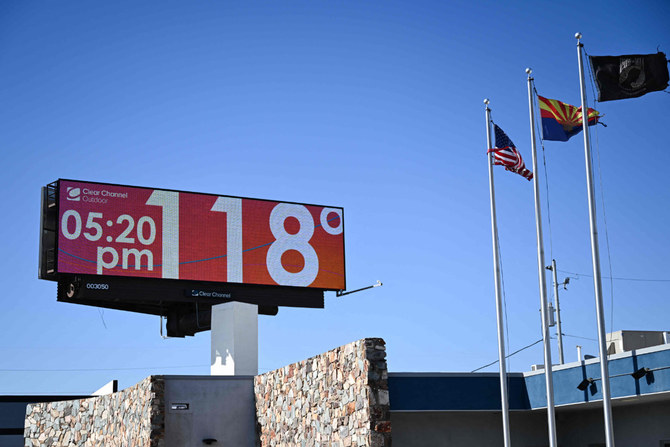
A billboard displays a temperature of 118 degrees Fahrenheit (48 degrees Celsius) during a record heat wave in Phoenix, Arizona on July 18, 2023. (AFP) Phoenix, Arizona, (AFP)
3 / 4
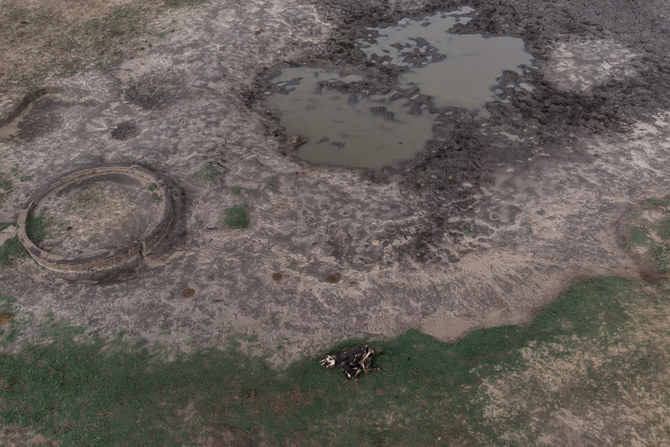
This aerial view shows a juvenile elephant carcass which died due to drought at a depleted watering hole in Hwange National Park in Hwange, northern Zimbabwe on December 16, 2023. (AFP)
4 / 4
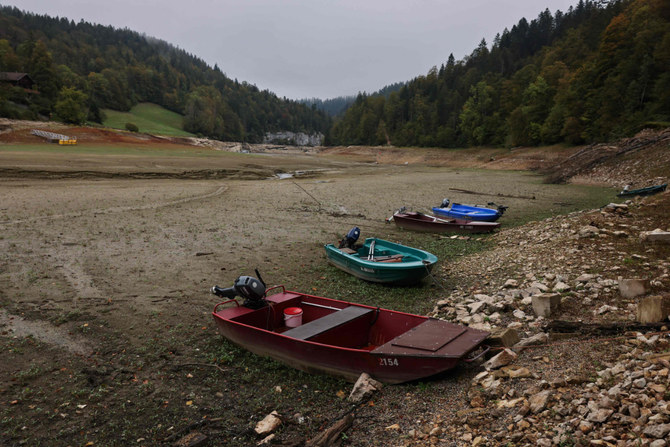
Small boats washed up on the banks of the Villers-le-Lac basins, eastern France, on October 4, 2023. (AFP)
Short Url
Updated 12 January 2024
Follow

Global warming pushes ocean temperatures off the charts: study

  • Oceans soaked up around 9 to 15 zettajoules more than in 2022, according to estimates from the US NOAA and the Chinese Institute of Atmospheric Physics
  • Some of the colossal amounts of energy stored in the ocean helped make 2023, a year rife with heatwaves, droughts and wildfires, the hottest on record

PARIS: In 2023, the world’s oceans took up an enormous amount of excess heat, enough to “boil away billions of Olympic-sized swimming pools,” according to an annual report published Thursday.
Oceans cover 70 percent of the planet and have kept the Earth’s surface livable by absorbing 90 percent of the excess heat produced by the carbon pollution from human activity since the dawn of the industrial age.
In 2023, the oceans soaked up around 9 to 15 zettajoules more than in 2022, according to the respective estimates from the US National Oceanic and Atmospheric Administration (NOAA) and the Chinese Institute of Atmospheric Physics (IAP).
One zettajoule of energy is roughly equivalent to ten times the electricity generated worldwide in a year.
“Annually the entire globe consumes around half a zettajoule of energy to fuel our economies,” according to statement.
“Another way to think about this is 15 zettajoules is enough energy to boil away 2.3 billion Olympic-sized swimming pools.”
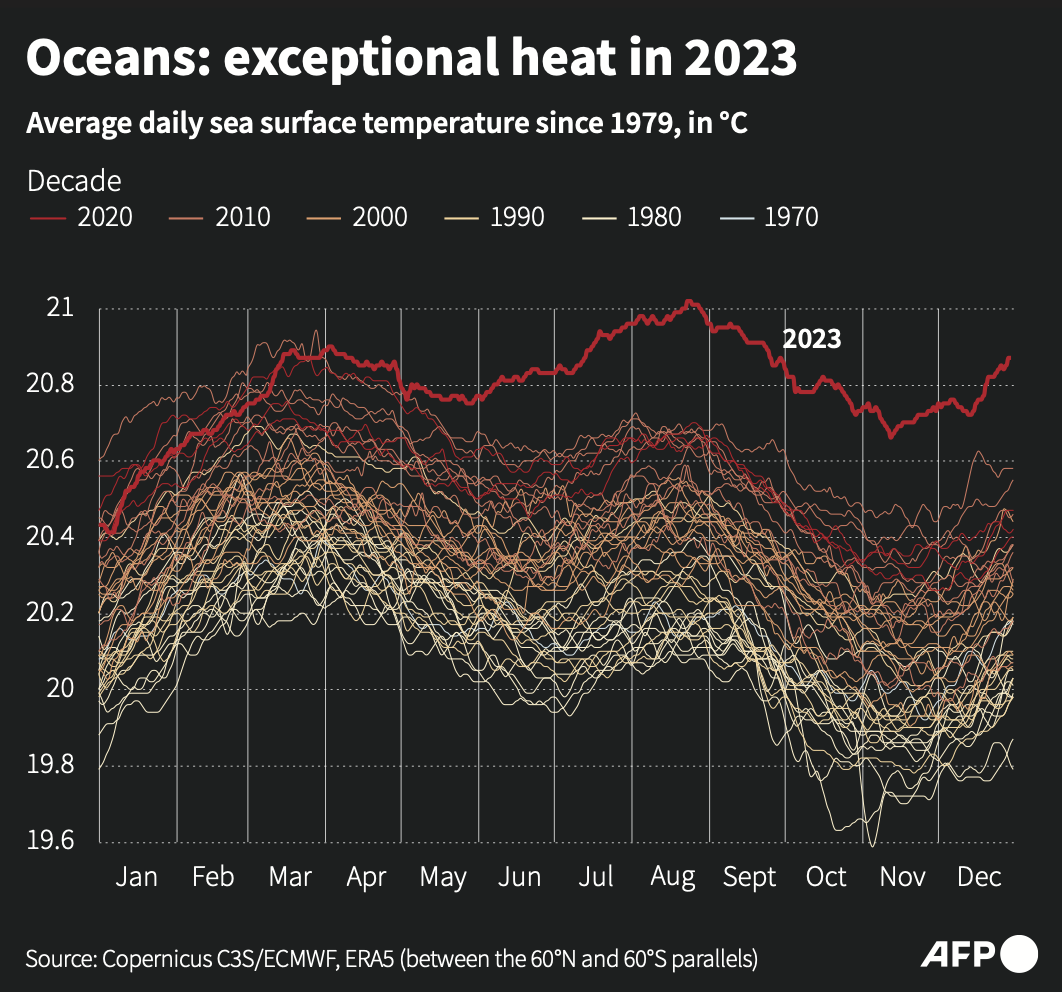
In 2023, sea surface temperature and the energy stored in the upper 2000 meters of the ocean both reached record highs, according to the study published in the journal Advances in Atmospheric Sciences.
The amount of energy stored in the oceans is a key indicator of global warming because it is less affected by natural climate variability than sea surface temperature.
Some of the colossal amounts of energy stored in the ocean helped make 2023, a year rife with heatwaves, droughts and wildfires, the hottest on record.
That’s because the warmer the oceans gets, the more heat and moisture enters the atmosphere. This leads to increasingly erratic weather, like fierce winds and powerful rain.
Warmer sea surface temperatures are driven mostly by global warming, caused mainly by the burning of fossil fuels.
Every few years, a naturally occurring weather phenomenon, El Nino, warms the sea surface in the southern Pacific, leading to hotter weather globally. The current El Nino is expected to peak in 2024.
Conversely, a mirror phenomenon called La Nina periodically helps cool the surface of the ocean.
Increasing water temperatures and ocean salinity — also at an all-time high — directly contribute to a process of “stratification,” where water separates into layers that no longer mix.
This has wide-ranging implications because it affects the exchange of heat, oxygen and carbon between the ocean and atmosphere, with effects including a loss of oxygen in the ocean.
Scientists are also concerned about the long-term capacity of the oceans to continue absorbing 90 percent of the excess heat from human activity.


Nobel laureate Machado says US helped her leave Venezuela, vows return

Updated 6 sec ago
Follow

Nobel laureate Machado says US helped her leave Venezuela, vows return

  • Machado emerged on a hotel balcony in Oslo to cheering supporters early Thursday
  • “We did get support from the United States government to get here,” Machado said

OSLO: Nobel Peace laureate Maria Corina Machado said on Thursday that the United States helped her get to Norway from hiding in Venezuela, expressing support for US military action against her country and vowing to return home.
Machado, who vanished in January after challenging the rule of President Nicolas Maduro, emerged on a hotel balcony in Oslo to cheering supporters early Thursday after several days of confusion over her whereabouts.
“We did get support from the United States government to get here,” Machado told a press conference when asked by AFP about whether Washington had helped.
The Wall Street Journal reported that she wore a wig and a disguise on the high-risk journey, leaving her hide-out in a Caracas suburb on Monday for a coastal fishing village, where she took a fishing skiff across the Caribbean Sea to Curacao.
The newspaper said the US military was informed to avoid the boat being targeted by airstrikes. Once on the island, she took a private jet to Oslo early on Wednesday.
Machado thanked those who “risked their lives” to get her to Norway but it was not immediately clear how or when she will return to Venezuela, which has said it would consider her a fugitive if she left.
“Of course, the risk of going back, perhaps it’s higher, but it’s always worthwhile. And I’ll be back in Venezuela, I have no doubt,” she added.
Machado has been hailed for her fight for democracy but also criticized for aligning herself with US President Donald Trump, to whom she has dedicated her Nobel, and for inviting foreign intervention in her country.

- Military build-up -

The United States has launched a military build-up in the Caribbean in recent weeks and deadly strikes on what Washington says are drug-smuggling boats.
“I believe every country has the right to defend themselves,” Machado told reporters Thursday.
“I believe that President Trump’s actions have been decisive to reach the point where we are right now, in which the regime is weaker than ever, because the regime previously thought that they could do anything,” she continued.
Late Wednesday, Trump said the United States had seized a “very large” oil tanker near Venezuela, which Caracas denounced as “blatant theft.”
Maduro maintains that US operations are aimed at toppling his government and seizing Venezuela’s oil reserves.
Machado first appeared on a balcony of the Grand Hotel in the middle of the night, waving and blowing kisses to supporters chanting “libertad” (“freedom“) below.
On the ground, she climbed over metal barriers to get closer to her supporters, many of whom hugged her and presented her with rosaries.
She said she has missed much of her children’s lives while hiding, including graduations and weddings.

- ‘ Political risk’ -

Machado won the Peace Prize for “her struggle to achieve a just and peaceful transition from dictatorship to democracy.”
She has accused Maduro of stealing Venezuela’s July 2024 election, from which she was banned — a claim backed by much of the international community.
She last appeared in public on January 9 in Caracas, where she protested Maduro’s inauguration for his third term.
The decision to leave Venezuela and join the Nobel festivities in Oslo comes at both personal and political risk.
“She risks being arrested if she returns even if the authorities have shown more restraint with her than with many others, because arresting her would have a very strong symbolic value,” said Benedicte Bull, a professor specializing in Latin America at the University of Oslo.
While Machado is the ” undisputed” leader of the opposition, “if she were to stay away in exile for a long time, I think that would change and she would gradually lose political influence,” Bull said.
In her acceptance speech read by one of her daughters Wednesday, Machado denounced kidnappings and torture under Maduro’s tenure, calling them “crimes against humanity” and “state terrorism, deployed to bury the will of the people.”