

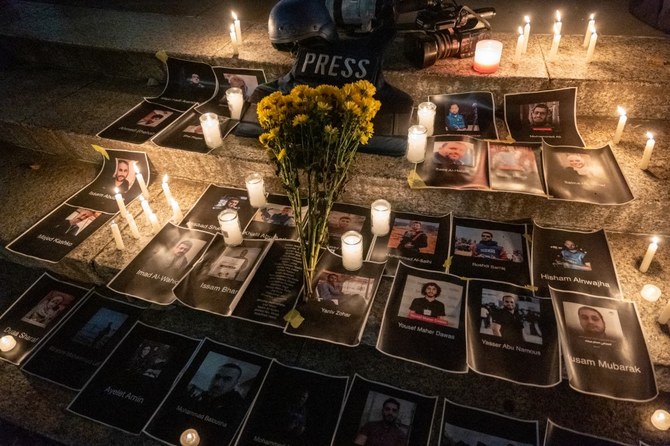
Rights groups urge US to ‘pursue accountability’ for journalists killed in Gaza

The six organizations said the killing of journalists, whether deliberately or as a result of recklessness, 'is a war crime.' (AFP/File)
Short Url
Updated 11 January 2024
Follow

Rights groups urge US to ‘pursue accountability’ for journalists killed in Gaza

  • 6 groups send letter to President Joe Biden calling on him to ‘ensure that all parties to the conflict abide by international law’ and to ‘do more to protect press freedom’
  • They say 75 of 79 journalists who have died in fighting between the Israeli military and Palestinian and Lebanese armed groups were killed by members of the Israel Defense Forces

LONDON: Six human rights organizations and press-freedom groups have called on authorities in the US, in its role as one of Israel’s strongest and most influential allies, to “pursue accountability” for the journalists killed during the ongoing assault on the Gaza Strip.

In a letter sent to President Joe Biden on Wednesday, the Committee to Protect Journalists, Human Rights Watch, Freedom House, the Freedom of Press Foundation, the Knight First Amendment Institute at Columbia University, and Reporters Without Borders urged his administration to “ensure that all parties to the conflict abide by international law” and to “do more to protect press freedom.”

They said that 75 of 79 journalists and media workers who lost their lives in Gaza, Lebanon and Israel during the ongoing fighting between the Israeli military and Palestinian and Lebanese armed groups were killed by members of the Israel Defense Forces.

Israel launched its assault on Gaza in retaliation for the surprise attack by Hamas on Oct. 7 during which 1,200 people were killed in Israel and 240 were taken hostage. Israel’s air and land campaign in the Gaza Strip has so far killed more than 23,000 people, at least 10,000 of whom were children, according to the Hamas-run health ministry in the territory.

The letter from the rights groups noted that though the US has denied there is any evidence that Israel is deliberately targeting journalists, “credible reports” by human rights and media organizations suggest that IDF strikes in southern Lebanon on Oct. 13, which killed one journalist and injured six others, “were unlawful and apparently deliberate.” Moreover, the Israeli military acknowledged targeting a car in which journalists were traveling on Jan. 7, and at least two journalists in Gaza reported that they were threatened by Israeli officials before members of their families were killed.

Highlighting what they described as Israel’s “longstanding pattern of impunity in the killings of journalists,” the writers of the letter called on Biden to support investigations into the killings of all journalists by Israeli forces, including that of Al-Jazeera reporter Shireen Abu Akleh in May 2022.

The six organizations said the killing of journalists, whether deliberately or as a result of recklessness, “is a war crime” and the International Criminal Court “will investigate reports of war crimes committed against journalists in Gaza.”

They also demanded that the right of journalists to report on the hostilities be fully respected, that Egypt and Israel grant international media access to the Gaza Strip, and that the US “conducts thorough, transparent, and public assessments of the end use of US weapons and military assistance to Israel in the course of the hostilities.”


Israel extends foreign media ban law until end of 2027

Updated 23 December 2025
Follow

Israel extends foreign media ban law until end of 2027

  • Order replaces temporary emergency legislation that allowed authorization of so-called ‘Al Jazeera bill’
  • Extension of temporary order empowers Communications Ministry to restrict foreign channels deemed to cause ‘real harm to state security’

LONDON: Israel’s Knesset approved late Monday an extension of the temporary order empowering the Communications Ministry to shut down foreign media outlets, pushing the measure through until Dec. 31, 2027.

The bill, proposed by Likud lawmaker Ariel Kallner, passed its second and third readings by a 22-10 vote, replacing wartime emergency legislation known as the “Al Jazeera Law.”

Under the extended order, the communications minister — with prime ministerial approval and security cabinet or government ratification — can restrict foreign channels deemed to cause “real harm to state security,” even outside states of emergency.

Measures include suspending broadcasts, closing offices, seizing equipment, blocking websites, and directing the defense minister to block satellite signals, including in the West Bank, without disrupting other channels.

Administrative orders last 90 days, with possible extensions. Unlike the temporary measure, the new law does not require court approval to shut down a media outlet.

The move has drawn sharp criticism from human rights and media groups, who warn it entrenches restrictions on Arab and foreign outlets amid a broader erosion of press freedoms.

“Israel is openly waging a battle against media outlets, both local and foreign, that criticize the government’s narrative; that is typical behavior of authoritarian regimes,” International Federation of Journalists General Secretary Anthony Bellanger said in November after the bill’s first reading.

“We are deeply concerned about the Israeli parliament passing this controversial bill, as it would be a serious blow to free speech and media freedom, and a direct attack on the public’s right to know.”

In a parallel development, the Israeli Cabinet unanimously approved on Monday the shutdown of Army Radio (Galei Tzahal) after 75 years, with operations ceasing on March 1, 2026.

In a statement, Attorney General Gali Baharav-Miara warned the decision “undermines public broadcasting in Israel and restricts freedom of expression,” lacking a legal basis.