

US envoy says ‘diplomatic solution’ needed for Lebanon-Israel escalation

1 / 2
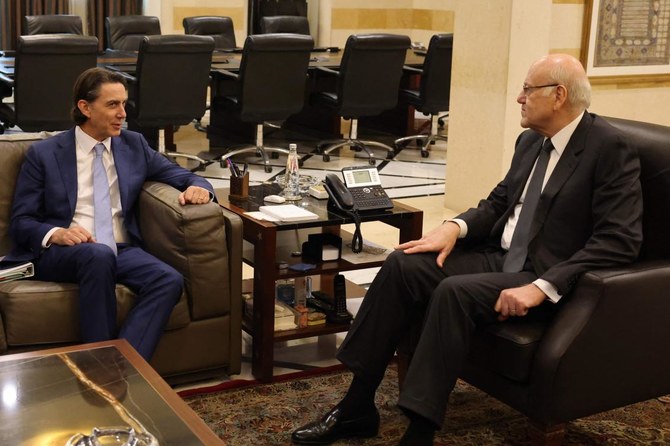
US special envoy Amos Hochstein meets with Lebanese caretaker PM Najib Mikati in Beirut on Jan. 11, 2024 amid continuing tenions on the Lebanese-Israeli border. (AFP)
2 / 2
US envoy Amos Hochstein meeting with Lebanese Parliament Speaker Nabih Berri in Beirut, Lebanon, on January 11, 2024. (REUTERS/Mohamed Azakir)
Short Url
Updated 11 January 2024
Follow

US envoy says ‘diplomatic solution’ needed for Lebanon-Israel escalation

  • Hochstein met Lebanon’s caretaker prime minister, foreign minister, army commander and speaker of parliament in an hours-long visit
  • As the meetings were going on, Israeli and Hezbollah forces exchanged fire along the border and casualties were reported on both sides

BEIRUT: US special envoy Amos Hochstein said on Thursday he was hopeful diplomacy could calm tensions on the disputed border between Lebanon and Israel, where the Israeli military and armed group Hezbollah have been exchanging fire for three months.

“We need to find a diplomatic solution that will allow for the Lebanese people to return to their homes in south Lebanon ... as the people of Israel need to be able to return to their homes in their north,” he said.

Hochstein — US special presidential coordinator for global infrastructure and energy security — was speaking to reporters in Beirut, where he met top Lebanese officials on Thursday after visiting Israel.

The US envoy’s meetings included Army Commander Gen. Joseph Aoun, caretaker Prime Minister Najib Mikati and Parliament Speaker Nabih Berri:

Hochstein stressed the necessity of “working on calming the situation in southern Lebanon, even if it is not possible to reach a final solution in the meantime.”

He also called for “working on a middle ground temporary solution so things do not worsen.”

Mikati stressed that “the priority should be a ceasefire in Gaza and the stopping of Israeli aggression in Lebanon as well as repeated Israeli violations of Lebanese sovereignty.”

He added: “We want peace and stability through adherence to international resolutions.”

Hochstein said after meeting with Berri: “It is clear that we are going through a difficult stage and a time of urgency, and I am grateful that I was able to hold meetings with the Lebanese government and with the commander of the Lebanese Armed Forces to discuss how to reach a diplomatic solution to the crisis on the border between Israel and Lebanon.”

The US envoy said that when he was in Israel last week, “I said we prefer a diplomatic solution to the current crisis.

“We had discussions, and I firmly believe that the Lebanese people do not want to see the current crisis escalate into another conflict.”

Hochstein described his talks in Beirut as “good discussions” and expressed hope that “we can continue to make this effort to reach, together, on both sides of the border, a solution that allows all people in Lebanon and Israel to reach a solution.”

The US envoy’s meetings coincided with Israeli escalation against Hezbollah along the border, with a civil defense center at the border town of Hanine being targeted.

The assault led to the killing of Dr. Ali Mahmoud Al-Sheikh Ali from the town of Rachaf and paramedic Sajid Ramzi Kassem from Aita Al-Shaab. Several others were wounded.

Hezbollah said in a statement it was “a blatant attack on a center that serves Lebanese citizens, providing relief and care to the wounded as a result of the ongoing Israeli aggression against our country and our people, and a continuation of the aggressive policy that is based on murder and terrorism.”

The Lebanese Ministry of Health denounced the targeting of the center and ambulances “in violation of international laws,” demanding safety for health workers.

Hezbollah later announced that it targeted the settlement of Kiryat Shmona with rocket salvos and a gathering of Israeli soldiers in the vicinity of the Metula site in the Galilee panhandle with missiles.

Israeli soldiers in the vicinity of Tayhat Hill and Mount Nothor “were also targeted with missiles, causing confirmed casualties.”

Sirens sounded in Metula and Israeli media reported: “For the second time during the day, an anti-tank missile was launched from Lebanon toward the settlement.”

Hezbollah, meanwhile, said that it targeted Israeli spy equipment on Cobra Hill with “appropriate weapons, causing damage and destruction.”

It said the number of Israeli attacks by drones on Hezbollah’s members has increased over the past two weeks — based on advanced technology and the hacking of Lebanese communications data.

The latest of these attacks on the commander of Hezbollah’s Radwan force, Wissam Al-Tawil, prompted the party to issue more warnings to the displaced people of the border region and those remaining in their homes.

The party also claimed that the Israel Defense Forces were using Lebanese phone numbers to contact people and gain intelligence on certain individuals.

In a statement, Hezbollah asked people in the border area not to answer callers in any inquiry related to the surroundings and the movement of people, to cut off any communications immediately and then quickly inform the relevant authorities.

Hezbollah had previously asked residents of the south to disconnect wireless surveillance cameras in front of their homes from the internet or to switch them off completely, as they they could presumably be hijacked by Israeli intelligence.

Israeli shelling has killed at least 25 Lebanese civilians and 140 fighters from Iran-backed Hezbollah in southern Lebanon. At least nine Israeli troops have been killed in northern Israel.


A look at Ramadan and how Muslims observe the holy month

Updated 4 sec ago
Follow

A look at Ramadan and how Muslims observe the holy month

  • Ramadan is the ninth month of the Islamic lunar calendar; the month cycles through the seasons
  • Ramadan is followed by the Islamic holiday of Eid Al-Fitr
CAIRO: Observant Muslims the world over will soon be united in a ritual of daily fasting from dawn to sunset as the Islamic holy month of Ramadan starts. For Muslims, it’s a time for increased worship, religious reflection and charity. Socially, it often brings families and friends together in festive gatherings around meals to break their fast.
Ramadan is followed by the Islamic holiday of Eid Al-Fitr.
First day of Ramadan expected around Feb. 18-19
Ramadan is the ninth month of the Islamic lunar calendar; the month cycles through the seasons.
The start of the month traditionally depends on the sighting of the crescent moon. This year, the first day of Ramadan is expected to be on or around Feb. 18 or 19. The actual start date may vary among countries and Muslim communities due to declarations by multiple Islamic authorities around the globe on whether the crescent had been sighted or different methodologies used to determine the beginning of the month.
This year, the start of Ramadan is expected around the same time as Ash Wednesday, a solemn day of fasting and reflection that signals the start of Lent, the most penitential season of the church calendar for Catholics and many other Christians.
Fasting is one of the pillars of Islam
Fasting is one of the Five Pillars of Islam, along with the profession of faith, prayer, almsgiving and pilgrimage.
Muslims see various meanings and lessons in observing the fast.
It’s regarded as an act of worship to attain piety and one of submission to God. The devout see benefits, including practicing self-restraint, cultivating gratitude and empathizing with people who are poor and hungry.
The daily fast in Ramadan includes abstaining from all food and drink — not even a sip of water is allowed — from dawn to sunset, before breaking the fast in a meal known as “iftar” in Arabic.
Muslims typically stream into mosques for congregational prayers and dedicate more time to religious contemplation and the reading of the Qur’an, the Muslim holy book.
Charity is a hallmark of Ramadan. Among other ways of giving, many seek to provide iftar for those in need, distributing Ramadan boxes filled with pantry staples, handing out warm meals alongside such things as dates and juice or helping hold free communal meals.
Muslims eat a predawn meal, called “suhoor,” to hydrate and nurture their bodies ahead of the daily fast.
Exemptions from fasting
There are certain exemptions, such as for those who are unable to because of illness or travel. Those unable to fast due to being temporarily ill or traveling need to make up for the missed days of fasting later.
Cultural and social traditions associated with Ramadan
Muslims are ethnically and racially diverse and not all Ramadan traditions are rooted in religion. Some customs may transcend borders, while others can differ across cultures.
Many social rituals center on gathering and socializing after the daily fast. Some Muslims decorate their homes, put out Ramadan-themed tableware and centerpieces or throng to markets and Ramadan bazaars.
In Egypt, Ramadan is typically a festive time. Colorful lanterns, in different shapes and sizes, dangle from children’s hands and adorn homes. Ramadan songs may be played to welcome the month.
Ramadan’s soundscape in Egypt has traditionally included the predawn banging on drums by a “mesaharati” who roams neighborhoods, calling out to the faithful, sometimes by name, to wake them up for the suhoor meal.
New TV shows and communal meals
A lineup of new television series is another social fixture of the month in some countries, and advertisers compete for viewers’ attention.
In various regions, some Muslims worry that the month is getting commercialized, and say an emphasis on decorations, TV shows, outings or lavish iftar banquets can detract from Ramadan’s religious essence. Others say that a balance can be struck and that, in moderation, such rituals are part of the month’s festive spirit.
In Indonesia, Ramadan rituals vary across regions, reflecting the diversity of cultures. In deeply conservative Aceh province, animals are slaughtered during Meugang festivities, the meat cooked and shared with family, friends, poor people and orphans.
Hundreds of residents in Tangerang, a city outside the capital, Jakarta, flock to the Cisadane River to wash their hair with rice straw shampoo and welcome the fasting month with a symbolic spiritual cleansing.
Across the island of Sumatra, after evening prayers, many boys and girls parade through the streets, carrying torches and playing Islamic songs.
In the United States, where Muslims make up a racially and ethnically diverse minority, gathering at mosques and Islamic centers when possible for iftar meals and prayers provides many Muslim families with a sense of community. Some Muslims also organize or attend interfaith iftar meals.