Nigeria can be global minerals supplier thanks to abundant lithium resources: minister

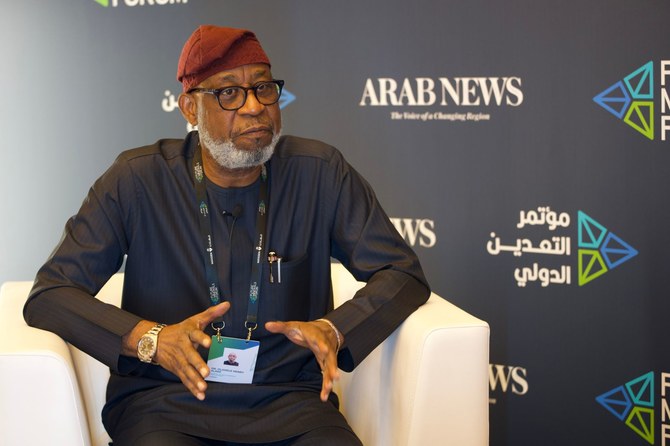
Nigeria’s Minister of Solid Minerals Henry Dele Alake stressed that his country possesses critical metals and elements in large quantities, acting as a “breadbasket” for the supply chain. AN Photo
Short Url
Updated 11 January 2024
Follow

Nigeria can be global minerals supplier thanks to abundant lithium resources: minister

RIYADH: Nigeria is positioning itself as a supplier in the global minerals market with the country possessing multiple elements such as lithium, according to its minister of solid minerals development. 

Henry Dele Alake conveyed a message of optimism and enthusiasm during an interview with Arab News at the Future Minerals Forum being held in Riyadh.  

He highlighted Nigeria’s significant role in this collaborative effort, and said: “For us in Nigeria, being part of this (event) is quite a positive development.” 

The minister added: “It creates another need for us to market minerals in Nigeria because we have the globally sought after minerals in Nigeria like lithium, which is in high demand. Now we have it in large quantity and of the highest grades.” 

The forum signifies the collective efforts of nations with abundant mineral resources, working together to enhance exploration, processing and extraction as well as exportation and distribution. The ultimate objective is to create local value, boost revenue, and assert a strong presence in international economic affairs, Alake highlighted. 

He also spoke about the opportunities the forum provides for networking and deal-making.  

Alake shared a particularly fruitful interaction with a Saudi minister, saying, “Two days ago, I mentioned the minister of Saudi, who is our host here; we had very fruitful discussions. From our discussion, Saudi Arabia needs iron ore in large quantity. Nigeria has iron ore in large deposits. So, we have formed a technical committee to work out the details. That’s a takeaway, a very positive takeaway.” 

Emphasizing Nigeria’s commitment to diversifying its economy away from oil, Alake highlighted the country’s pivotal role in the global energy transition.  

The minister stressed that Nigeria possesses critical metals and elements in large quantities, acting as a “breadbasket” for the supply chain.

He said: “We are also opening our doors and telling the world that we are ready and open for business. We have what it takes to be part of this supply chain and are ready to do that.” 

In conclusion, Alake highlighted the importance of the Future Minerals Forum as a platform for nations to collaborate, stating: “This forum is a very good opportunity and Nigeria is part of that supply chain. Now if we are deepening trade relations amongst the member states of this region, it expands the opportunities for Nigeria and other African countries to increase their revenue intake, which also indirectly and directly increases their welfare, the socioeconomic welfare of member states.” 

The ongoing forum continues to be a catalyst for nations, fostering partnerships, exploring opportunities, and contributing to the diversification of the global mineral supply chain. 


Saudi POS spending jumps 28% in final week of Jan: SAMA

Updated 06 February 2026
Follow

Saudi POS spending jumps 28% in final week of Jan: SAMA

RIYADH: Saudi Arabia’s point-of-sale spending climbed sharply in the final week of January, rising nearly 28 percent from the previous week as consumer outlays increased across almost all sectors. 

POS transactions reached SR16 billion ($4.27 billion) in the week ending Jan. 31, up 27.8 percent week on week, according to the Saudi Central Bank. Transaction volumes rose 16.5 percent to 248.8 million, reflecting stronger retail and service activity. 

Spending on jewelry saw the biggest uptick at 55.5 percent to SR613.69 million, followed by laundry services which saw a 44.4 percent increase to SR62.83 million. 

Expenditure on personal care rose 29.1 percent, while outlays on books and stationery increased 5.1 percent. Hotel spending climbed 7.4 percent to SR377.1 million. 

Further gains were recorded across other categories. Spending in pharmacies and medical supplies rose 33.4 percent to SR259.19 million, while medical services increased 13.7 percent to SR515.44 million. 

Food and beverage spending surged 38.6 percent to SR2.6 billion, accounting for the largest share of total POS value. Restaurants and cafes followed with a 20.4 percent increase to SR1.81 billion. Apparel and clothing spending rose 35.4 percent to SR1.33 billion, representing the third-largest share during the week. 

The Kingdom’s key urban centers mirrored the national surge. Riyadh, which accounted for the largest share of total POS spending, saw a 22 percent rise to SR5.44 billion from SR4.46 billion the previous week. The number of transactions in the capital reached 78.6 million, up 13.8 percent week on week. 

In Jeddah, transaction values increased 23.7 percent to SR2.16 billion, while Dammam reported a 22.2 percent rise to SR783.06 million. 

POS data, tracked weekly by SAMA, provides an indicator of consumer spending trends and the ongoing growth of digital payments in Saudi Arabia.  

The data also highlights the expanding reach of POS infrastructure, extending beyond major retail hubs to smaller cities and service sectors, supporting broader digital inclusion initiatives.  

The growth of digital payment technologies aligns with Saudi Arabia’s Vision 2030 objectives, promoting electronic transactions and contributing to the Kingdom’s broader digital economy.