

Tate St. Ives explores Moroccan modernism in Casablanca Art School show 

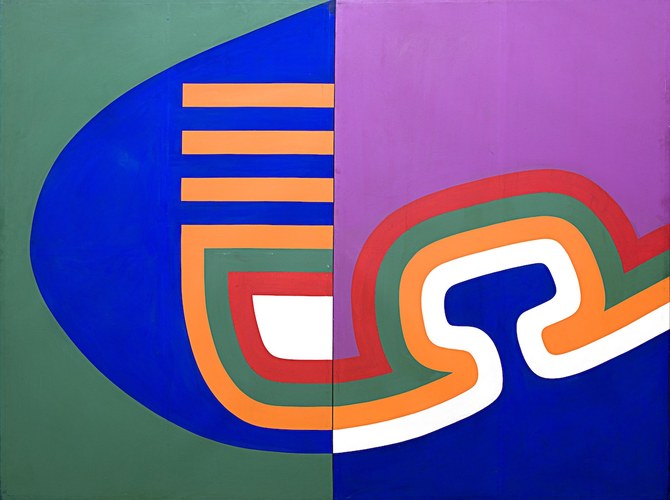
Mohammed Chabâa, Untitled, 1975. (Supplied)
Short Url
Updated 10 January 2024
Follow

Tate St. Ives explores Moroccan modernism in Casablanca Art School show 

DUBAI: Between the 1960s and 1980s, post-independence Morocco witnessed the rise of a game-changing artistic movement known as the Casablanca Art School. It was spearheaded by a new generation of pioneering Moroccan artists and educators such as Farid Belkahia, Mohammed Chabaa and Mohamed Melehi, who sought to create a modern and vibrant visual language that paid tribute to their country’s multicultural heritage.    


Mohamed Melehi, Untitled, 1969. (Supplied)

The movement is the subject of an ongoing exhibition, until Jan. 14, at Tate St. Ives in Cornwall, England. A landmark show, it is the first time that a major British museum explores Moroccan modernism. Organized along with the Sharjah Art Foundation in the UAE, “The Casablanca Art School” show gathers an extensive selection of abstract works, sculptures and tapestries by 22 artists, accompanied by attractive displays of print archives, vintage journals, photographs and films. 

“The Casablanca Art School always had something compelling to everybody, probably because of the visual efficiency in their work and the fact that the fusion of Western art and local tradition is kind of perfect in a way,” Morad Montazami, the show’s co-curator, told Arab News. “With the Casablanca Art School, there’s something about their work and trajectory that feels kind of resolved about ‘West’ and ‘East’ influences.” 


Casablanca Art School Installation View at Tate St Ives 2023. (Supplied)

One of the unique aspects of the school was how unconventional it was. “The anti-colonial position was about creating a new language, which should be based on local arts and crafts in terms of geometric creativity and materials that they used,” said Montazami. Artists went beyond the canvas and other traditional Western media in favor of copper, leather and animal skin. They were also inspired by Amazigh, Berber and African jewelry and carpets. A lot of paintings of this era implemented fluorescent colors through cellulosic, industrial paint that was commonly used by local workers in car garages and workshops. 

Casablanca Art School artists also literally took to the streets with their art, turning the city into a public canvas. “It was a way to attract the viewer of the streets because they began showing in non-museum spaces and outdoor exhibitions,” said Montazami. “There weren’t really local galleries — only French-owned galleries exhibited Moroccan artists as naive or folk painters. There wasn’t even a modern art museum. So Casablanca as a postcolonial city was really transformed by these innovative artists.” 


World of Coffee trade show capitalizes on Gulf’s strong coffee culture

Updated 06 January 2026
Follow

World of Coffee trade show capitalizes on Gulf’s strong coffee culture

DUBAI: Long regarded as the birthplace of coffee brewing, the Middle East is entering a new phase of cafe culture — and the fifth edition of World of Coffee, which takes place in Dubai from Jan. 18-20, will help drive that momentum.

Saudi Arabia alone is home to more than 5,100 branded cafes, with daily coffee consumption exceeding 36 million cups. Coffee is part of the social and cultural fabric, from traditional majlis gatherings to contemporary specialty cafes.

“Saudi Arabia’s coffee sector is evolving rapidly. There is increasing investment in quality, education, and presentation, alongside renewed interest in origin storytelling and cultural context,” said Shouq Bin Redha, exhibition manager for World of Coffee Dubai 2026, where Saudi Arabia will host a national pavilion.

“Saudi coffee has a very distinct identity rooted in heritage, ritual, and hospitality. Its profile is closely tied to traditional preparation methods and regional flavor preferences, which sets it apart on the global stage,” she told Arab News. “The national pavilion reflects this balance between tradition and modernization.”

Organized by DXB LIVE in partnership with the Specialty Coffee Association, World of Coffee Dubai has expanded dramatically, growing from 5,000 sq. meters in 2022 to more than 20,000 sq. meters in 2026. The event brings together producers, traders, roasters, cafe owners and innovators from around the world.

“At its core, the event is about bringing together the full coffee value chain in one place,” Redha said. “We want participants to leave not only having discovered new products or origins, but with stronger partnerships, clearer market insight, and a deeper understanding of how the industry is evolving.”

She added: “The Gulf has become an increasingly attractive market for producers because it combines strong consumer demand with a growing appreciation for quality, origin, and traceability.”

The UAE’s coffee market alone exceeds $3.2 billion, while Dubai continues to strengthen its position as one of the world’s most cafe-dense and diverse cities.

“Dubai, in particular, offers a unique gateway to multiple markets at once. For producers, World of Coffee Dubai provides direct access not only to local buyers, but to an international audience that uses the city as a regional and global trading hub,” Redha said.

When it comes to trends in the Gulf’s coffee scene, Redha said she expected to see “continued diversification in sourcing, with buyers exploring a broader range of origins and flavor profiles. There is also growing interest in coffees that offer greater transparency, whether through direct trade relationships, clearer traceability, or stronger sustainability credentials.”