

US-China conclude two days of military talks in Washington

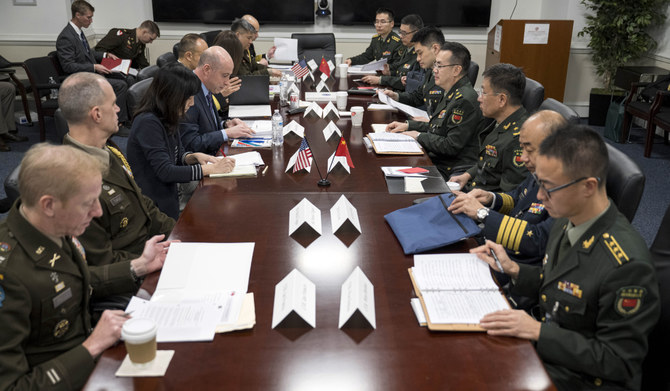
In this photo proved by the Defense Department, Deputy Assistant Secretary of Defense for China, Taiwan and Mongolia Michael Chase hosts delegates from China for the annual U.S.-PRC Defense Policy Coordination Talks at the Pentagon, on Tuesday, Jan. 9, 2024. (AP)
Short Url
Updated 10 January 2024
Follow

US-China conclude two days of military talks in Washington

  • The face-to-face meetings follow a call between Gen. CQ Brown Jr., chairman of the Joint Chiefs of Staff, & his counterpart Gen. Liu Zhenli, several weeks ago, which marked the first senior military communications between the US & China since August 2022

WASHINGTON: The United States and China concluded two days of military talks in Washington on Tuesday, the Pentagon said, the latest engagement between the two countries since they agreed to resume military-to-military ties.
US President Joe Biden and Chinese President Xi Jinping agreed Late last year to restart the engagement that had been severed by Beijing after then-House of Representatives Speaker Nancy Pelosi visited self-ruled Taiwan in August 2022.
Michael Chase, the deputy assistant secretary of defense for China, Taiwan, and Mongolia, met with China’s Major General Song Yanchao, deputy director of the central military commission office for international military cooperation, the Pentagon said. These were the 17th US-China defense policy coordination talks.
“The two sides discussed US-PRC defense relations, and Dr. Chase highlighted the importance of maintaining open lines of military-to-military communication in order to prevent competition from veering into conflict,” the statement added, using an acronym for the People’s Republic of China.
The top US military officer, Chairman of the Joint Chiefs of Staff General Charles Q. Brown, held a virtual meeting with his Chinese counterpart, General Liu Zhenli, last month.
Pentagon officials say communication between the two militaries is crucial to preventing a miscalculation from spiraling into conflict.
US officials have cautioned that even with some restoration of military communications, forging truly functional dialogue between the two sides could take time.
Washington and Beijing are at loggerheads over everything from the future of democratically ruled Taiwan to territorial claims in the South China Sea. Diplomatic relations are still recovering after the US downed an alleged Chinese spy balloon in February.
Taiwan is holding presidential and parliamentary polls this weekend, which are taking place against a backdrop of a ramped-up war of words between Taiwan and China, which views the island as its own territory despite the strong objections of the Taiwanese government.


ICE agents can’t make warrantless arrests in Oregon unless there’s a risk of escape, US judge rules

Updated 2 sec ago
Follow

ICE agents can’t make warrantless arrests in Oregon unless there’s a risk of escape, US judge rules

  • US District Judge Mustafa Kasubhai issued a preliminary injunction in a proposed class-action lawsuit
  • Case targets Department of Homeland Security’s practice of arresting immigrants they happen to come across
PORTLAND, Oregon: US immigration agents in Oregon must stop arresting people without warrants unless there’s a likelihood of escape, a federal judge ruled Wednesday.
US District Judge Mustafa Kasubhai issued a preliminary injunction in a proposed class-action lawsuit targeting the Department of Homeland Security’s practice of arresting immigrants they happen to come across while conducting ramped-up enforcement operations — which critics have described as “arrest first, justify later.”
The department, which is named as a defendant in the suit, did not immediately comment in response to a request from The Associated Press.
Similar actions, including immigration agents entering private property without a warrant issued by a court, have drawn concern from civil rights groups across the country amid President Donald Trump’s mass deportation efforts.
Courts in Colorado and Washington, D.C., have issued rulings like Kasubhai’s, and the government has appealed them.
In a memo last week, Todd Lyons, the acting head of US Immigration and Customs Enforcement, emphasized that agents should not make an arrest without an administrative arrest warrant issued by a supervisor unless they develop probable cause to believe that the person is in the US illegally and likely to escape from the scene before a warrant can be obtained.
But the judge heard evidence that agents in Oregon have arrested people in immigration sweeps without such warrants or determining escape was likely.
The daylong hearing included testimony from one plaintiff, Victor Cruz Gamez, a 56-year-old grandfather who has been in the US since 1999. He told the court he was arrested and held in an immigration detention facility for three weeks even though he has a valid work permit and a pending visa application.
Cruz Gamez testified that he was driving home from work in October when he was pulled over by immigration agents. Despite showing his driver’s license and work permit, he was detained and taken to the ICE building in Portland before being sent to an immigration detention center in Tacoma, Washington. After three weeks there, he was set to be deported until a lawyer secured his release, he said.
He teared up as he recounted how the arrest impacted his family, especially his wife. Once he was home they did not open the door for three weeks out of fear and one of his grandchildren did not want to go to school, he said through a Spanish interpreter.
Afterward a lawyer for the federal government told Cruz Gamez he was sorry about what he went through and the effect it had on them.
Kasubhai said the actions of agents in Oregon — including drawing guns on people while detaining them for civil immigration violations — have been “violent and brutal,” and he was concerned about the administration denying due process to those swept up in immigration raids.
“Due process calls for those who have great power to exercise great restraint,” he said. “That is the bedrock of a democratic republic founded on this great constitution. I think we’re losing that.”
The lawsuit was brought by the nonprofit law firm Innovation Law Lab, whose executive director, Stephen Manning, said he was confident the case will be a “catalyst for change here in Oregon.”
“That is fundamentally what this case is about: asking the government to follow the law,” he said during the hearing.
The preliminary injunction will remain in effect while the lawsuit proceeds.