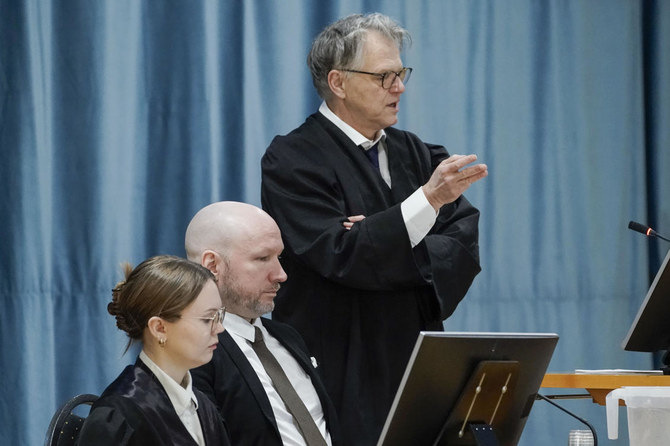
OSLO: A tearful Anders Behring Breivik, the right-wing extremist who killed 77 people in 2011, on Tuesday accused Norway of trying to “push (him) to suicide” with strict prison conditions, while authorities insisted he remained extremely violent.
“I have the impression that the government’s aim is to try to push me to suicide,” Breivik said on the second day of a court hearing in the lawsuit he has brought against the Norwegian state over his prison conditions.
“They are close to succeeding. I don’t think I will manage to survive much longer without human relations,” the 44-year-old told the court, convened for security reasons in the gymnasium of Ringerike prison where he is serving his sentence.
Held apart from other inmates in high-security facilities for almost 12 years, Breivik claims his extended isolation is a violation of Article 3 of the European Convention on Human Rights, which prohibits “inhuman” and “degrading” treatment.
The lawyer representing the state, Andreas Hjetland, defended Breivik’s conditions — which are strict but comfortable — as warranted since he still poses “an absolutely extreme risk of totally unbridled violence.”
On July 22, 2011, Breivik set off a bomb near government offices in Oslo, killing eight people, before gunning down 69 others, mostly teens, at a Labour Party youth wing summer camp on the island of Utoya.
He was sentenced in 2012 to 21 years in prison, which can be extended as long as he is considered a threat.
At one point during his testimony on Tuesday, Breivik, who takes anti-depressants, broke down in sobs.
“I understand that... revenge is important and that a lot of people hate me. But I’m still a human being,” he said.
He claimed he had distanced himself from his crimes — which he attributed to his “vulnerability” to radicalization — and said he thought of suicide “every day.”
Breivik has apologized in the past and showed no remorse on other occasions.
His testimony left families of the victims unmoved.
“He cries when he feels sorry for himself but when he says he’s sorry for what he did, he’s cold and cynical. I don’t believe him for a second,” Lisbeth Kristine Royneland, the head of a support group for families of the victims and who lost her 18-year-old daughter on Utoya, told AFP.
During Tuesday’s proceedings it emerged that Breivik tried to kill himself in 2020 by hanging himself with a towel, but made sure to inform prison guards first, the state’s lawyers noted.
In 2018, he also launched a disobedience campaign, drawing symbols such as swastikas with his feces, shouting “Sieg Heil” and undertaking a hunger strike.
“Breivik represents the same danger today as on July 21, 2011,” the eve of the twin attacks he prepared meticulously for years, Hjetland said.
He cited assessments by psychiatrists and prison wardens which suggest that Breivik remains dangerous and still believes his attacks were justified.
Asked once how he felt about having killed children on Utoya, he responded that in extreme-right circles the belief is that “if you’re old enough to be politically active, you’re old enough to be the target of terrorism.”
At the Ringerike prison, located on the shores of the lake that surrounds the island of Utoya, Breivik has access to several rooms including a kitchen, a TV room with a game console, and an exercise room.
Prison officials have also complied with his request for a pet by providing him with three budgies.
But Breivik’s lawyer Oystein Storrvik insists Norwegian authorities have not put sufficient measures in place to compensate for his relative isolation.
His human interactions are mostly limited to contacts with professionals such as wardens, lawyers and a chaplain.
“There is still no indication suggesting any (psychological) suffering linked to his isolation or that he is suicidal,” argued another lawyer for the state, Kristoffer Nerland.
Breivik enjoys “a wide range of activities,” he said, including cooking, video games, walks, basketball and studies.
Citing another article of the Convention on Human Rights that guarantees the right to correspondence, Breivik has also asked for an easing of his mail restrictions.
In 2016, Breivik sued the Norwegian state on the same grounds, with a lower court ruling in his favor before higher courts found in the state’s favor.
In 2018, the European Court of Human Rights dismissed his case as “inadmissible.”

Norway trying to ‘push me to suicide’, says sobbing Breivik
Short Url
https://arab.news/nu9jg
Norway trying to ‘push me to suicide’, says sobbing Breivik
- “I have the impression that the government’s aim is to try to push me to suicide,” Breivik said on the second day of a court hearing
- “I don’t think I will manage to survive much longer without human relations,” said the 44-year-old
Trump says Iran ‘want to negotiate’ after reports of hundreds killed in protests
- US President Donald Trump said Sunday that Iran’s leadership had called him seeking “to negotiate” after he repeatedly threatened to intervene militarily if Tehran killed protesters
WASHINGTON: US President Donald Trump said Sunday that Iran’s leadership had called him seeking “to negotiate” after he repeatedly threatened to intervene militarily if Tehran killed protesters.
For two weeks, Iran has been rocked by a protest movement that has swelled in spite of a crackdown rights groups warn has become a “massacre.”
Initially sparked by anger over the rising cost of living, the demonstrations have evolved into a serious challenge of the theocratic system in place since the 1979 revolution.
Information has continued to trickle out of Iran despite a days-long Internet shutdown, with videos filtering out of capital Tehran and other cities over the past three nights showing large demonstrations.
As reports emerge of a growing protest death toll, and images show bodies piled outside a morgue, Trump said Tehran indicated its willingness to talk.
“The leaders of Iran called” yesterday, Trump told reporters aboard Air Force One, adding that “a meeting is being set up... They want to negotiate.”
He added, however, that “we may have to act before a meeting.”
The US-based Center for Human Rights in Iran (CHRI) said it had received “eyewitness accounts and credible reports indicating that hundreds of protesters have been killed across Iran during the current Internet shutdown.”
“A massacre is unfolding,” it said.
The Norway-based NGO Iran Human Rights (IHR) said it confirmed the killing of at least 192 protesters but that the actual toll could be much higher.
“Unverified reports indicate that at least several hundreds, and according to some sources, more than 2,000 people may have been killed,” said IHR.
More than 2,600 protesters have been arrested, IHR estimates.
A video circulating on Sunday showed dozens of bodies accumulating outside a morgue south of Tehran.
The footage, geolocated by AFP to Kahrizak, showed bodies wrapped in black bags, with what appeared to be grieving relatives searching for loved ones.
- Near paralysis -
In Tehran, an AFP journalist described a city in a state of near paralysis.
The price of meat has nearly doubled since the start of the protests, and many shops are closed. Those that do open must close at around 4:00 or 5:00 pm, when security forces deploy en masse.
There were fewer videos showing protests on social media Sunday, but it was not clear to what extent that was due to the Internet shutdown.
One widely shared video showed protesters again gathering in the Pounak district of Tehran shouting slogans in favor of the ousted monarchy.
The protests have become one of the biggest challenges to the rule of supreme leader Ayatollah Ali Khamenei, 86, coming in the wake of Israel’s 12-day war against the Islamic republic in June, which was backed by the United States.
State TV has aired images of burning buildings, including a mosque, as well as funeral processions for security personnel.
But after three days of mass actions, state outlets were at pains to present a picture of calm returning, broadcasting images of smooth-flowing traffic on Sunday. Tehran Governor Mohammad-Sadegh Motamedian insisted in televised comments that “the number of protests is decreasing.”
The Iranian government on Sunday declared three days of national mourning for “martyrs” including members of the security forces killed.
President Masoud Pezeshkian also urged Iranians to join a “national resistance march” Monday to denounce the violence.
In response to Trump’s repeated threats to intervene, Iran’s parliament speaker Mohammad Bagher Ghalibaf said Iran would hit back, calling US military and shipping “legitimate targets” in comments broadcast by state TV.
- ‘Stand with the people’ -
Reza Pahlavi, the US-based son of Iran’s ousted shah, who has emerged as an anti-government figurehead, said he was prepared to return to the country and lead a democratic transition.
“I’m already planning on that,” he told Fox News on Sunday.
He later urged Iran’s security forces and government workers to join the demonstrators.
“Employees of state institutions, as well as members of the armed and security forces, have a choice: stand with the people and become allies of the nation, or choose complicity with the murderers of the people,” he said in a social media post.
He also urged protesters to replace the flags outside of Iranian embassies.
“The time has come for them to be adorned with Iran’s national flag,” he said.
The ceremonial, pre-revolution flag has become an emblem of the global rallies that have mushroomed in support of Iran’s demonstrators.
In London, protesters managed over the weekend to swap out the Iranian embassy flag, hoisting in its place the tri-colored banner used under the last shah.
For two weeks, Iran has been rocked by a protest movement that has swelled in spite of a crackdown rights groups warn has become a “massacre.”
Initially sparked by anger over the rising cost of living, the demonstrations have evolved into a serious challenge of the theocratic system in place since the 1979 revolution.
Information has continued to trickle out of Iran despite a days-long Internet shutdown, with videos filtering out of capital Tehran and other cities over the past three nights showing large demonstrations.
As reports emerge of a growing protest death toll, and images show bodies piled outside a morgue, Trump said Tehran indicated its willingness to talk.
“The leaders of Iran called” yesterday, Trump told reporters aboard Air Force One, adding that “a meeting is being set up... They want to negotiate.”
He added, however, that “we may have to act before a meeting.”
The US-based Center for Human Rights in Iran (CHRI) said it had received “eyewitness accounts and credible reports indicating that hundreds of protesters have been killed across Iran during the current Internet shutdown.”
“A massacre is unfolding,” it said.
The Norway-based NGO Iran Human Rights (IHR) said it confirmed the killing of at least 192 protesters but that the actual toll could be much higher.
“Unverified reports indicate that at least several hundreds, and according to some sources, more than 2,000 people may have been killed,” said IHR.
More than 2,600 protesters have been arrested, IHR estimates.
A video circulating on Sunday showed dozens of bodies accumulating outside a morgue south of Tehran.
The footage, geolocated by AFP to Kahrizak, showed bodies wrapped in black bags, with what appeared to be grieving relatives searching for loved ones.
- Near paralysis -
In Tehran, an AFP journalist described a city in a state of near paralysis.
The price of meat has nearly doubled since the start of the protests, and many shops are closed. Those that do open must close at around 4:00 or 5:00 pm, when security forces deploy en masse.
There were fewer videos showing protests on social media Sunday, but it was not clear to what extent that was due to the Internet shutdown.
One widely shared video showed protesters again gathering in the Pounak district of Tehran shouting slogans in favor of the ousted monarchy.
The protests have become one of the biggest challenges to the rule of supreme leader Ayatollah Ali Khamenei, 86, coming in the wake of Israel’s 12-day war against the Islamic republic in June, which was backed by the United States.
State TV has aired images of burning buildings, including a mosque, as well as funeral processions for security personnel.
But after three days of mass actions, state outlets were at pains to present a picture of calm returning, broadcasting images of smooth-flowing traffic on Sunday. Tehran Governor Mohammad-Sadegh Motamedian insisted in televised comments that “the number of protests is decreasing.”
The Iranian government on Sunday declared three days of national mourning for “martyrs” including members of the security forces killed.
President Masoud Pezeshkian also urged Iranians to join a “national resistance march” Monday to denounce the violence.
In response to Trump’s repeated threats to intervene, Iran’s parliament speaker Mohammad Bagher Ghalibaf said Iran would hit back, calling US military and shipping “legitimate targets” in comments broadcast by state TV.
- ‘Stand with the people’ -
Reza Pahlavi, the US-based son of Iran’s ousted shah, who has emerged as an anti-government figurehead, said he was prepared to return to the country and lead a democratic transition.
“I’m already planning on that,” he told Fox News on Sunday.
He later urged Iran’s security forces and government workers to join the demonstrators.
“Employees of state institutions, as well as members of the armed and security forces, have a choice: stand with the people and become allies of the nation, or choose complicity with the murderers of the people,” he said in a social media post.
He also urged protesters to replace the flags outside of Iranian embassies.
“The time has come for them to be adorned with Iran’s national flag,” he said.
The ceremonial, pre-revolution flag has become an emblem of the global rallies that have mushroomed in support of Iran’s demonstrators.
In London, protesters managed over the weekend to swap out the Iranian embassy flag, hoisting in its place the tri-colored banner used under the last shah.
© 2026 SAUDI RESEARCH & PUBLISHING COMPANY, All Rights Reserved And subject to Terms of Use Agreement.


