

Pakistani religious party chief meets Afghanistan’s PM to discuss regional security, refugees 

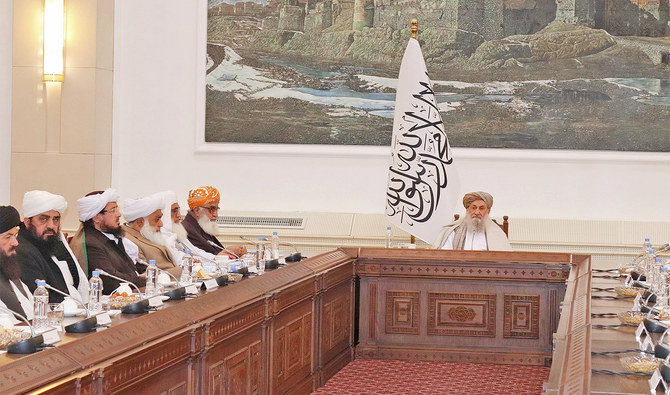
Afghanistan Prime Minister Mullah Mohammad Hassan Akhund (center) meets Maulana Fazl-ur-Rehman (first from right), leader of Pakistan's prominent religious party, Jamiat Ulama-e-Islam (last from left), in Kabul, Pakistan, on January 8, 2024. (@juipakofficial/X)
Short Url
Updated 08 January 2024
Follow

Pakistani religious party chief meets Afghanistan’s PM to discuss regional security, refugees 

  • Fazl arrived in Kabul on Sunday evening to hold talks with Afghan leadership amid strained Pakistan-Afghanistan ties
  • Purpose of our Afghanistan visit is to remove misunderstandings between the two countries, says Fazl-ur-Rehman 

ISLAMABAD: The leader of a prominent Pakistani religious political party, Maulana Fazl-ur-Rehman, met Afghanistan’s Prime Minister Mohammad Hasan Akhund on Monday to discuss bilateral issues such including the repatriation of Afghan migrants from Pakistan, regional security and other matters, a statement from the party said. 

Rehman arrived in Pakistan on Sunday evening with a delegation to hold talks with the Afghan leadership. His visit comes at a time when ties between the two countries are strained due to rising militant attacks in Pakistan’s western provinces bordering Afghanistan and Islamabad’s move to deport thousands of “illegal immigrants,” mostly Afghan nationals, which it says are behind a surge in suicide attacks in the country. 

On Sunday, Rehman met Afghanistan’s deputy prime minister, Maulana Abdul Kabeer, in Kabul to discuss the regional situation and its impact on bilateral relations between the two countries. 

“The purpose of our Afghanistan visit is to remove the misunderstandings between the two countries,” Rehman was quoted as saying by his party, the Jamiat Ulama-e-Pakistan Fazl (JUI-F), in a statement. “To find ways to cooperate in political, economic, trade and matters of mutual interest between the two nations.”

Rehman regretted Pakistan’s move to deport Afghan migrants from the country, noting that his party had protested against the government’s decision to do so. 

“We consider this behavior wrong and declare it as the reason for problems between the two countries,” Rehman said. “We have brought a message of goodwill and hope this visit brings forth positive results.”

According to the JUI-F’s statement, Akhund said Pakistan and Afghanistan had a lot in common with each other due to which it was not possible to separate the two countries. 

“The Islamic Emirate does not intend to harm or create problems for any neighboring country, including Afghanistan,” Akhund was quoted as saying by the JUI-F. 
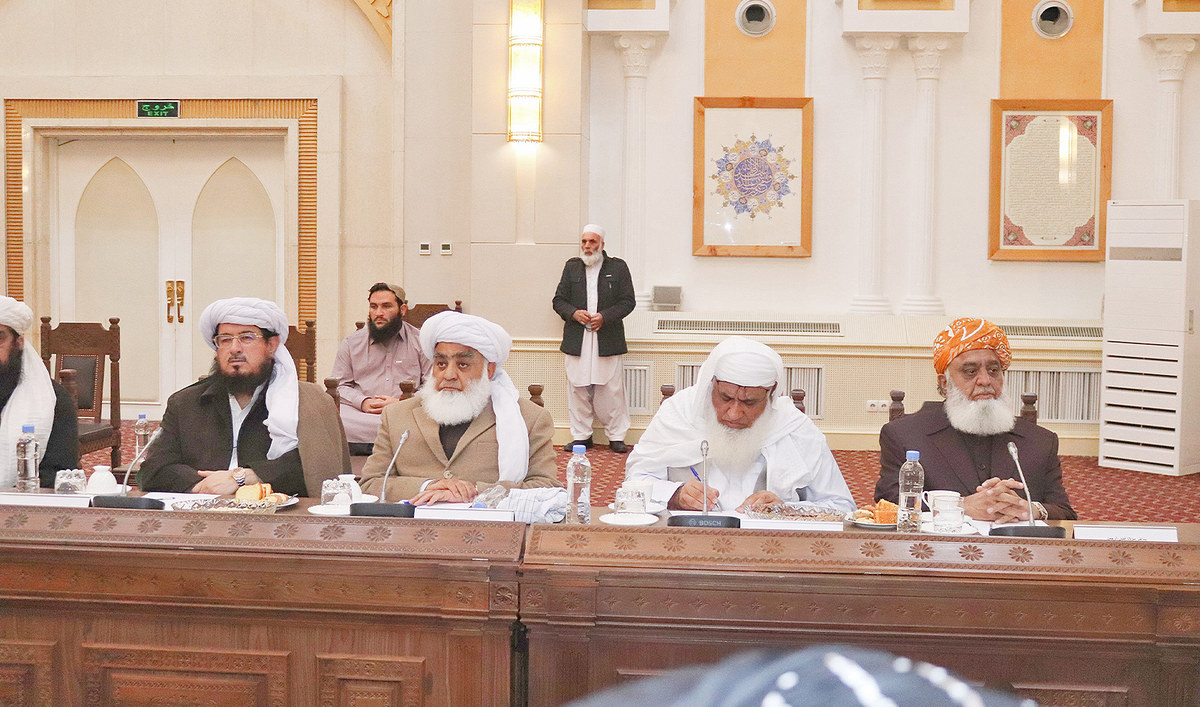


Maulana Fazl-ur-Rehman (first from right), leader of Pakistan's prominent religious party, Jamiat Ulama-e-Islam (JUI-F), is pictured during a meeting with Afghanistan Prime Minister Mullah Mohammad Hassan Akhund in Kabul, Pakistan, on January 8, 2024. (@juipakofficial/X)

The statement said Akhund urged Pakistan not to stop their “cruel behavior” toward Afghan refugees, adding that such behavior causes differences and disappointment instead of solving problems. 

“Foreign Minister Amir Khan Muttaqi discussed, apart from the problems faced by Afghan refugees, the difficulties of the Afghan traders and the problems caused by Pakistani authorities in the transit trade route and exports which causes every year a heavy loss to Afghan traders,” the statement said. 

Fazl’s delegation included JUI-F leaders Maulana Abdul Wasay, Maulana Salahuddin, Maulana Jamaluddin, Maulana Saleemuddin Shamzai and others. Akhund’s delegation comprised Afghanistan’s Chief Justice Abdul Hakim Haqqani, Foreign Minister Amir Khan Muttaqi and other senior members of the government. 

Rehman enjoys close relations with the Taliban leadership in Afghanistan, as his party is known for its staunch advocacy of Islamic laws and values. The party wields considerable influence in Pakistan’s Khyber Pakhtunkhwa and Balochistan provinces both which border Afghanistan. 


Islamic military coalition, Pakistan to deepen cooperation to combat ‘terrorism’ — Pakistani military

Updated 02 February 2026
Follow

Islamic military coalition, Pakistan to deepen cooperation to combat ‘terrorism’ — Pakistani military

  • Islamic Military Counter Terrorism Coalition is a 43-member alliance that includes Pakistan, Saudi Arabia, Egypt, Jordan, UAE and other nations
  • The Pakistani military statement comes after a meeting between IMCTC secretary-general and the chief of Pakistani defense forces in Rawalpindi

ISLAMABAD: Pakistan and the Islamic Military Counter Terrorism Coalition (IMCTC) have reaffirmed their commitment to deepening cooperation, including intelligence sharing and capacity building, to jointly combat “terrorism” and “extremism,” the Pakistani military said on Monday.

The IMCTC is a 43-member military alliance that was formed on Saudi Arabia’s initiative in Dec. 2015 to consolidate Muslim countries’ efforts in countering “terrorism.”

A 17-member IMCTC delegation is visiting Pakistan from Feb. 2-6 to conduct a training at National University of Sciences and Technology on “Re-integration and Rehabilitation of Extremist Elements,” according to the Pakistani military.

On Monday, IMCTC Secretary-General Maj. Gen. Mohammed bin Saeed Al-Moghedi held a meeting with Chief of Pakistani Defense Forces Field Marshal Asim Munir to discuss cooperation among IMCTC member states.

“During the meeting, matters of mutual interest were discussed, with particular emphasis on regional security dynamics and enhanced cooperation in counter-terrorism efforts,” the Inter-Services Public Relations (ISPR), the Pakistani military’s media wing, said in a statement.

“Both sides reaffirmed their shared commitment to combating terrorism and extremism through collaborative strategies, intelligence sharing, and capacity building among member states.”

The IMCTC features Pakistan, Saudi Arabia, Türkiye, Afghanistan, Egypt, Jordan, Qatar, Palestine, UAE, Bangladesh and other nations. In 2017, Pakistan’s former army chief Gen. (retd) Raheel Sharif was appointed as the IMCTC commander-in-chief.

During discussions with Major General Al-Moghedi, Field Marshal Munir appreciated the role of IMCTC in fostering stability and promoting coordinated counterterrorism initiatives across the Islamic world, according to the ISPR.

The IMCTC secretary-general acknowledged Pakistan’s significant contributions and sacrifices in the fight against militancy and lauded the professionalism of Pakistan’s armed forces.

“The meeting underscored the resolve of both sides to further strengthen institutional collaboration for peace, stability, and security in the region,” the ISPR added.

Pakistan enjoys cordial ties with most Muslim countries around the world, particularly Gulf Cooperation Council countries. In Sept. 2025, Pakistan signed a landmark defense pact with Saudi Arabia according to which an act of aggression against one country will be treated as an act of aggression against both.