

Pakistani religious party chief meets Afghanistan’s PM to discuss regional security, refugees 

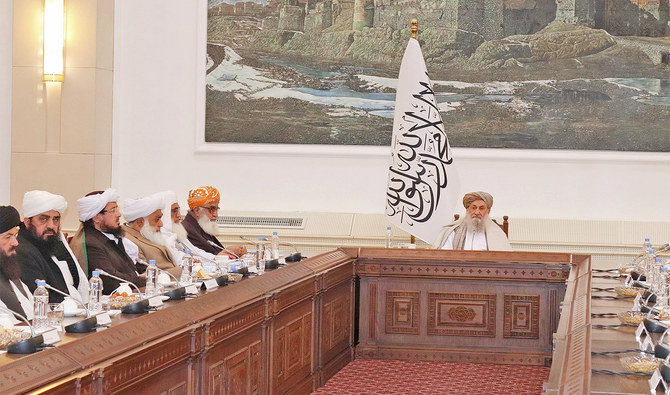
Afghanistan Prime Minister Mullah Mohammad Hassan Akhund (center) meets Maulana Fazl-ur-Rehman (first from right), leader of Pakistan's prominent religious party, Jamiat Ulama-e-Islam (last from left), in Kabul, Pakistan, on January 8, 2024. (@juipakofficial/X)
Short Url
Updated 08 January 2024
Follow

Pakistani religious party chief meets Afghanistan’s PM to discuss regional security, refugees 

  • Fazl arrived in Kabul on Sunday evening to hold talks with Afghan leadership amid strained Pakistan-Afghanistan ties
  • Purpose of our Afghanistan visit is to remove misunderstandings between the two countries, says Fazl-ur-Rehman 

ISLAMABAD: The leader of a prominent Pakistani religious political party, Maulana Fazl-ur-Rehman, met Afghanistan’s Prime Minister Mohammad Hasan Akhund on Monday to discuss bilateral issues such including the repatriation of Afghan migrants from Pakistan, regional security and other matters, a statement from the party said. 

Rehman arrived in Pakistan on Sunday evening with a delegation to hold talks with the Afghan leadership. His visit comes at a time when ties between the two countries are strained due to rising militant attacks in Pakistan’s western provinces bordering Afghanistan and Islamabad’s move to deport thousands of “illegal immigrants,” mostly Afghan nationals, which it says are behind a surge in suicide attacks in the country. 

On Sunday, Rehman met Afghanistan’s deputy prime minister, Maulana Abdul Kabeer, in Kabul to discuss the regional situation and its impact on bilateral relations between the two countries. 

“The purpose of our Afghanistan visit is to remove the misunderstandings between the two countries,” Rehman was quoted as saying by his party, the Jamiat Ulama-e-Pakistan Fazl (JUI-F), in a statement. “To find ways to cooperate in political, economic, trade and matters of mutual interest between the two nations.”

Rehman regretted Pakistan’s move to deport Afghan migrants from the country, noting that his party had protested against the government’s decision to do so. 

“We consider this behavior wrong and declare it as the reason for problems between the two countries,” Rehman said. “We have brought a message of goodwill and hope this visit brings forth positive results.”

According to the JUI-F’s statement, Akhund said Pakistan and Afghanistan had a lot in common with each other due to which it was not possible to separate the two countries. 

“The Islamic Emirate does not intend to harm or create problems for any neighboring country, including Afghanistan,” Akhund was quoted as saying by the JUI-F. 
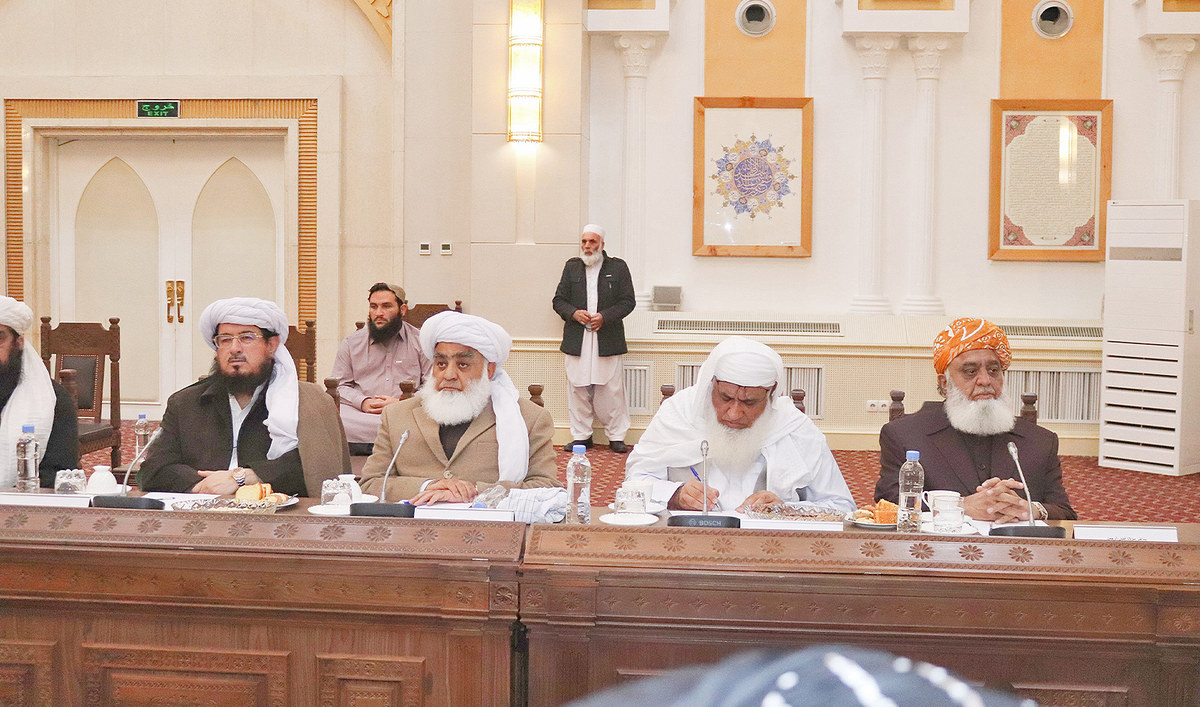


Maulana Fazl-ur-Rehman (first from right), leader of Pakistan's prominent religious party, Jamiat Ulama-e-Islam (JUI-F), is pictured during a meeting with Afghanistan Prime Minister Mullah Mohammad Hassan Akhund in Kabul, Pakistan, on January 8, 2024. (@juipakofficial/X)

The statement said Akhund urged Pakistan not to stop their “cruel behavior” toward Afghan refugees, adding that such behavior causes differences and disappointment instead of solving problems. 

“Foreign Minister Amir Khan Muttaqi discussed, apart from the problems faced by Afghan refugees, the difficulties of the Afghan traders and the problems caused by Pakistani authorities in the transit trade route and exports which causes every year a heavy loss to Afghan traders,” the statement said. 

Fazl’s delegation included JUI-F leaders Maulana Abdul Wasay, Maulana Salahuddin, Maulana Jamaluddin, Maulana Saleemuddin Shamzai and others. Akhund’s delegation comprised Afghanistan’s Chief Justice Abdul Hakim Haqqani, Foreign Minister Amir Khan Muttaqi and other senior members of the government. 

Rehman enjoys close relations with the Taliban leadership in Afghanistan, as his party is known for its staunch advocacy of Islamic laws and values. The party wields considerable influence in Pakistan’s Khyber Pakhtunkhwa and Balochistan provinces both which border Afghanistan. 


World Bank president in Pakistan to discuss development projects, policy issues

Updated 01 February 2026
Follow

World Bank president in Pakistan to discuss development projects, policy issues

  • Pakistan, World Bank are currently gearing up to implement a 10-year partnership framework to grant $20 billion loans to the cash-strapped nation
  • World Bank President Ajay Banga will hold meetings with Pakistan Prime Minister Shehbaz Sharif and other senior officials during the high-level visit

ISLAMABAD: World Bank President Ajay Banga has arrived in Pakistan to hold talks with senior government officials on development projects and key policy issues, Pakistani state media reported on Sunday, as Islamabad seeks multilateral support to stabilize economy and accelerate growth.

The visit comes at a time when Pakistan and the World Bank are gearing up to implement a 10-year Country Partnership Framework (CPF) to grant $20 billion in loans to the cash-strapped nation.

The World Bank’s lending for Pakistan, due to start this year, will focus on education quality, child stunting, climate resilience, energy efficiency, inclusive development and private investment.

"World Bank President Ajay Banga arrives in Pakistan for a high-level visit," the state-run Pakistan TV Digital reported on Sunday. "During his stay, he will meet Prime Minister Shehbaz Sharif and other senior officials to discuss economic reforms, development projects, and key policy issues."

Pakistan, which nearly defaulted on its foreign debt obligations in 2023, is currently making efforts to stabilize its economy under a $7 billion International Monetary Fund (IMF) program.

Besides efforts to boost trade and foreign investment, Islamabad has been seeking support from multilateral financial institutions to ensure economic recovery.

“This partnership fosters a unified and focused vision for your county around six outcomes with clear, tangible and ambitious 10-year targets,” Martin Raiser, the World Bank vice president for South Asia, had said at the launch of the CPF in Jan. last year.

“We hope that the CPF will serve as an anchor for this engagement to keep us on the right track. Partnerships will equally be critical. More resources will be needed to have the impact at the scale that we wish to achieve and this will require close collaboration with all the development partners.”

In Dec., the World Bank said it had approved $700 million in ​financing for Pakistan under a multi-year initiative aimed at supporting the country's macroeconomic stability and service delivery.

It ‍followed a $47.9 ‍million World Bank grant ‍in August last year to improve primary education in Pakistan's most populous Punjab province.