Five policemen killed, 22 injured as blast targets polio protection team in northwestern Pakistan 

People gather next to a police vehicle targeted in a blast in Bajaur city, Pakistan, on January 8, 2024. (Rescue 1122)
Short Url
Updated 08 January 2024
Follow

Five policemen killed, 22 injured as blast targets polio protection team in northwestern Pakistan 

  • Outlawed Tehreek-e-Taliban Pakistan group takes responsibility for remote-controlled blast
  • Pakistan kicked off a nationwide polio campaign on Monday to inoculate children below 5 years

ISLAMABAD: Five policemen were killed and 22 others injured on Monday morning after a blast targeted a polio protection team in northwestern Pakistan, a police official confirmed. 

The bomb blast targeted the vehicle in Mamund village in Pakistan's northwestern Bajaur district, police officer Aziz-ur-Rehman told Arab News. He said a police contingent was heading out to far-flung areas in the province to protect polio volunteers when one of the vehicles was targeted in a bomb blast. 

“Five policemen were martyred and 22 others injured, with half of them in critical condition, when the vehicle they were travelling in was targeted by a remote-controlled bomb," Rehman said. He added that the village is located on the outskirts of Khar, a busy town in the tribal district. 
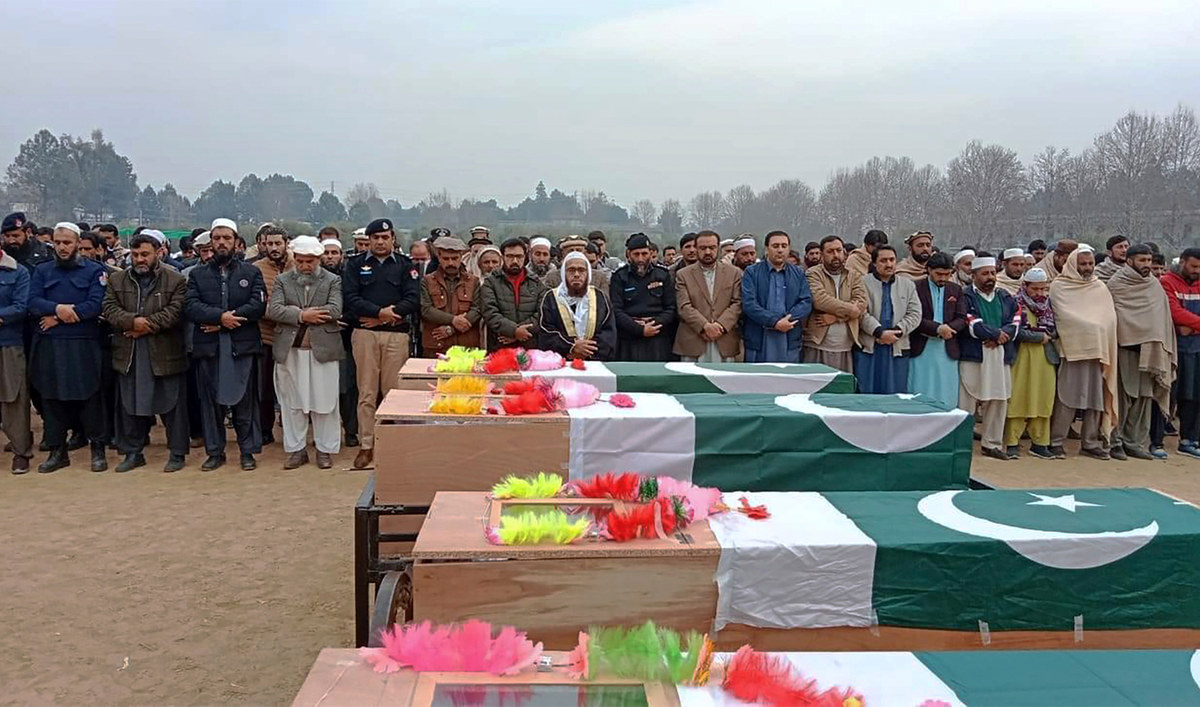


Officials and local residents offer funeral prayers of police officers, who were killed in the roadside bombing, in Khar, Pakistan, on January 8, 2024. (AP)

Rehman said another police contingent was dispatched to the area after the blast, adding that all those who were critically injured were being shifted to Peshawar for treatment. 

The outlawed Tehreek-e-Taliban Pakistan (TTP) militant group claimed responsibility for the blast. "A police mobile party was targeted with a mine blast in which six policemen were killed and 10 others severely wounded," Muhammad Khorasani, a TTP spokesperson, said in a statement. 

Pakistan Peoples Party (PPP) Chairman and former foreign minister Bilawal Bhutto-Zardari condemned the blast, describing the police officers who were protecting the polio volunteers as "national heroes."

"Khyber Pakhtunkhwa police is frustrating the aims of terrorists," Bhutto-Zardari said in a statement. "The terrorists involved in the Bajaur incident and their facilitators are enemies of the nation."

The Bajur district near the Afghan border was once a stronghold of the Pakistani Taliban — a close ally of Afghanistan’s Taliban government — before the Pakistani army drove the militants out of the tribal districts in successive operations that began in late 2000s.

In July last year, a suicide bomb blast killed over 50 people and wounded scores of others when the Jamiat Ulama-e-Islam Fazl (JUI-F) party held a convention for its supporters in the city. 

Pakistan kicked off a nationwide door-to-door polio campaign to vaccinate children under the age of five years. The South Asian nation and Afghanistan are the only two countries in the world where the disease is still endemic.  

Militants, including the Pakistani Taliban, have killed scores of polio vaccination workers and their security escorts in the past. Opposition to inoculation grew after the US Central Intelligence Agency organized a fake vaccination drive to help track down Al-Qaeda's former leader Osama bin Laden in the Pakistani garrison town of Abbottabad in 2011. 


Pakistan remittances seen surpassing $40 billion in FY26 as Saudi Arabia leads November inflows

Updated 4 sec ago
Follow

Pakistan remittances seen surpassing $40 billion in FY26 as Saudi Arabia leads November inflows

  • The country’s November remittances rose 9.4 percent year-on-year to $3.2 billion, official data show
  • Economic experts say rupee stability and higher use of formal channels are driving the upward trend

ISLAMABAD: Pakistan’s workers’ remittances are expected to exceed the $40 billion mark in the current fiscal year, economic experts said Tuesday, after the country recorded an inflow of $3.2 billion in November, with Saudi Arabia once again emerging as the biggest contributor.

Remittances are a key pillar of Pakistan’s external finances, providing hard currency that supports household consumption, helps narrow the current-account gap and bolsters foreign-exchange reserves. The steady pipeline from Gulf economies, led by Saudi Arabia and the United Arab Emirates, has remained crucial for Pakistan’s balance of payments.

A government statement said monthly remittances in November stood at $3.2 billion, reflecting a 9.4 percent year-on-year increase.

“The growth in remittances means the full-year figure is expected to cross the $40 billion target in fiscal year 2026,” Sana Tawfik, head of research at Arif Habib Limited, told Arab News over the phone.

“There are a couple of factors behind the rise in remittances,” she said. “One of them is the stability of the rupee. In addition, the country is receiving more inflows through formal channels.”

Tawfik said the trend was positive for the current account and expected inflows to remain strong in the second half of the fiscal year, noting that both Muslim festivals of Eid fall in that period, when overseas Pakistanis traditionally send additional money home for family expenses and celebrations.

The official statement said cumulative remittances reached $16.1 billion during July–November, up 9.3 percent from $14.8 billion in the same period last year.

It added that November inflows were mainly sourced from Saudi Arabia ($753 million), the United Arab Emirates ($675 million), the United Kingdom ($481.1 million) and the United States ($277.1 million).

“UAE remittances have regained momentum in recent months, with their share at 21 percent in November 2025 from a low of 18 percent in FY24,” said Muhammad Waqas Ghani, head of research at JS Global Capital Limited. “Dubai in particular has seen a steady pick-up, reflecting improved inflows from Pakistani expatriates owing to some relaxation in emigration policies.”