

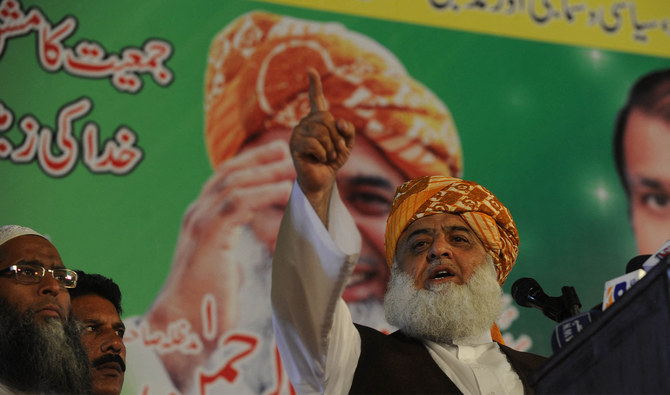

PESHAWAR: A prominent religious party in Pakistan’s northwestern Khyber Pakhtunkhwa (KP) province anticipated to exceed its previous electoral performances on Feb. 8, analysts observed over the weekend, before its leaders began proposing an election delay amid growing security threats that undermined their campaign.
Maulana Fazlur Rehman’s Jamiat Ulama-e-Islam (JUI-F) party has a history intertwined with the broader narrative of religious and political dynamics in Pakistan. The party’s roots can be traced back to the Jamiat Ulema-e-Hind, an influential group of Islamic scholars in British India that became actively involved in the struggle against British colonial rule.
The JUI-F is known for its staunch advocacy of Islamic laws and values, aiming to influence Pakistan’s governance with a religiously guided framework. While not known for securing significant numbers of national and provincial seats in elections, it has wielded considerable influence in KP and Balochistan provinces while remaining part of several coalition governments in the country.
Speaking to Arab News, analysts noted the party hoped to fill the political void left by former prime minister Imran Khan’s Pakistan Tehreek-e-Insaf (PTI) party, which had governed KP for two consecutive terms starting in 2013, but is now facing challenges with much of its top leadership imprisoned on various charges. However, it became increasingly difficult for the JUI-F to hold public rallies and workers’ conventions in recent months after enduring a string of militant attacks against its leaders and supporters.
“The JUI-F welcomed PTI’s exclusion [from politics],” Aamer Raza, who teaches at Peshawar University, said while speaking to Arab News. “It had no qualms while trying to secure more seats in the [national and provincial] assemblies at PTI’s cost.”
“Daesh started targeting it in the past couple of months, though, making it tough for the party to freely campaign,” he continued. “Since PTI is already hamstrung by the political situation and [Pashtun] nationalist parties have lost their appeal, we may witness a low voting turnout [in the next elections] and more local independent candidates taking advantage of the situation.”
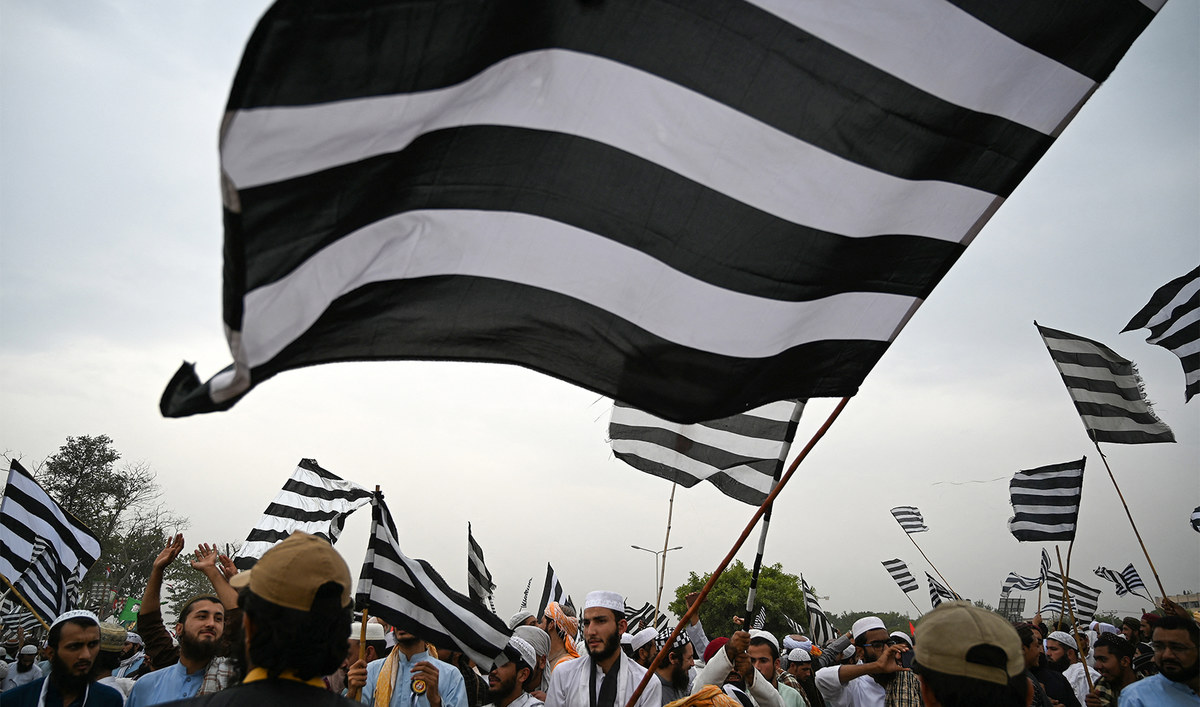
Activists and supporters of Islamic political party Jamiat Ulema-e-Islam (JUI-F) wave flags during anti-government "Azadi (Freedom) March" in Islamabad on November 1, 2019. (AFP/File)
Raza said the JUI-F’s stronghold had mostly been in KP’s southern districts, with pockets of support in central districts such as Peshawar, Mardan and Charsadda.
“With the rising PTI popularity, however, the JUI-F support has eroded over time,” he added. “Also, the JUI-F has failed to appeal to the young population and women voters.”
The security issue has started posing an even more daunting challenge to the party in recent months.
Rehman, the JUI-F chief, survived a shooting incident targeting his convoy on the Islamabad-Dera Ismail Khan motorway earlier this month. His son, Maulana Asad Mahmood, was warned of militant threats by police authorities in KP who asked him to keep his movements confidential and avoid unnecessary public gatherings weeks before the elections.
Last year in July, nearly 50 JUI-F workers were killed in a suicide blast targeting a workers’ convention in Bajaur district, and in a separate incident, one of the party’s top leaders, Hafiz Hamdullah, was injured in a blast in Balochistan’s Mastung region, which also wounded 10 others.
Asked about the situation, JUI-F spokesman Aslam Ghauri said: “Given the current law and order and [extremely cold] weather conditions, the [conducive] election environment which is the constitutional and fundamental right of every party is not available to us.”
Despite participating in all past general elections, the JUI-F only had a notable showing in 2002 when it was part of a six-party religious alliance called the Muttahida Majlis-e-Amal (MMA).
“During our five-year rule, the JUI-F enrolled 0.5 million children in schools, recruited 40,000 teachers, increased the health budget from Rs2.5 billion to Rs3.5 billion,” Ghauri said. “We also launched kidney, burn and cardiovascular centers, upgraded hospitals in 22 districts of the province, established four medical colleges, one medical university and three teaching hospitals with free medicines for patients.”
He maintained his party knew of people’s problems better than other political factions, saying it could also play a pivotal role in addressing religious militancy in the country.
“JUI-F has always opposed extremism,” he said. “With the help of public support, it can tackle and control this problem through fair utilization of resources for public welfare.”
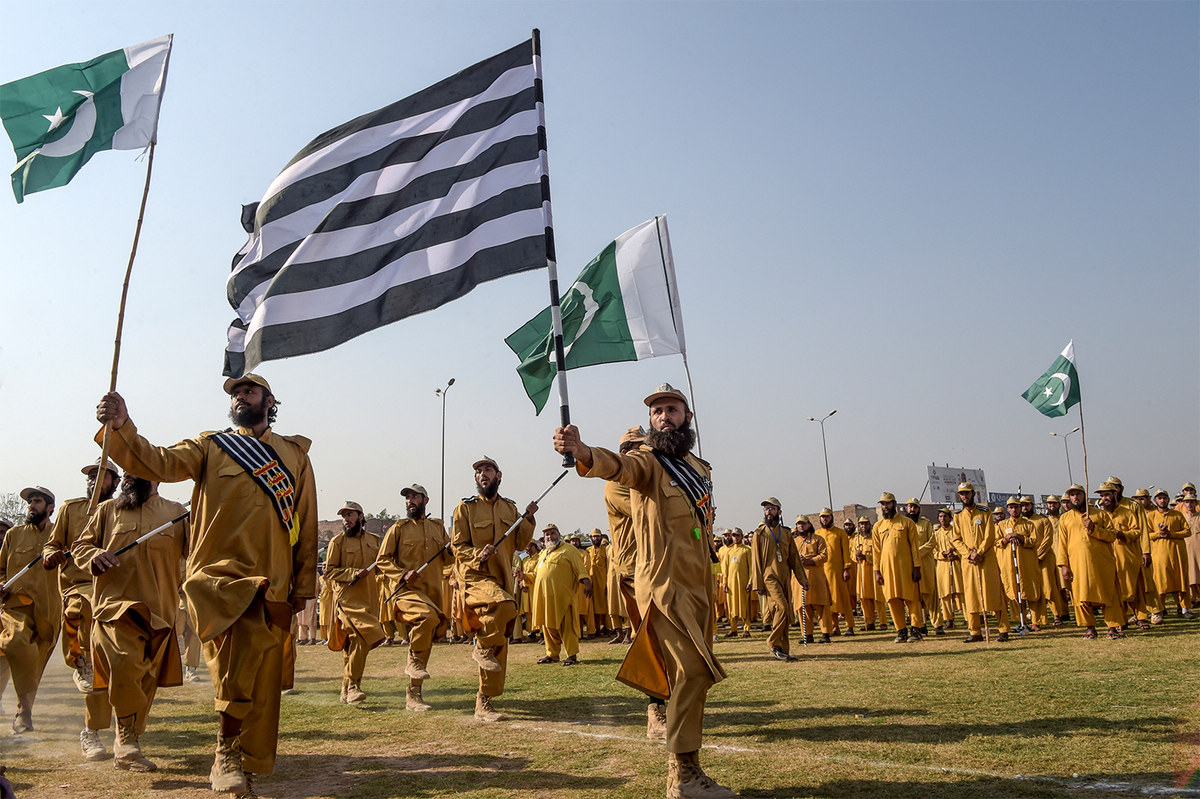
Activists of Jamiat Ulema-e Islam Fazal (JUI-F) party hold the Pakistani flag and their party flag as they prepare an 'Azadi' (freedom) march in Peshawar on October 13, 2019. (AFP/File)
However, Shamim Shahid, a Peshawar-based analyst, expressed skepticism about the party’s popularity and its solutions to people’s problems.
“It attracts voters through oft-repeated religious slogans,” he maintained. “Otherwise, it has no democratic motto, no specific plans to rid the country and nation of inflation, extremism or resolve other pressing issues such as poverty.”
Meanwhile, Jalil Jan, a party spokesperson in KP, said the state should ensure peace and prevent attacks on the JUI-F and its leadership ahead of the elections.
“Attack or firing on a national leader of Maulana Fazlur Rehman’s caliber raises a serious question mark over the state’s writ,” he said.



