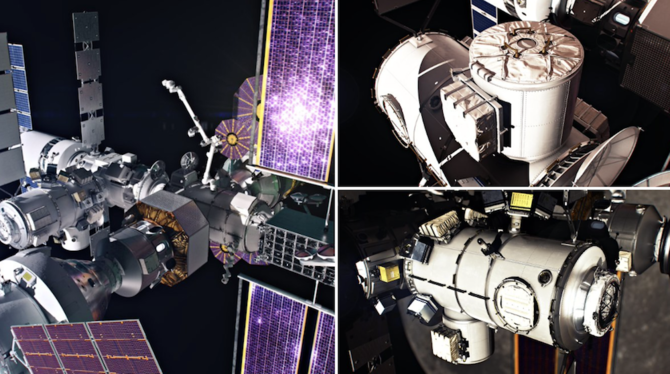

CHICAGO: The US National Space Agency announced on Sunday that it will partner with the UAE Mohammed bin Rashid Space Center, or MBRSC, to build an “air lock” that will be a critical part of future Artemis/Gateway space missions to launch a space station to orbit the Moon.
NASA launched the unmanned Artemis I Mission in November 2022, lasting 25 days, and is planning Artemis II, also called Gateway, to launch four astronauts on a Moon mission scheduled for November 2024.
The UAE is involved in the construction of a station that will eventually be launched in space around the Moon and that will serve as a stepping-stone to build a Moon base that will serve to launch further missions to explore Mars.
“The United States and the United Arab Emirates are marking a historic moment in our nations’ collaboration in space, and the future of human space exploration,” NASA Administrator Bill Nelson said in a statement.
“We are in a new era of exploration through Artemis — strengthened by the peaceful and international exploration of space. The UAE’s provision of the airlock to Gateway will allow astronauts to conduct groundbreaking science in deep space and prepare to one day send humanity to Mars.”
MBRSC will provide Gateway’s crew module and science airlock module, as well as a UAE astronaut to fly to the lunar space station on a future Artemis mission.
“Today’s announcement and partnership between the United States and United Arab Emirates advances this important work. By combining our resources, scientific capacity and technical skill, the US and UAE will further our collective vision for space and ensure it presents extraordinary opportunities for everyone here on Earth,” said US Vice President Kamala Harris.
Artemis II will land the first woman and first person of color on the Moon, using “innovative technologies to explore more of the lunar surface,” NASA officials said.
NASA is working with commercial and international partners including Saudi Arabia and the UAE to establish the first long-term presence on the Moon. NASA officials said that the Moon landing would allow the Artemis team “to take the next giant leap: sending the first astronauts to Mars.”
Gateway is a vital component of the NASA-led Artemis missions to return to the Moon and chart a path for the first human missions to Mars. The small space station will be a multi-purpose outpost orbiting the Moon and providing essential support for lunar surface missions, a destination for science, and serving as a staging point for further deep space exploration. NASA is working with commercial and international partners to establish Gateway, according to NASA information.
Among members of the Artemis Accords is Saudi Arabia, which established a scholarship program to train young people in space travel and launched an astronaut program in 2022. Saudi Prince Sultan bin Salman was the Arab world’s first astronaut to participate in Nasa’s Space Shuttle in 1985. He was also the first Arab and first Muslim to participate in a space mission.
Saudi Arabia joined the Artemis founding member nations in 2023. Those founding nations include Australia, Canada, Italy, Japan, Luxembourg, UAE, the UK and the US.
In addition to operating the airlock, MBRSC will also provide engineering support for the life of the lunar space station. The airlock will allow crew and science research transfers to and from the habitable environment of Gateway’s pressurized crew modules to the vacuum of space. These transfers will support broader science in the deep space environment, as well as Gateway maintenance.
Gateway will support sustained exploration and research in deep space, provide a home for astronauts to live and work, including a staging point for lunar surface missions, and an opportunity to conduct spacewalks while orbiting the Moon.
NASA’s Artemis program is the most diverse and broad coalition of nations in human exploration in deep space. In collaboration with the Canadian Space Agency, European Space Agency, Japan Aerospace Exploration Agency and now the MBRSC, NASA will return humans to the lunar surface for scientific discovery and chart a path for the first human missions to Mars.
This latest cooperation on Gateway builds on NASA’s and the UAE’s previous human spaceflight collaboration.
In 2019, Hazzaa Al-Mansoori became the first Emirati to fly to space during a short mission to the International Space Station, during which he collaborated with NASA to perform experiments and educational outreach.
A second Emirati astronaut, Sultan Al-Neyadi, traveled to the space station in 2023 on NASA’s SpaceX Crew-6 mission, where he participated in the floating laboratory’s scientific research that advances human knowledge and improves life on Earth.
The UAE currently has two additional astronaut candidates in training at NASA’s Johnson Space Center in Houston. NASA has also worked with UAE on Mars research and human research and analog studies to support mutual exploration priorities.