
US federal officials on Saturday ordered the immediate grounding of some Boeing 737 Max 9 jetliners until they are inspected after an Alaska Airlines plane suffered a blowout that left a gaping hole in the side of the fuselage.
The required inspections take around four to eight hours per aircraft and affect about 171 airplanes worldwide.
Alaska Airlines said in a statement that of the 65 737 Max 9 aircraft in its fleet, crews had inspected the paneled-over exits as part of recent maintenance work on 18 planes, and those were cleared to return to service Saturday. Inspections for the remaining aircraft were expected to be completed in the coming days, the company said.
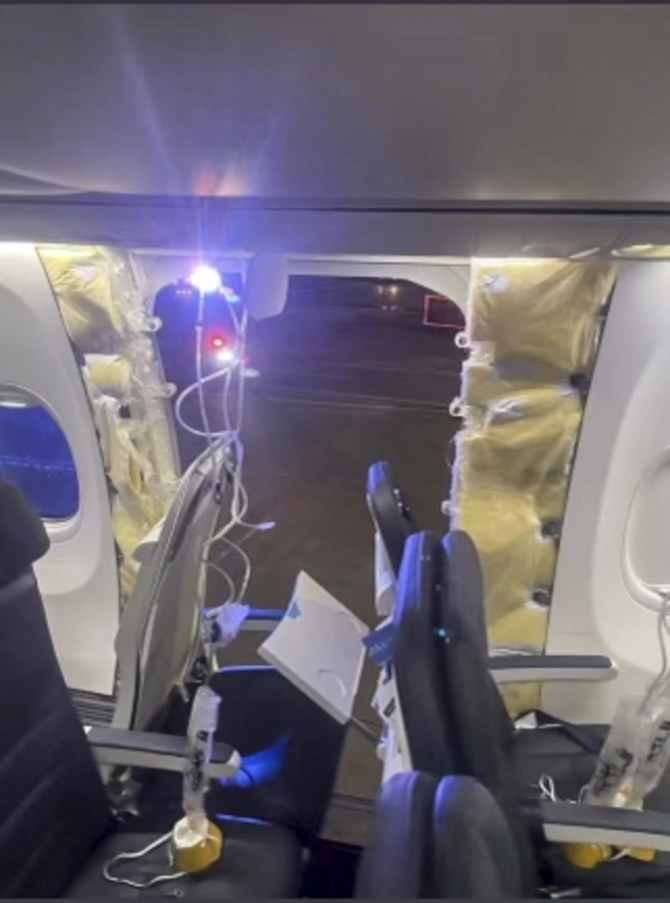
An Alaska Airlines jetliner blew out a portion of its fuselage shortly after takeoff 3 miles (4.8 kilometers) above Oregon late Friday, forcing the pilots to make an emergency landing as its 171 passengers and six crew members donned oxygen masks.

This photo provided by an unnamed source shows the damaged part of an Alaska Airlines Boeing 737 Max 9, Flight 1282, which was forced to return to Portland International Airport on Jan. 5, 2024. (The Oregonian via AP)
No one was seriously hurt as the depressurized plane returned safely to Portland International Airport about 20 minutes after departure.
Passenger Evan Smith said a boy and his mother were sitting in the row where the panel blew out, and the child’s shirt was sucked off him and out of the plane.
“You heard a big loud bang to the left rear. A whooshing sound and all the oxygen masks deployed instantly and everyone got those on,” Smith told KATU-TV.
The National Transportation Safety Board said Saturday it will investigate.
Alaska Airlines CEO Ben Minicucci said the inspection of the company’s 737-9 aircraft could take days to complete. They make up a fifth of the company’s 314 planes.
“We are working with Boeing and regulators to understand what occurred ... and will share updates as more information is available,” Minicucci said. “My heart goes out to those who were on this flight – I am so sorry for what you experienced.”
Alaska canceled more than 100 flights, or 15 percent of its Saturday schedule by midday, according to FlightAware. United said the plane inspections would result in about 60 cancelations.
The Port of Portland, which operates the airport, told KPTV that the fire department treated minor injuries at the scene. One person was taken for more treatment but wasn’t seriously hurt.
Flight 1282 took off from Portland at 5:07 p.m. Friday for a two-hour flight to Ontario, California. About six minutes later, the chunk of the fuselage blew out as the plane was at about 16,000 feet (4.8 kilometers). One of the pilots declared an emergency and asked for clearance to descend to 10,000 feet (3 kilometers), the altitude where the air would have enough oxygen to breathe safely.
’We need to turn back to Portland,” the pilot told controllers in a calm voice that she maintained throughout the landing.
Videos posted by passengers online showed a gaping hole where the paneled-over exit had been and passengers wearing masks. They applauded when the plane landed safely about 13 minutes after the blowout. Firefighters then came down the aisle, asking passengers to remain in their seats as they treated the injured.
The aircraft involved rolled off the assembly line and received its certification two months ago, according to online FAA records. It had been on 145 flights since entering commercial service Nov. 11, said FlightRadar24, another tracking service. The flight from Portland was the aircraft’s third of the day.
Aviation experts were stunned that a piece would fly off a new aircraft. Anthony Brickhouse, a professor of aerospace safety at Embry-Riddle Aeronautical University, said he has seen panels of fuselage come off planes before, but couldn’t recall one where passengers “are looking at the lights of the city.”
He said the incident is a reminder for passengers to stay buckled in.
“If there had been a passenger in that window seat who just happened to have their seat belt off, we’d be looking at a totally different news story.”
The Max is the newest version of Boeing’s venerable 737, a twin-engine, single-aisle plane frequently used on US domestic flights. The plane went into service in May 2017.
The president of the union representing flight attendants at 19 airlines, including Alaska Airlines, commended the crew for keeping passengers safe.
“Flight Attendants are trained for emergencies and we work every flight for aviation safety first and foremost,” Sara Nelson, president of the Association of Flight Attendants, said in a statement Saturday.
Two Max 8 jets crashed in 2018 and 2019, killing 346 people and leading to a near two-year worldwide grounding of all Max 8 and Max 9 planes. They returned to service only after Boeing made changes to an automated flight control system implicated in the crashes.
Last year the FAA told pilots to limit use of an anti-ice system on the Max in dry conditions because of concern that inlets around the engines could overheat and break away, possibly striking the plane.
Max deliveries have been interrupted at times to fix manufacturing flaws. The company told airlines in December to inspect the planes for a possible loose bolt in the rudder-control system.