

Yemeni journalist assaulted by Houthis receives hospital care in Jordan

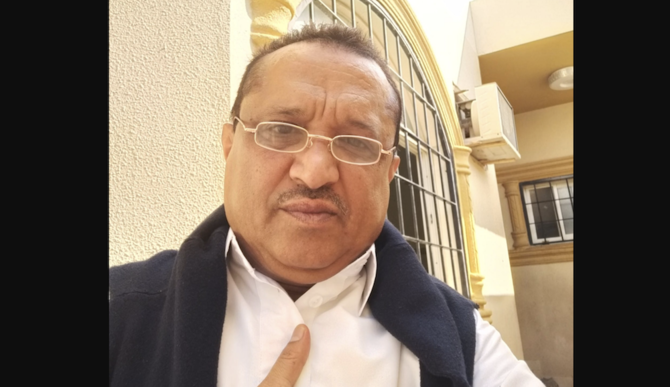
Majili Al-Samadi, head of Yemen Voice radio, shared this photograph on Facebook before heading to a hospital in Amman to seek treatment for wounds sustained in a Houthi attack outside his house in Sanaa on January 1. (Supplied)
Short Url
Updated 06 January 2024
Follow

Yemeni journalist assaulted by Houthis receives hospital care in Jordan

  • Majili Al-Samadi was beaten on Jan. 1, shortly after he criticized a judge at a Houthi-run court for dismissing an appeal against a ban on his radio broadcasts
  • Yemeni human rights advocates and government officials urge Houthis to release kidnapped judge Abdul Wahab Qatran and stop persecuting dissenting voices

AL-MUKALLA: A Yemeni journalist attacked by Iran-backed Houthis in Sanaa last week has flown to Jordan for medical treatment. It comes as local and international campaigners condemned the militant group for persecuting dissenting voices in Yemen.

Majili Al-Samadi, the head of Voice of Yemen Radio, posted a photo taken on a Yemenia flight from Houthi-controlled Sanaa to Amman and a message in which he said goodbye to his followers, followed by another about his hospital care in Jordan.

“Tomorrow, I’ll have my third therapy session for suctioning clotted blood beneath my skin, which was caused by an assault on me by an armed group linked with the Houthis,” he wrote on his Facebook page.

On Jan. 1, less than a day after Al-Samadi criticized a judge at a Houthi-run court for denying his appeal against a ban on his radio broadcasts, an armed group with suspected connections to the Houthis assaulted him, for the second time in six months, and broke the windows of his car outside his home in Sanaa.

He said the attack caused his hands to swell and become red as a result of blood clots and that he was having difficulty moving his hands and legs.


Al-Samadi said the attack caused his hands to swell and become red as a result of blood clots and that he was having difficulty moving his hands and legs.

In early 2022, the Houthis shut down Voice of Yemen Radio and five other radio stations for refusing to broadcast the group’s propaganda. The first attack on Al-Samadi was in August, after he continued to protest against the broadcast ban, and supported public demands for the Houthis to pay government employees’ wages.

Meanwhile, Yemeni human rights advocates and government officials urged the Houthis to release outspoken judge Abdul Wahab Qatran and halt their escalating persecution of dissenting voices.

The Houthis abducted the judge from his home last week after besieging it for hours, wrecking the property and detaining other his members of his family. Hours earlier, he had expressed support for Al-Samadi and criticized the Houthis for silencing opponents through intimidation.

The Houthis have not commented on the kidnapping but the judge’s sons said the group falsely accused him of possessing and consuming alcohol.

Yemen’s information minister, Muammar Al-Eryani, strongly condemned the Houthis for attacking Al-Samadi, Qatran and others who oppose their rule, and accused the group of attempting to exploit the conflict in Gaza as a means to silence their critics and deflect public outrage over their failure to pay public-sector workers.

“These assaults and threats indicate the Houthi militia’s state of panic, as well as its attempts to use regional events to silence critics of its actions, continuous robbery of the state’s public funds, and refusal to pay employee wages,” the minister wrote in a message posted on social media platform X.


Slain son of former Libya ruler Qaddafi to be buried near capital

Seif Al-Islam Qaddafi speaks to the media at a press conference in a hotel in Tripoli, Libya. (File/AP)
Updated 21 min ago
Follow

Slain son of former Libya ruler Qaddafi to be buried near capital

  • The burial will be held on Friday in the town of Bani Walid some 175 kilometers south of Tripoli, two of his brothers said

TRIPOLI: The slain son of former Libyan ruler Muammar Qaddafi will be buried in a town south of the capital that remains loyal to the family, relatives said Thursday.
Seif Al-Islam Qaddafi, once seen by some as Libya’s heir apparent, was shot dead on Tuesday in the northwestern city of Zintan.
The burial will be held on Friday in the town of Bani Walid some 175 kilometers south of Tripoli, two of his brothers said.
“The date and location of his burial have been decided by mutual agreement among the family,” half-brother Mohamed Qaddafi said in a Facebook post.
Mohamed said the plan reflected “our respect” for the town, which has remained loyal to the elder Qaddafi years after he was toppled and killed in the 2011 Arab Spring uprisings.
Each year, the town of about 100,000 celebrates the anniversary of a 1969 coup that brought Muammar to power, parading through the streets holding the ex-leader’s portrait.
Saadi Qaddafi, a younger brother, said his dead sibling will be “buried among the Werfalla,” an influential local tribe, in a grave next to his brother Khamis Qaddafi, who died during the 2011 unrest.
Marcel Ceccaldi, a French lawyer who had been representing Seif Al-Islam, told AFP he was killed by an unidentified “four-man commando” who stormed his house on Tuesday.
Seif Al-Islam had long been widely seen as his father’s heir. Under the elder Qaddafi’s iron-fisted 40-year rule, he was described as the de facto prime minister, cultivating an image of moderation and reform despite holding no official position.
But that reputation soon collapsed when he promised “rivers of blood” in retaliation for the 2011 uprising.
He was arrested that year on a warrant issued by the International Criminal Court for alleged crimes against humanity, and a Tripoli court later sentenced him to death, although he was later granted amnesty.
In 2021 he announced he would run for president but the elections were indefinitely postponed.
He is survived by four out of six siblings: Mohamed, Saadi, Aicha and Hannibal, who was recently released from a Lebanese prison on bail.
Libya has struggled to recover from chaos that erupted after the 2011 uprising. It remains split between a UN-backed government based in Tripoli and an eastern administration backed by Khalifa Haftar.