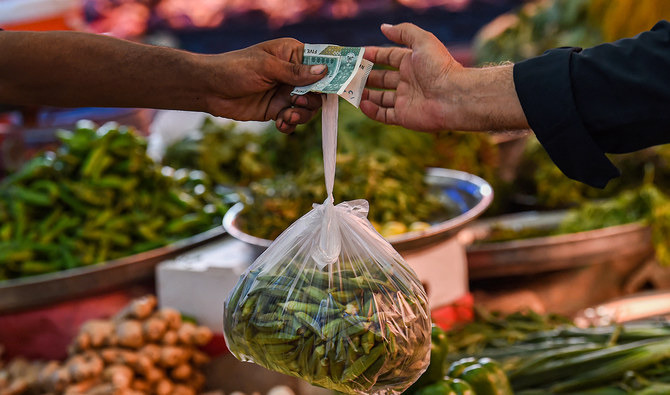
ISLAMABAD: The prices of essential commodities continued to stay away from the reach of the financially vulnerable segments this week, with data released by the Pakistan Bureau of Statistics showing the annual short-term inflation well above 40 percent on Friday.
The government computes the Sensitive Price Indicator (SPI) on a weekly basis to evaluate the price fluctuation of necessary commodities by evaluating the rates of 51 items collected from 50 markets in 17 cities of the country.
The SPI report for the week ending on January 4 reflected an increase in the rates of 19 commodities, decrease in nine and stability in 23.
“The SPI for the current week ended on 04th January, 2024 increased by 0.81 percent,” the PBS said in its report. “Major increase is observed in the prices of Tomatoes (16.04 percent), Chicken (13.98 percent), Eggs (3.20 percent), Onions (3.04 percent), Bananas (2.13 percent), Pulse Gram (2.12 percent), Sugar (2.04 percent), Pulse Moong (1.68 percent), LPG (1.19 percent), Firewood (0.51 percent) and Georgette (0.23 percent).”
“The year on year trend depicts increase of 42.86 percent,” it added.
Pakistan’s rapidly depreciating national currency and its rising energy imports led to significant inflation, prompting the central bank to retain the policy rate at 22 percent last month to mitigate the situation.
The bank also informed in one of its recent reports to parliament it wanted to prevent high inflation from becoming entrenched in the coming months and hoped to bring it down to nearly 20 percent in the current fiscal year.


Essential goods remain out of reach as Pakistan’s annual short-term inflation stays above 40 percent
https://arab.news/nbtyf
Essential goods remain out of reach as Pakistan’s annual short-term inflation stays above 40 percent

- The Sensitive Price Indicator released by the government shows an increase of 0.81 percent during the current week
- Pakistan’s central bank said last month it wanted to prevent high inflation from becoming entrenched in the coming months

Islamabad launches real-time fuel monitoring system as Iran war rattles oil markets
- Authorities say they will track petrol stocks at 145 stations through City Islamabad app
- Petrol stations in the city are required to upload daily stock data to prevent shortages
ISLAMABAD: Authorities in Pakistan’s capital have launched a digital system to monitor petroleum stocks at fuel stations in real time, and official statement said on Tuesday, as the government steps up oversight of supplies following market disruptions linked to tensions in the Middle East.
The system has been introduced by the Islamabad district administration days after authorities sealed seven petrol stations for refusing fuel to motorists. It will allow officials to track fuel inventories through the “City Islamabad” mobile application, requiring petrol pump operators to upload daily stock details as authorities seek to prevent hoarding and artificial shortages.
The initiative comes days after Pakistan raised fuel prices sharply and authorities across the country launched crackdowns on hoarding amid fears that escalating conflict in the Middle East could disrupt global energy shipments and push oil prices higher.
“Real-time monitoring will ensure that any shortage of petroleum products can be addressed immediately,” Islamabad Deputy Commissioner Irfan Memon said in the statement announcing the system.
The statement noted the new digital tool would enable authorities to track stock levels at 145 fuel stations across Islamabad and monitor transactions through the mobile platform.
Under the system, petrol pump owners must upload daily stock information, while the district administration has released a tutorial explaining how to use the feature.
Authorities warned that failure to upload stock data could result in action against fuel station owners.
Pakistan has tightened monitoring of fuel supplies in recent days after global oil markets were rattled by United States and Israeli strikes on Iran, which raised concerns about possible disruptions to shipping routes in the Middle East, particularly around the Strait of Hormuz, a key corridor for global energy trade.
The government has said it is closely watching domestic supply conditions and international oil markets while taking steps to ensure fuel availability and prevent panic buying.


