
TORONTO: Khaleejis are no strangers to Georgia. Last year alone, more than 140,000 GCC residents made their way there to, with Saudi Arabia providing the most visitors from the region (79 percent).
And it’s no surprise. After a flight of just three-and-a-half-hours, tourists from the Gulf will find themselves in a country that’s a unique blend of European and Asian cultures, but also — post-liberation from the Soviet Union in 1991 — one keen on expressing its individual identity. In Tbilisi’s Rustaveli Avenue alone, for instance, you will find neoclassical architecture, but also Moorish-style at the National Opera and Ballet Theater, and a Soviet-era printers that has been transformed into a trendy creative space and café.

Tbilisi's Peace Bridge over the Kura River. (Shutterstock)
Apart from its rich cultural tapestry, there are several other reasons why Georgia appeals: you’re never far away from the snow-capped Caucasus Mountain range, making it a year-round playground for skiers and snowboarders. And the locals are hospitable and welcoming people, so it’s easy to find good food and conversation.
Start your trip at the Metekhi cliff that houses a well-known church and a larger-than-life statue of King Vakhtang I of Iberia, founder of Tbilisi. Legend has it that the king’s falcon was hunting a pheasant, which fell into a hot water spring, leading to the discovery of an area abundant in natural, sulfuric water. The name Tbilisi comes from the Georgian word for ‘warm place.’
On the east bank of the Kura River (Mt’k’vari to the locals), you will find sulfur baths that were once frequented by aristocrats and now host tourists and celebrities (British musician Sting is rumored to frequent the largest suite here).

The Mother of Georgia statue in Tbilisi. (Shutterstock)
Head down the cliff and walk through Rike Park to the glass-and-steel Peace Bridge. The 150-meter-long, pedestrian bridge is illuminated by 50,000 LEDs after sunset and symbolizes the union between the old, historical district and the newer urban, aspirational part of the city. You can also get a great view of the bridge by taking one of the many boat rides on offer along the Kura.
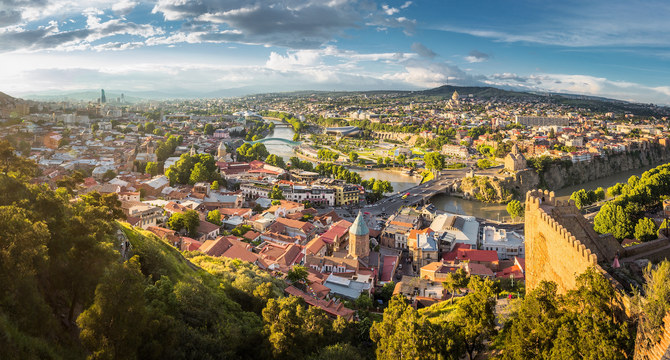
If you prefer panoramic views, take a cable car up to the Narikala Fortress. From here, you can take in a bird’s eye view of Old Tbilisi, the Mother of Georgia (a 66-foot-tall statue that holds a sword and drink to symbolize both resilience against invaders and hospitality for guests), Queen Darejan’s Palace (an 18th-century palace, now a monastery), and the 160-hectare Botanical Garden (which, according to some accounts, was first cultivated during Arab rule of Georgia in the 7th century).
At the foot of the Narikala Fortress lies the Abanotubani district, which houses six religious institutes — the Georgian Orthodox and Catholic church, the Armenian Gregorian Cathedral, the Jumah Mosque, the Great Synagogue, and the now-defunct Atashgah Zoroastrian fire temple.

Underground Meidan Bazaar in Tbilisi. (Shutterstock)
King David Aghmashenebeli IV (aka David the Builder), rebuilt the country after a series of invasions, including those by the Seljuk tribes and the Ottoman Empire. Among other reforms, he was known to promote religious equality, and today the social fabric of Georgia replicates that of David’s time. Nowhere is that clearer than in Abanotubani.
Named after David (and known colloquially as “Arab Street”), Aghmashenebeli Avenue is a wonderful blend of patterned façades, cobbled streets, and plentiful street cafés, all reminiscent of the chic style of Paris.
A short walk away from nearby Freedom Square and Rustaveli Avenue is the Dry Bridge Flea Market. Here you will find memorabilia from the Soviet period, ranging from well-kept matryoshka dolls and soldier’s medals to half empty bottles of perfume.

Rustaveli Avenue in Tbilisi. (Shutterstock)
Opposite the Georgian National Museum on Rustaveli Avenue sits one of the city’s oldest underground bakeries. Try the lobiyani — a red-bean-stuffed variant of khachapuri (Georgian cheese bread), or enjoy traditional Georgian fare recreated from 19th-century chef Barbare Jorjadze’s cookbook at the nearby Barbarestan Restaurant.
Underneath Meidan Square in the heart of the Old City you will find a spectacular bazaar filled with Georgian specialties including jam and spices.
Georgians celebrate Christmas according to the Julian calendar, and this year it falls on Jan. 7. So if you’re looking to experience the famed European Christmas markets on a budget and enjoy some festive cheer, there’s still time to head to Tbilisi.