

Israel ‘has gone too far,’ Lebanon’s caretaker PM warns

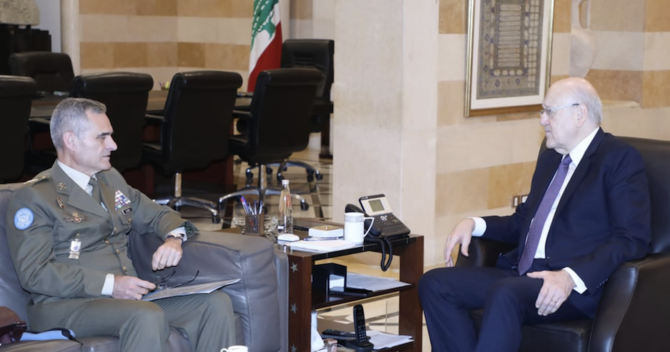
Lebanese caretaker Prime Minister Najib Mikati condemned what he described as repeated Israeli violations of the country’s sovereignty in a meeting on Thursday with Maj. Gen. Aroldo Lazaro, UNIFIL’s head of mission and force commander. (NNA)
Short Url
Updated 04 January 2024
Follow

Israel ‘has gone too far,’ Lebanon’s caretaker PM warns

  • Najib Mikati demands UN action in talks with head of peacekeeping force
  • Hundreds mourn Hamas deputy Saleh Al-Arouri at Beirut funeral

BEIRUT: Lebanese caretaker Prime Minister Najib Mikati condemned what he described as repeated Israeli violations of the country’s sovereignty in a meeting on Thursday with Maj. Gen. Aroldo Lazaro, UNIFIL’s head of mission and force commander.

Mikati told the leader of the peacekeeping force that Israel has ignored UN resolutions for years, and called for “voices to be raised” in the UN in support of Lebanon.

The caretaker prime minister’s comments coincided with the funeral of Hamas deputy political leader Saleh Al-Arouri, who died in a suspected drone strike in southern Beirut on Tuesday.

Al-Arouri was buried in the Palestinian Al-Shuhada cemetery in Shatila, Beirut, along with two Hamas officials, Azzam Al-Aqra’ and Mohammed Al-Rayes, who were also killed in the blast.

Gunshots were fired in the air during the funeral, and mourners raised the Palestinian flag and banners of Hamas and Islamic Jihad.

Lebanese security services are investigating Al-Arouri’s death, while Hezbollah is also carrying out its own probe into the assassination.

A security source said that the investigations are “complex,” and focused on the type of drone, its route, and the specifications of the missiles launched.

Retired Brig. Gen. George Nader suggested in a media statement that there might be “an agent from the decision-making circle, and not from outside, if we were to talk about a security breach.”

Nader said: “Israel has technology that allows it to fly drones at 30,000 feet or 7,000 meters without being heard or seen. Fighter jets can launch missiles at a distance of 15,000 meters without being heard or seen, with very high accuracy exceeding 99 percent.”

He added: “There are two ceilings above the room where Al-Arouri was present that were destroyed and fell on him. This indicates the capabilities that Israel possesses.

“Technically, the assassination has several possibilities, and we must wait for the investigation.”

Former Prime Minister Fouad Siniora, in a statement denouncing Al-Arouri’s assassination, questioned the reason for “the presence of this number of armed Palestinian organizations and other armed organizations in various Lebanese regions, including in Beirut’s southern suburbs.”

He said: “In principle, this matter requires the approval of the Lebanese official authorities, especially since Lebanon is ultimately a republic that must preserve and protect its sovereignty and emphasize not endangering its security and stability.”

Siniora’s reaction came as Israel’s operations on Thursday targeted border villages, including Maroun Al-Ras, near a Lebanese army point, where a fighter jet launched two air-to-surface missiles.

The Israeli army attacked the former Israeli detention site in the town of Khiam with phosphorus bombs, and shelled the outskirts of Bint Jbeil, Yaroun, and Aita Al-Shaab. 

Hezbollah announced on Thursday that it had targeted “a position of Israeli soldiers in Shtula and the Al-Jardah military point, and a gathering of soldiers in Metula and the Branit military site, achieving direct hits.”

Israeli media said Hezbollah fired an anti-tank missile toward Metula, hitting a building there.

Israeli drone strikes continued late on Wednesday and Thursday, targeting residential buildings.

Hezbollah paid a heavy toll, losing nine fighters in less than 24 hours, including field official Hussein Hadi Yazbek in the Naqoura area.

On Wednesday evening, the Israeli army stepped up its attacks, destroying a three-story building in Naqoura with drones.

Among Hezbollah members killed were Hadi Ali Rida from Teffahta, Ibrahim Afif Fahs from Jibchit, and Hussein Ali Mohammad Ghazaleh from Adloun, in addition to Abbas Hassan Jammoul, Hassan Dakik, and Mohammad Hadi Obeid.


Three brothers arrested over US embassy blast in Oslo

Updated 12 March 2026
Follow

Three brothers arrested over US embassy blast in Oslo

  • The brothers, who were Norwegian citizens of Iraqi origin, had been arrested in Oslo and police were investigating the motive
  • While none of the brother were previously known to police, Hatlo said investigators were not ruling out links to “criminal networks“

OSLO: Norwegian police said Wednesday three brothers had been arrested on suspicion of a “terrorist bombing” over a weekend explosion at the US embassy in Oslo, which caused minor damage but no injuries.
Police prosecutor Christian Hatlo told a press conference the brothers, who were Norwegian citizens of Iraqi origin, had been arrested in Oslo and that police were investigating the motive.
“We are still working from several hypotheses. One of them is whether this is an order from a government entity,” Hatlo said.
“This is quite natural given the target — the US embassy — and the security situation the world is in today,” he said.
Hatlo said the investigation would seek to clarify exactly what roles the brothers, who were in their 20s, had played.
“We believe that one of them is the person who placed the bomb outside the embassy and that the other two were complicit in the act,” Hatlo told reporters.
Oystein Storrvik, a lawyer for one of the suspects, told broadcaster TV 2 that his client had admitted “to being involved in the case.”
“He admits that he placed the bomb there,” Storrvik told the broadcaster.
Storrvik added that his client had been questioned by police.
“He has explained what happened, and I have no further comments at this time,” he said.

- ‘Proxy actors’ -

While none of the brother were previously known to police, Hatlo said investigators were not ruling out links to “criminal networks.”
In its annual threat assessment, Norwegian security service PST said last month that Iran, which it considers one of the main threats to the country, could rely on “proxy actors,” including “criminal networks,” to commit acts.
On Tuesday, Iran’s ambassador in Oslo denied any involvement by his country in the embassy explosion.
“It is unacceptable that we are being singled out,” Alireza Jahangiri told Norwegian newspaper Verdens Gang.
According to police, the perpetrators of the bombing, described as “powerful,” may also have acted out of their own motives.
US embassies have been placed on high alert in the Middle East due to American strikes on Iran. Several have faced attacks as Tehran responds by targeting industrial and diplomatic facilities.
The blast took place at around 1:00 am (0000 GMT) on Sunday at the entrance to the embassy’s consular section.
On Monday, two images were released from surveillance camera footage showing a suspect dressed in dark clothing with a hood over his head and wearing a backpack.
Roughly at the time the incident occurred, a video had been uploaded to the Google Maps page for the US embassy.
The video, which has since been taken down, appeared to show Iran’s late supreme leader Ayatollah Ali Khamenei, who was killed on the first day of the US-Israeli strikes in Iran.
According to Norwegian public broadcaster NRK, the person who uploaded the video wrote in Persian: “God is great. We are victorious.”
Police have also opened an investigation into this.