

What is at stake in Bangladesh’s upcoming poll?

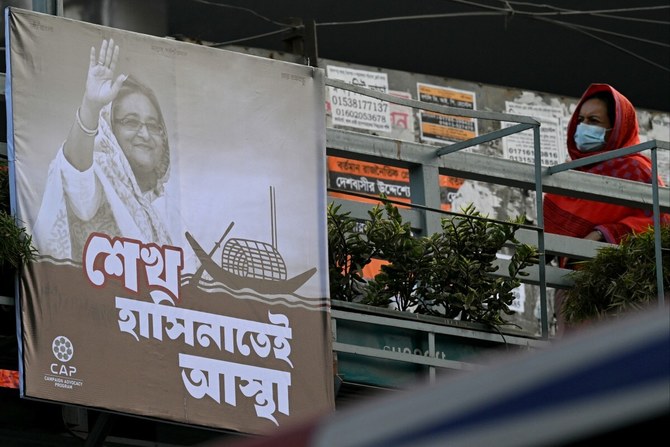
A pedestrian walks past an election poster of Awami League featuring its leader and Bangladesh’s Prime Minister Sheikh Hasina in Dhaka on Jan. 4, 2024, ahead of the upcoming general elections. (AFP)
Short Url
Updated 04 January 2024
Follow

What is at stake in Bangladesh’s upcoming poll?

  • Incumbent PM’s Vision 2041 aims to end poverty, build advanced economy
  • Ruling party set for 4th straight term as opposition boycotts Jan. 7 polls

DHAKA: As Bangladesh prepares for elections without opposition, incumbent Prime Minister Sheikh Hasina is poised to win and continue her modernization vision at the cost of significant democratic backsliding, critics say.

The South Asian country of almost 170 million people will vote on Sunday in a poll expected to give the ruling Awami League its fourth straight parliamentary term.

No major rivals are in sight for the prime minister as most have either faced mass arrests of members or announced in protest that they will not take part in the vote.

The main opposition Bangladesh Nationalist Party estimates that police have arrested some 20,000 of its members and supporters in recent months. The BNP is boycotting the election as Hasina rejected demands to allow the polls to be held under a neutral caretaker government.

Before the Awami League’s win in 2009, the Bangladeshi system encouraged three-month non-partisan governments to conduct elections and prevent irregularities during polls.

The practice was abolished by the ruling party with a constitutional amendment in 2011, and as Bangladeshis will go to the polls on Sunday, the candidates on the ballot will all be from the Awami League, its allies and independents.

“The election will determine the future course of Bangladeshi politics. Whether an effective multi-party system will exist after the so-called election is an open question,” Ali Riaz, a distinguished professor of political science from Illinois State University, told Arab News.

“The persecution of the opposition, particularly the BNP, indicates that the government is unlikely to allow any substantive dissenting voices, let alone a formidable opposition party. The country is heading toward becoming a de facto one-party state.”

For Riaz, the result of the upcoming vote is a “foregone conclusion.

“Sheikh Hasina will win the election. While Hasina and her party speak of a vision for the future, which highlights a narrative of development and modernization, those have become hollow words to the people of Bangladesh, who are suffering immensely due to price hikes and low income,” he said.

Bangladesh Vision 2041 is a national strategic plan announced by the prime minister in 2020 that aims to rid the country of poverty and develop an advanced economy by 2041.

The Muslim-majority country, once one of the world’s poorest, has been lauded for achieving economic success under Hasina’s leadership since 2009, which put Bangladesh on track to graduate from the UN’s list of least developed countries in 2026.

Even though it has recently been hit by soaring inflation, Bangladesh remains one of the fastest-growing economies in the region.

The World Bank estimates that more than 25 million people in the country have been lifted out of poverty in the last two decades.

“The regime stability that we had for the last 15 years, actually, has contributed toward economic growth. Although we have faltered, it was not due to our problems, but mostly because of the international economic issues emerging from COVID-19 and the war in Ukraine,” Naimul Islam Khan, a political analyst and media pundit, told Arab News.

Khan believes that credit for the growth should go directly to Hasina, daughter of Bangladeshi founding leader Sheikh Mujibur Rahman.

“She has been very instrumental in showing that Bangladesh has a future ... this is one of the finest things that Sheikh Hasina provides Bangladesh with,” Khan said.

Dr. A.S.M. Amanullah, a professor of sociology at Dhaka University, has also observed “major accomplishments” achieved by Hasina’s government throughout the past 15 years.

“The first one is political stability in the country. Secondly, she managed to maintain economic stability during her first two terms. Thirdly, there were some major infrastructural developments in the country, like Padma Bridge, metro rail in the capital, the Karnaphuli River tunnel, etc.,” he said.

But democratic practice was no more.

“There is no democratic practice at any level in Bangladesh. Be it on the local level, be it on the national level, be it on the political party level, be it in social organizations or any other government and non-government ones,” Amanullah told Arab News.

It was not always like this. In the 1980s, the incumbent prime minister fought for multi-party democracy as she joined hands with other opposition leaders, also her rivals, including BNP leader Khaleda Zia, to hold pro-democracy street protests against the military rule of Gen. Hussain Muhammad Ershad.

Zia has been under house arrest on corruption charges for years.

“We don’t need to wait until Jan. 7 to see the results of the election. The people of this country are not waiting to see the results of the election,” Amanullah said.

“Election means uncertainty in the results: Nobody knows who would win. But there is no uncertainty over the result in Bangladesh. Throughout the country, there is a certainty among the voters that the ruling Awami League is coming to power.

“The voting culture of South Asia is lost here.”


US to cut roughly 200 NATO positions, sources say

Updated 21 January 2026
Follow

US to cut roughly 200 NATO positions, sources say

  • Trump famously threatened to withdraw from NATO during ⁠his first presidential term and said on the campaign trail that he would encourage Russia to attack NATO members that did not pay their fair share on defense

WASHINGTON: The United States plans to reduce the number of personnel it has stationed within several key NATO command centers, a move that could intensify concerns ​in Europe about Washington’s commitment to the alliance, three sources familiar with the matter said this week.
As part of the move, which the Trump administration has communicated to some European capitals, the US will eliminate roughly 200 positions from the NATO entities that oversee and plan the alliance’s military and intelligence operations, said the sources, who requested anonymity to discuss private diplomatic conversations.
Among the bodies that will be affected, said the sources, are the UK-based NATO Intelligence Fusion Center and the Allied Special Operations Forces Command in Brussels. Portugal-based STRIKFORNATO, which oversees some maritime operations, will also be cut, as will several other similar NATO entities, the sources said.
The sources did not specify why the US had decided to cut the number of staff dedicated to the NATO roles, but the moves broadly align with the ‌Trump administration’s stated intention to ‌shift more resources toward the Western Hemisphere.
The Washington Post first reported the decision.

TRUMP ‌RE-POSTS ⁠MESSAGE ​IDENTIFYING NATO ‌AS THREAT
The changes are small relative to the size of the US military force stationed in Europe and do not necessarily signal a broader US shift away from the continent. Around 80,000 military personnel are stationed in Europe, almost half of them in Germany. But the moves are nonetheless likely to stoke European anxiety about the future of the alliance, which is already running high given US President Donald Trump’s stepped-up campaign to wrest Greenland away from Denmark, raising the unprecedented prospect of territorial aggression within NATO.
On Tuesday morning, the US president, who is scheduled to fly to the World Economic Forum in Switzerland in the evening, shared another user’s post on social media that identified NATO as a threat to the ⁠United States. The post described China and Russia as merely “boogeymen.”
Asked for comment, a NATO official said changes to US staffing are not unusual and that the US presence in ‌Europe is larger than it has been in years.
“NATO and US authorities are in ‍close contact about our overall posture – to ensure NATO retains our ‍robust capacity to deter and defend,” the NATO official said.
The White House and the Pentagon did not respond to requests for ‍comment.

MILITARY IMPACT UNCLEAR, SYMBOLIC IMPACT OBVIOUS
Reuters could not obtain a full list of NATO entities that will be affected by the new policy. About 400 US personnel are stationed within the entities that will see cuts, one of the sources said, meaning the total number of Americans at the affected NATO bodies will be reduced by roughly half.
Rather than recalling servicemembers from their current posts, the US will for the most part decline to ​backfill them as they move on from their positions, the sources said.
The drawdown comes as the alliance traverses one of the most diplomatically fraught moments in its 77-year history. Trump famously threatened to withdraw from NATO during ⁠his first presidential term and said on the campaign trail that he would encourage Russian President Vladimir Putin to attack NATO members that did not pay their fair share on defense. But he appeared to warm to NATO over the first half of 2025, effusively praising NATO Secretary-General Mark Rutte and other European leaders after they agreed to boost defense spending at a June summit.
In recent weeks, however, his administration has again provoked alarm across Europe. In early December, Pentagon officials told diplomats that the US wants Europe to take over the majority of NATO’s conventional defense capabilities, from intelligence to missiles, by 2027, a deadline that struck European officials as unrealistic. A key US national security document released shortly after called for the US to dedicate more of its military resources to the Western Hemisphere, calling into question whether Europe will continue to be a priority theater for the US
In the first weeks of 2026, Trump has revived his longstanding campaign to acquire Greenland, an overseas territory of Denmark, enraging officials in Copenhagen and throughout Europe, many of whom believe any territorial aggression within the alliance would mark the end of NATO. Over the weekend, ‌Trump said he would slap several NATO countries with tariffs starting February 1 due to their support for Denmark’s sovereignty over the island. That has caused European Union officials to mull retaliatory tariffs of their own.