

Pakistan to test two percent of arriving passengers for new COVID-19 variant as prevention strategy

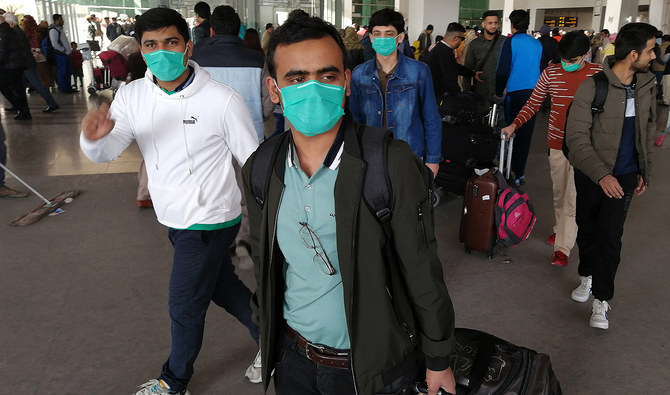
In this file photo, taken on February 3, 2020, Pakistani students arrive at the Islamabad International Airport in Islamabad. (AFP/File)
Short Url
Updated 04 January 2024
Follow

Pakistan to test two percent of arriving passengers for new COVID-19 variant as prevention strategy

  • World Health Organization has named JN-1 a variant of concern but not added it to the high-risk ‘watchlist’ of strains
  • Pakistan has not reported any JN-1 case, though the virus has surged in other countries necessitating precautionary steps

ISLAMABAD: The government decided to implement necessary measures to prevent the spread of a new coronavirus variant, JN-1, by deciding earlier this week to test two percent of passengers arriving in the country, revealed an official notification circulated on Wednesday.

Pakistan’s COVID-19 experience was marked by several challenges and phases. Initially, the country faced a rapid spread of the virus, leading to strict lockdowns and pressure on its healthcare system. Despite limited resources, however, Pakistan implemented effective measures such as smart lockdowns, mass testing and public awareness campaigns.

Over time, the situation improved with a decrease in infection rates and the rollout of vaccination programs. The country’s response, adapting to changing scenarios and collaborating with international agencies, played a key role in managing the pandemic’s impact.

Referring to its latest meeting on January 2, the National Command and Operation Center (NCOC), which served as the country’s pandemic response body, said in its notification it was “vigilantly observing the situation” in other countries that witnessed a surge in the cases of viral infections.

“In this regard,” it added, “following decisions were made by NCOC for all international travelers: Implementation of 2% screening of all travellers coming through all Points of Entry (PoEs); stringent vigilance at all PoEs; and ensure visibility of staff at all times at respective areas.”

The notification addressed the top officials of the Civil Aviation Authority, Border Health Services Pakistan and Pakistan International Airlines.

The World Health Organization has named JN-1 a variant of concern, indicating that it is being closely monitored, but it has not been added to the high-risk “watchlist” of strains.

Symptoms of JN-1 are thought to be similar to those of other members of the Omicron family of COVID-19 variants, typically starting with a sore throat, followed by congestion and a dry cough.

So far, Pakistan has not reported any case of JN-1.


‘Terrified’ Sydney man misidentified as Bondi shooter turns to Pakistan consulate for help

Updated 4 sec ago
Follow

‘Terrified’ Sydney man misidentified as Bondi shooter turns to Pakistan consulate for help

  • The man says he received death threats after his images were spread widely on social media
  • He sought consular help after relatives in home country began receiving alarmed phone calls

SYDNEY: A Sydney man said he had received death threats and was “terrified” to leave his home Monday after his photo was widely shared online as the gunman responsible for the Bondi Beach shooting.

A father and son duo opened fire on a Jewish festival at Australia’s best-known beach on Sunday evening, killing 15 people, including a child, and wounding 42 more.

Authorities have condemned the attack as an act of terrorism, though they have not named the two shooters — one killed at the scene, and the other now in hospital.

However, Australian public broadcaster ABC said the alleged assailant was Naveed Akram from the western Sydney suburb of Bonnyrigg, quoting an anonymous official, and other local media reported that police had raided his home.

Photos of a beaming man in a green Pakistan cricket jersey pinged across social media.

Some of the posts were shared thousands of times, drawing vitriolic comments.

But the photo was taken from the Facebook profile of a different Naveed Akram, who pleaded Monday for people to stop the misinformation in a video published by the Pakistan Consulate of Sydney.

“Per media reports, one of the shooters’ name is Naveed Akram and my name is Naveed Akram as well,” he said in the video.

“That is not me. I have nothing to do with the incident or that person,” he said, condemning the “terrible” Bondi Beach shooting.

“I just want everyone’s help to help me stop this propaganda,” he said, asking for users to report accounts that misused his photo, which he had shared in a 2019 post.

’ LIFE-THREATENING

The 30-year-old, who lives in a northwestern suburb of Sydney, told AFP he first heard around 9:30 p.m. on Sunday that he had been falsely identified as the shooter.

“I could not even sleep last night,” Akram told AFP by phone, adding he deleted all the “terrible” messages he got.

“I’m terrified. I could not go outside, like it’s a life-threatening issue, so I don’t want to risk anything... my family is worried as well, so it’s quite a hard time for me.”

He asked the Pakistan Consulate to put out the video because relatives in the country’s Punjab province were getting phone calls as well.

“It was destroying my image, my family’s image,” he said.

“People started to call them. They were worried, and they have told the police over there.”

The Pakistan native moved to Australia in 2018 to attend Central Queensland University and later did a masters at Sydney’s Holmes Institute.

Today he runs a car rental business, and he said Australia is “the perfect country.”

“I love this country. I have never had any safety issues here, like everyone is so nice, the people are so nice here,” Akram said.

“It’s only this incident that has caused me this trauma.”