

Pakistan to test two percent of arriving passengers for new COVID-19 variant as prevention strategy

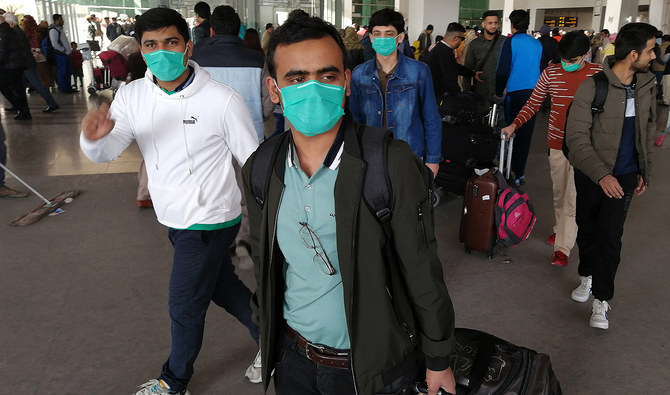
In this file photo, taken on February 3, 2020, Pakistani students arrive at the Islamabad International Airport in Islamabad. (AFP/File)
Short Url
Updated 04 January 2024
Follow

Pakistan to test two percent of arriving passengers for new COVID-19 variant as prevention strategy

  • World Health Organization has named JN-1 a variant of concern but not added it to the high-risk ‘watchlist’ of strains
  • Pakistan has not reported any JN-1 case, though the virus has surged in other countries necessitating precautionary steps

ISLAMABAD: The government decided to implement necessary measures to prevent the spread of a new coronavirus variant, JN-1, by deciding earlier this week to test two percent of passengers arriving in the country, revealed an official notification circulated on Wednesday.

Pakistan’s COVID-19 experience was marked by several challenges and phases. Initially, the country faced a rapid spread of the virus, leading to strict lockdowns and pressure on its healthcare system. Despite limited resources, however, Pakistan implemented effective measures such as smart lockdowns, mass testing and public awareness campaigns.

Over time, the situation improved with a decrease in infection rates and the rollout of vaccination programs. The country’s response, adapting to changing scenarios and collaborating with international agencies, played a key role in managing the pandemic’s impact.

Referring to its latest meeting on January 2, the National Command and Operation Center (NCOC), which served as the country’s pandemic response body, said in its notification it was “vigilantly observing the situation” in other countries that witnessed a surge in the cases of viral infections.

“In this regard,” it added, “following decisions were made by NCOC for all international travelers: Implementation of 2% screening of all travellers coming through all Points of Entry (PoEs); stringent vigilance at all PoEs; and ensure visibility of staff at all times at respective areas.”

The notification addressed the top officials of the Civil Aviation Authority, Border Health Services Pakistan and Pakistan International Airlines.

The World Health Organization has named JN-1 a variant of concern, indicating that it is being closely monitored, but it has not been added to the high-risk “watchlist” of strains.

Symptoms of JN-1 are thought to be similar to those of other members of the Omicron family of COVID-19 variants, typically starting with a sore throat, followed by congestion and a dry cough.

So far, Pakistan has not reported any case of JN-1.


Pakistan PM condoles death of Saudi Prince Mishaal bin Badr’s mother

Updated 08 December 2025
Follow

Pakistan PM condoles death of Saudi Prince Mishaal bin Badr’s mother

  • Saudi prince’s mother passed away on Saturday, drawing condolences from Pakistan, Qatar, other states
  • Pakistan, Saudi Arabia who enjoy close cooperation in defense, economic, trade, investment and other sectors

ISLAMABAD: Prime Minister Shehbaz Sharif on Monday expressed his condolences to the Saudi royal family over the recent passing of Prince Mishaal bin Badr bin Saud bin Abdulaziz Al Saud. 

The Saudi Royal Court announced the death of Prince Mishaal bin Badr’s mother on Saturday. Her funeral prayers were held a day later, at the Imam Turki bin Abdullah Grand Mosque in Riyadh after Asr prayers. 

“I extend my heartfelt condolences to the Royal Family on the passing of the mother of Prince Mishaal bin Badr bin Saud bin Abdulaziz Al Saud,” Sharif wrote on social media platform X. 

He prayed for the highest rank in paradise for the departed and hoped the royal family would be able to bear the loss with fortitude. 

“Our prayers are with the Custodian of the Two Holy Mosques, His Royal Highness the Crown Prince, and the entire Royal Family in this moment of profound grief,” Sharif added. 

Pakistan and Saudi Arabia are close allies that cooperate in several sectors such as defense, trade, investment, tourism, agriculture, mines and minerals and others. The two countries signed a landmark defense pact in September, according to which both agreed to treat an attack on one country as an attack against both of them. 

Apart from being a vital trade ally, Saudi Arabia also serves as the top source for foreign remittances for Pakistan, where over 2 million expatriates reside.