

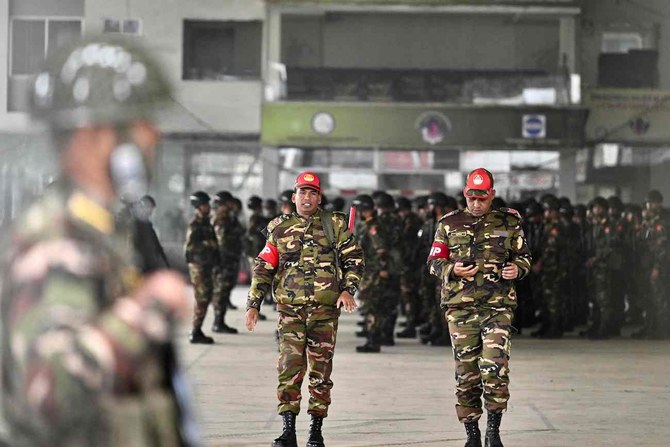

DHAKA: Bangladeshi troops were deployed on the country’s streets on Wednesday to maintain order ahead of the Jan. 7 parliamentary election, which is set to be boycotted by the main opposition party.
The nation of nearly 170 million people will vote this coming Sunday after a string of anti-government protests led by the Bangladesh Nationalist Party in the last few months called for Prime Minister Sheikh Hasina to resign and the polls to be held under a neutral caretaker government.
With those demands rejected by the government, the ruling Awami League is widely expected to win its fourth straight parliamentary term.
“The armed forces have been deployed nationwide from 3 to 10 January 2024 to ensure peace and order before polling, on polling day and after polling,” the Bangladesh Army said in a statement ahead of the deployment.
Army troops were deployed in 62 districts across the country, with nearly 100 sub-districts covered by officers from the paramilitary Border Guard Bangladesh, some of whom will be on joint duties with the military.
A number of helicopters have also been set aside to “provide electoral assistance in case of emergency,” the Army said.
“The upcoming 12th National Parliament election is going to be held on 7 January 2024 … the armed forces have taken all-out preparations to provide any necessary assistance to maintain peace and order,” the statement said.
Hasina, the daughter of Bangladesh’s founding father Sheikh Mujibur Rahman, is the longest-serving leader in the country’s history, a predominantly Muslim nation strategically located as a link between South Asia and the rest of the Indo-Pacific.
While Hasina’s government insists that the upcoming election is inclusive and fair, her main rival, the BNP, is boycotting the polls and saying that the incumbent administration cannot ensure a fair vote.
Many leaders of Bangladesh’s opposition parties are currently jailed, and violence has marred a number of rallies they held to demand the government’s resignation.
As Bangladeshis head to the polls to choose 300 MPs, the premier who has been in power since 2009 appears set to secure her fourth consecutive and fifth overall term in office.
Ahead of the parliamentary election, President Mohammed Shahabuddin, also an Awami League member, is calling on Bangladeshis to cast their vote on Sunday.
“Let’s vote ourselves and encourage others to cast their vote,” Shahabuddin told reporters on Wednesday.
“Voting is a democratic right of the people. As citizens, it is our duty to vote.”


