

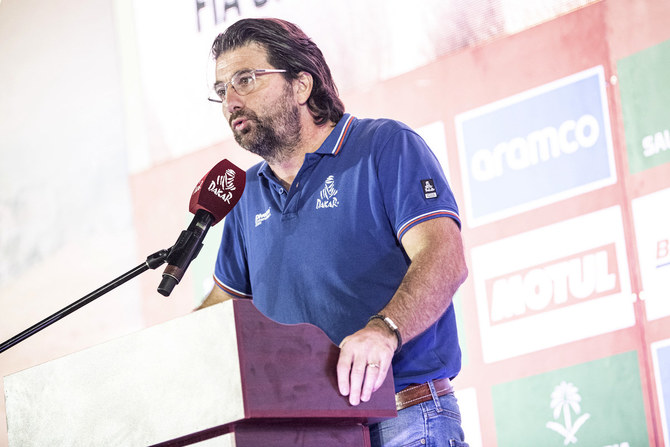

RIYADH: Thanks to his sweeping journey from motor sports competitor to event mastermind, David Castera, the race director of the Dakar Rally in Saudi Arabia, surely embodies the spirit of one of the world’s most grueling motor sports events like no one else.
He spent his competitive career as a professional Enduro and Rally Raid driver and was crowned National Enduro Champion in France in 1992. In 2019, he was appointed director of the Dakar Rally, overseeing the event’s move from South America to Saudi Arabia.
Since then, he has been in charge of the route planning and overall organization of the annual rally raid, which this month the Kingdom will host for the fifth time.
In an exclusive interview with Arab News, Castera spoke about the evolving technological landscape of the Dakar Rally under his stewardship, the rigors of race planning, and the unique challenges that come with holding the race in Saudi Arabia.
How does the addition of new technology, including hydrogen-powered and electric vehicles, affect the Dakar Rally?
The Dakar needs to embrace new technology. It’s related to what’s happening in the world and climate issues. The Dakar must be part of and contribute to a mobility revolution. We are fortunate to have a sport that is highly demanding. If we can succeed in this sport, we can apply it to many others.
So it’s not the effects of vehicle technology on the Dakar, it’s more about the Dakar wanting to introduce these vehicles and new technologies to the rally, to the tracks. Why? Because the Dakar must align with today’s global issues, listen to them and, most importantly, serve as a laboratory.
Today, this is also the great strength of motor sport. It has always been a driver, an accelerator for technologies, including safety, performance and more.
The Dakar has begun its energy transformation and pushed new technologies so that they become part of the rally. We have the introduction of hydrogen and electric technologies but it doesn’t always progress as quickly as we want due to logistical challenges.
Today, we use them for demonstrations alongside our events to work on and develop the future of the rally so that one day we can make a complete transition. Right now, we’re in the experimentation phase but we’re working hard on the topic.
What keeps you going and what do you enjoy most about being on-site during the Dakar Rally?
First and foremost, I’m simply passionate about motor sports. I used to ride motorcycles before I got into rally raid. I became interested in the Dakar Rally at a very young age and was captivated by those vast expanses, deserts, and the idea of crossing them on motorcycles and in cars, facing the risks.
I also need that adrenaline rush. I can’t imagine living without it and I cultivate it in various ways on different levels. But being in the desert, setting up camps, as I’ve done numerous times in Saudi Arabia, those are extraordinary moments for me.
However, the 15 days of the rally itself don’t bring me the same pleasure. They are the least enjoyable because of the pressure and the many things to manage; it’s not the most pleasant part.
But things like reconnaissance missions, for example, traversing the country at a relaxed pace with smaller teams, that’s what motivates me, that’s what I enjoy. At that time, the passion I feel makes me want to share my experiences with the drivers afterward; obviously in a different way, because they are racing against the clock, while we are following and overlooking the racing action.
However, it is about conveying what I have experienced, the atmosphere, the people I have met, and I want to share that. When people are happy, I’m happy. But for me, the pleasure lies before the rally itself.
How much preparation time goes into organizing a Dakar Rally?
The Dakar Rally requires one year of preparation. We have several teams involved. There are the teams at the ASO (Amaury Sport Organisation) office in Paris, who mainly work on the sporting aspects and the specifications. And then there are also all the Saudi teams associated with us, who are more focused on logistics.
Together, we work for over a year to prepare for this rally. So, we need to make about four to five inspection trips of around two weeks each to arrive at a more or less complete Dakar. Additionally, there are roadbook (a series of instructions for navigating the rally route, including turn-by-turn information) checks. So, we end up doing five or six complete passes of the Dakar in a year to prepare for it.
So we essentially do four Dakar rallies with our vehicles to prepare for one. But to give you an idea, we cover a lot of kilometers. Some routes get approved, others don’t. Some routes are prohibited, so we need to come back. There is a lot of work to ensure that everything is validated and well-organized by all the institutions so that we can launch the rally.
The 2024 Dakar Rally will be the fifth time the event has been staged in Saudi Arabia. What changes have you noticed in the past five years?
Indeed, the rally has evolved because, first and foremost, we have learned to understand the country, we have experienced the desert and learned to read, and work with, respective terrain. Initially, we barely touched the Empty Quarter. Today, we are fully immersed in it. We explore the dunes even more. So, we discover new territories, new tracks. And we adapt the Dakar accordingly.
It becomes more challenging with time because we get better at measuring the level of difficulty of the tracks. The difficulty of the sand, rocky tracks, and the weather has presented many challenges, forcing us to be cautious, because there can be heavy rain. We’ve experienced a lot of rain and had to change stages accordingly.
It’s a constant evolution but it also has a significant impact. The nights are much shorter, so the competitors drive more at night than when we were in South America. It’s much colder, which has changed habits, and competitors face different challenges. In South America, it was summer and too hot. Here, it’s rather cold. So it has brought about many changes and has made the race tougher, if anything.
What sets the Dakar in Saudi Arabia apart from previous hosts?
I believe that all the Dakar rallies are special. Each Dakar has its own uniqueness. But as I mentioned earlier, the weather has a significant impact on the Dakar Rally in Saudi Arabia, making it more challenging. The multitude of deserts, very different and vast deserts. The landscapes, too.
It’s true that this is a rally that evolves with time. Still, it remains the Dakar, with all its ingredients: the desert, the difficulty, solitude at times, the weather, night, cold, heat, dunes — everything exists.
Navigation has become more challenging in Saudi Arabia and that is one of the primary characteristics that makes it very special. It runs on relatively fast tracks, often less dangerous than what we have experienced elsewhere.
Nonetheless, the Dakar Rally must remain a special event and we always work to keep it special. That’s why we reinvent ourselves and create new concepts. This year, there’s the “48 Hours Chrono,” a two-day special in the desert, in the Empty Quarter, which will be absolutely incredible.
We constantly try to bring in something new. It’s important to maintain this attraction and keep reinventing ourselves. The desert helps us do that but we also need to be imaginative and offer new things to always remain attractive and make this rally the greatest rally in the world. We manage to do so also thanks to Saudi Arabia.
The Dakar Rally in Saudi Arabia runs from Jan. 5 to 19.


