

15 bodies from same family recovered from rubble of bombed house in Jabalia

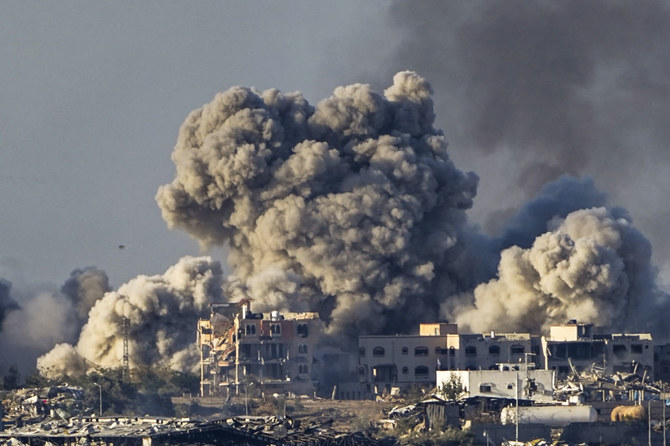
Smoke rises following an Israeli bombardment in the Gaza Strip, as seen from southern Israel, Saturday, Dec. 16, 2023. (AP)
Short Url
Updated 01 January 2024
Follow

15 bodies from same family recovered from rubble of bombed house in Jabalia

  • Since Israel imposed a siege at the outset of the war, Gazans have been facing dire shortages of food, water, fuel and medicine — eased only by aid trucks, about 120 of which entered on Sunday

GAZA: Israel warned the Gaza war would continue throughout 2024 as unrelenting strikes killed dozens in the Palestinian territory, and Hamas fired a rocket barrage at the stroke of midnight.
Israeli military spokesman Daniel Hagari said that some 300,000 army reservists would get a break from the war to prepare for the “prolonged fighting” ahead.
The army “must plan, understanding that we will be required for additional tasks and warfare throughout this year,” Hagari said as the conflict sparked by the October 7 Hamas attacks raged on.
Heavy artillery fire again pounded Gaza, killing at least 24 people, Health Ministry officials there said, with attacks reported across the length of the territory.
In the besieged Gaza Strip, where the UN says 85 percent of the population has been displaced, 20-year-old Hamdan Abu Arab said he hoped “2024 will be better.”
“We used to go out and enjoy our time on the last day of the year,” he recalled.
“But this New Year’s Eve, there are only missiles and the remains of people.”
According to the Health Ministry, 15 bodies from the same family were recovered on Monday from the rubble of a bombed house in Jabalia in the northern Gaza Strip.
“It’s the worst year of our lives. They have killed our sons,” said Sami Hamouda, 64. “Every new day is like the previous one: bombings, death, and mass killings.”
Hamas marked the start of the year by firing a rocket barrage at Israel in what it called a “response to the massacres of civilians.”
AFP journalists in Tel Aviv witnessed missile defense systems intercept rockets overhead as some revelers ran for cover and others kept up the party with a shrug.
“My heart was pounding,” said one, Gabriel Zemelman, 26, shortly after the rocket fire.
“It’s terrifying. You just saw the life we live. It’s crazy.”
Prime Minister Benjamin Netanyahu warned on Saturday that the fighting would last “many months until Hamas is eliminated and the hostages are returned.”
Hagari said the army was “adapting the planning of the force deployment in Gaza and the reserve system. Some of the reservists will return to their families and employment this week.
“This will significantly ease the burden on the economy and allow them to gather strength for the upcoming activities in the next year, as the fighting will continue and they will still be required.”
Since Israel imposed a siege at the outset of the war, Gazans have been facing dire shortages of food, water, fuel and medicine — eased only by aid trucks, about 120 of which entered on Sunday.
“We are exhausted ... We were displaced five times during this war,” said 29-year-old Bassam Hana.
“We hope things improve in 2024 and we live just like any other human being. Currently, we live like animals.”
One Palestinian man, Bilal Emad Abu Haykal, recounted how, weeks ago, Israeli tanks rolled up outside his home in northern Gaza’s
Beit Lahia.
He was told to head south but was then stopped on the road by soldiers, who took the men’s clothes ahead of questioning them, he said, recounting that “we stayed on the road without any food or water.”
“When they took us, the buildings here were still standing. But when we returned at night, we found the houses in ruins or on fire.
“All was turned into ruins or destroyed; I didn’t even recognize the streets of Beit Lahia — destruction that I cannot describe.”
Hagar, in a briefing on Sunday, said several militants “were killed and subdued during the battles in Khan Younis,” the main southern city, earlier in the day.
“We are continuing to handle the underground tunnels and to strike the rocket launching array, to reduce rocket fire into the State of Israel,” he said, adding that “dozens of aircraft are in the skies of Gaza at any given moment.”
International mediators have continued efforts toward a new pause in fighting.
The Israeli army said Sunday night it had intercepted two “hostile aircraft” flying from Syria toward northern Israel.


Hundreds flee to government-held areas in north Syria ahead of possible offensive

Updated 56 min 18 sec ago
Follow

Hundreds flee to government-held areas in north Syria ahead of possible offensive

  • Many of the civilians who fled used side roads to reach government-held areas
  • Men, women and children arrived in cars and pickup trucks that were packed with bags of clothes

DEIR HAFER, Syria: Scores of people carrying their belongings arrived in government-held areas in northern Syria on Friday ahead a possible attack by Syrian troops on territory held by Kurdish-led fighters east of the city of Aleppo.
Many of the civilians who fled used side roads to reach government-held areas because the main highway was blocked with barriers at a checkpoint that previously was controlled by the Kurdish-led and US-backed Syrian Democratic Forces, Associated Press journalists observed.
The Syrian army said late Wednesday that civilians would be able to evacuate through the “humanitarian corridor” from 9 a.m. to 5 p.m. Thursday. The announcement appeared to signal plans for an offensive against the SDF in the area east of Aleppo.
There were limited exchanges of fire between the two sides.
Men, women and children arrived in cars and pickup trucks that were packed with bags of clothes, mattresses and other belongings. They were met by local officials who directed them to shelters.
In other areas, people crossed canals on small boats and crossed a heavily damaged pedestrian bridge to reach the side held by government forces.
The SDF closed the main highway but about 4,000 people were still able to reach government-held areas on other roads, Syrian state TV reported.
A US military convoy arrived in Deir Hafer in the early afternoon but it was not immediately clear whether those personnel will remain. The US has good relations with both sides and has urged calm.
Inside Deir Hafer, many shops were closed and people stayed home.
“When I saw people leaving I came here,” said Umm Talal, who arrived in the government-held area with her husband and children. She added that the road appeared safe and her husband plans to return to their home.
Abu Mohammed said he came from the town of Maskana after hearing the government had opened a safe corridor, “only to be surprised when we arrived at Deir Hafer and found it closed.”
SDF fighters were preventing people from crossing through Syria’s main east-west highway and forcing them to take a side road, he said.
The tensions in the Deir Hafer area come after several days of intense clashes last week in Aleppo, previously Syria’s largest city and commercial center, that ended with the evacuation of Kurdish fighters from three neighborhoods north of the city that were then taken over by government forces.
The fighting broke out as negotiations stalled between Damascus and the SDF over an agreement reached in March to integrate their forces and for the central government to take control of institutions including border crossings and oil fields in the northeast.
The US special envoy to Syria, Tom Barrack, posted on X Friday that Washington remains in close contact with all parties in Syria, “working around the clock to lower the temperature, prevent escalation, and return to integration talks between the Syrian government and the SDF.”
The SDF for years has been the main US partner in Syria in fighting against the Daesh group, but Turkiye considers the SDF a terrorist organization because of its association with Kurdish separatist insurgents in Turkiye.